Key idea: A compliance technique gets people to agree to a request without force. Used on a whole group, it can change group behaviour.
Compliance techniques
1
Social proof
'Most guests reuse their towels': people copy what most others do.
2
Foot in the door
A small request first, then a bigger one.
3
Reciprocity
Give something first; people feel they should give back.
4
Commitment
A public promise makes people stick to it.
Social proof · Foot in the door · Reciprocity · Commitment
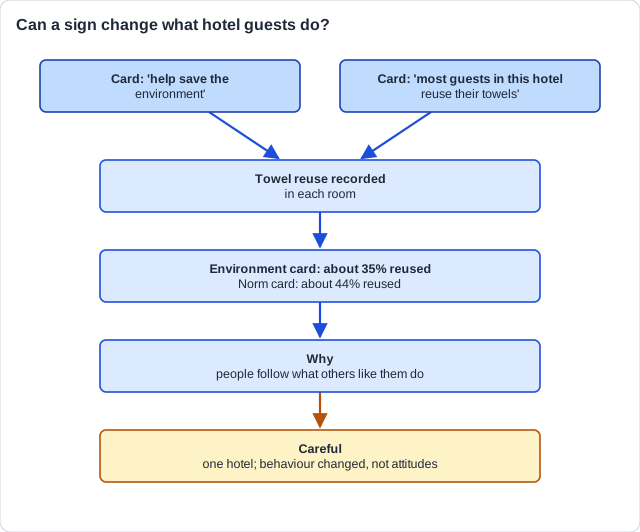
Goldstein, Cialdini and Griskevicius (2008) put different cards in hotel rooms. Guests told that most other guests reused their towels reused them more than guests asked to help the environment.
Go further: higher-level insight: The techniques themselves are taught in 2.3.4. Here the guide asks how they are applied to change the behaviour of a group.
Free preview
This is the free notes preview
You're reading the free notes. Aimnova Pro unlocks the full study experience — and you can try it with your first topic free to keep:
- FlashcardsLock in vocabulary and key terms with spaced repetition.
- Practice questionsAnswer exam-style questions and get instant AI marking.
- Mock exams & past-paper vaultSit full mocks and see exactly how examiners award marks.
- Personalised study planA daily plan built around your exam date and weak areas.
Start Studying Free Full access to Aimnova Pro · cancel anytime
Key idea: Norm messages work cheaply in the field, but they change behaviour more than attitudes.
Strengths
- Field experiment: natural behaviour
- Cheap and easy to apply
- Used for energy, tax, health
Limitations
- One hotel
- Behaviour, not attitudes
- People did not know they were studied
Steering a group without telling it raises a question of responsibility: when is a nudge fair?
Watch out: Say which technique, and why it works. 'Most people do it' works through social proof.