Key idea: Acculturation can follow four strategies. Which one people take changes how they feel and how groups get on.
Berry's four strategies
1
Integration
Keep your heritage culture and join the new one.
2
Assimilation
Give up the heritage culture, join the new one.
3
Separation
Keep the heritage culture, stay apart from the new one.
4
Marginalisation
Lose touch with both cultures.
Integration · Assimilation · Separation · Marginalisation
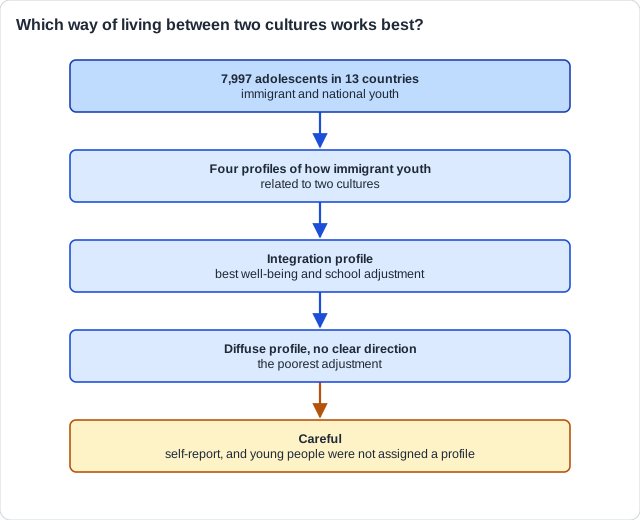
Berry and colleagues (2006) surveyed nearly 8,000 adolescents in 13 countries, in the International Study of Cultural Identity and Youth. Immigrant youth with an integration profile were the best adjusted.
Go further: higher-level insight: The term is taught in 2.3.8. Here the question is its effect on behaviour: well-being, school, friendships between groups.
Free preview
This is the free notes preview
You're reading the free notes. Aimnova Pro unlocks the full study experience — and you can try it with your first topic free to keep:
- FlashcardsLock in vocabulary and key terms with spaced repetition.
- Practice questionsAnswer exam-style questions and get instant AI marking.
- Mock exams & past-paper vaultSit full mocks and see exactly how examiners award marks.
- Personalised study planA daily plan built around your exam date and weak areas.
Start Studying Free Full access to Aimnova Pro · cancel anytime
Key idea: Integration goes with better adjustment, but the receiving society shapes which strategy people can take.
Strengths
- Large sample, 13 countries
- Same pattern across many groups
- Points to support for newcomers
Limitations
- Self-report
- Correlational: cause unclear
- Discrimination limits the choice
A newcomer cannot integrate into a society that rejects them, so acculturation depends on both groups.
Watch out: Acculturation is two-way. Say what the receiving group does, not only the newcomer.