Key idea: Conformity is changing what we do or believe to match a group. It explains why groups develop shared habits, even ones few members want.
Why people conform
1
Normative influence
Going along to be liked and accepted by the group.
2
Informational influence
Going along because the group seems to know better.
3
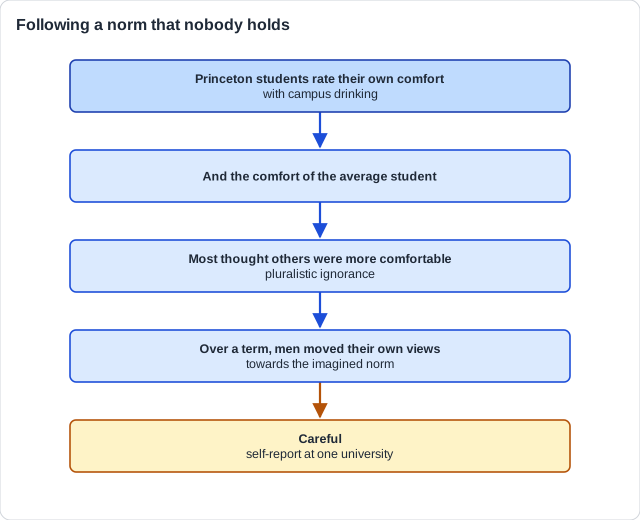
Pluralistic ignorance
Everyone privately disagrees but thinks the others agree.
Normative influence · Informational influence · Pluralistic ignorance
Prentice and Miller (1993) asked Princeton students how comfortable they and the average student were with heavy drinking. Most thought others were more comfortable than themselves.
Go further: higher-level insight: Conformity as a term is taught in 2.3.3 (Asch). Here the question is how it explains, and can change, what a group does.
Free preview
This is the free notes preview
You're reading the free notes. Aimnova Pro unlocks the full study experience — and you can try it with your first topic free to keep:
- FlashcardsLock in vocabulary and key terms with spaced repetition.
- Practice questionsAnswer exam-style questions and get instant AI marking.
- Mock exams & past-paper vaultSit full mocks and see exactly how examiners award marks.
- Personalised study planA daily plan built around your exam date and weak areas.
Start Studying Free Full access to Aimnova Pro · cancel anytime
Key idea: Conformity explains shared habits; people still differ in how much they go along.
Strengths
- Real students, real habits
- Explains false norms
- Points to a fix: correct the norm
Limitations
- Women did not shift the same way
- Self-report at one university
- Many people resist the group
Correcting a false norm, 'most students drink less than you think', applies conformity to change a group's behaviour.
Watch out: Conformity is not obedience. No one gives an order; the pressure comes from the group.