Key idea: Hard early experiences raise risk, but many children do well: that is resilience.
Risks
- Poverty: stress, poor diet, fewer books and toys
- Trauma: abuse, neglect, violence
- Unstable care
Protective factors
- One caring adult
- Easy temperament, problem-solving
- Support from school or community
Werner and Smith followed every child born in 1955 on the island of Kauai, Hawaii, for 40 years. About one in three of the high-risk children grew into competent, caring adults, usually with at least one adult who cared for them.
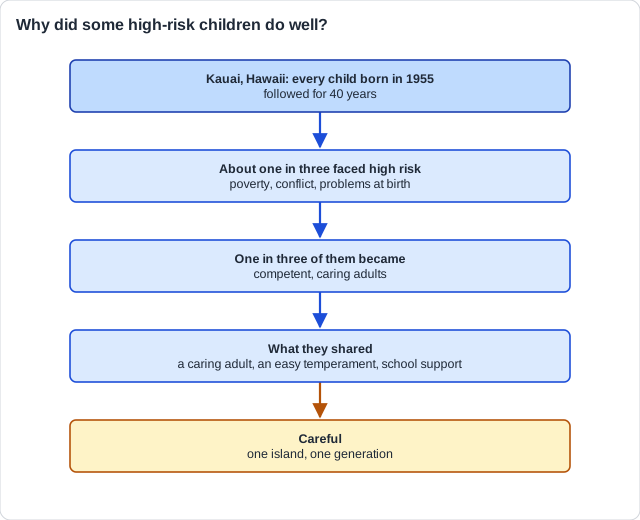
Watch out: Risk is not fate. Say how protective factors change the outcome.
Free preview
This is the free notes preview
You're reading the free notes. Aimnova Pro unlocks the full study experience — and you can try it with your first topic free to keep:
- FlashcardsLock in vocabulary and key terms with spaced repetition.
- Practice questionsAnswer exam-style questions and get instant AI marking.
- Mock exams & past-paper vaultSit full mocks and see exactly how examiners award marks.
- Personalised study planA daily plan built around your exam date and weak areas.
Start Studying Free Full access to Aimnova Pro · cancel anytime
Key idea: Trauma early in life can shape how a child sees themselves and others, but later care can change the path.
What early trauma can affect
1
The stress system
A body that stays on alert, quick to fear and anger.
2
Trust
Expecting others to hurt or leave, which makes relationships harder.
3
Self-esteem
Seeing oneself as unworthy or to blame.
4
Learning
Stress makes it harder to concentrate and remember.
Stress · Trust · Self · Learning
What supports it
- Romanian adoptees: timing matters (3.2.1)
- Kauai: risk raises problems
- Long follow-up studies
Where to be careful
- Natural experiments, not random groups
- Adults recalling their childhood
- Many children are resilient
Watch out: Risk is not fate. Every answer about childhood experiences needs resilience.