Key idea: Enculturation is how a child learns what is expected, allowed and admired. Gender norms are a clear example.
Who teaches the norms
Family
What parents praise, buy and expect: toys, chores, clothes.
Peers
Friends reward children who fit the group's norms and tease those who do not.
School
Rules, uniforms and who is asked to do which jobs.
Media
Who is shown doing what, again and again.
Family · Peers · School · Media
Smith and Lloyd (1978) asked mothers to play with a six-month-old baby they had not met. Dressed and named as a boy, the baby was more often offered a hammer and urged to move; as a girl, the same baby was more often offered a doll.
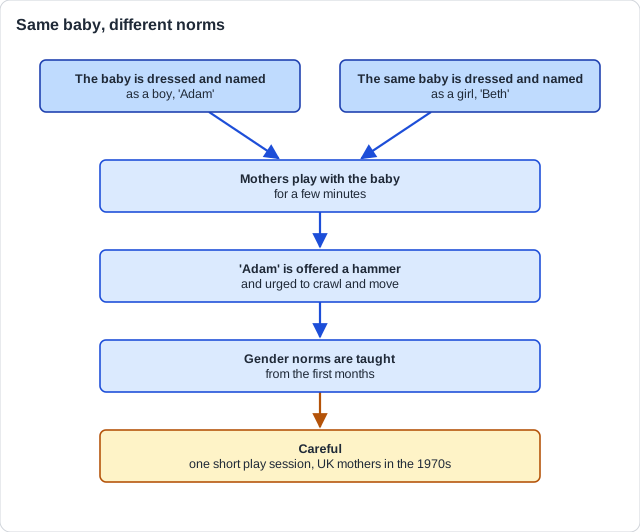
Go further: higher-level insight: This is enculturation (2.3.7) through social learning (2.3.2): norms are taught through what adults reward, and copied from the models children see.
Free preview
This is the free notes preview
You're reading the free notes. Aimnova Pro unlocks the full study experience — and you can try it with your first topic free to keep:
- FlashcardsLock in vocabulary and key terms with spaced repetition.
- Practice questionsAnswer exam-style questions and get instant AI marking.
- Mock exams & past-paper vaultSit full mocks and see exactly how examiners award marks.
- Personalised study planA daily plan built around your exam date and weak areas.
Key idea: Norms shape how children see themselves, but children also choose, resist and change the norms.
Strengths
- Shows norms taught from infancy
- Explains differences between cultures
- Fits social learning evidence
Limitations
- One short session, 1970s mothers
- Hard to separate from biology
- Children choose and resist norms
Norms change over time: what parents expect of boys and girls is different today in many countries, which itself shows that these parts of the self are learned. Gender is only one example: Wang (2004) found young American children described themselves mostly by personal qualities, and Chinese children mostly by roles and relationships, matching the norms their parents stressed.
Watch out: Enculturation is two-way. Say how children take part in it, not only how it shapes them.