In one line: Our earliest bond with a caregiver helps shape how we relate to others for years to come.
In the human development context, the development of the self is a key area of study. Attachment is central: it is the first close relationship and a foundation for later development.
This links to the concept of change: attachment shapes how the self develops over time. Learn one theory (Bowlby) and one study (Ainsworth): exam answers need them.
Remember: First bond, lasting blueprint. Early attachment influences later relationships.
Free preview
This is the free notes preview
You're reading the free notes. Aimnova Pro unlocks the full study experience — and you can try it with your first topic free to keep:
- FlashcardsLock in vocabulary and key terms with spaced repetition.
- Practice questionsAnswer exam-style questions and get instant AI marking.
- Mock exams & past-paper vaultSit full mocks and see exactly how examiners award marks.
- Personalised study planA daily plan built around your exam date and weak areas.
Key idea: Attachment comes in types, forms through sensitive caregiving, and is explained by all three approaches.
Attachment at a glance
Secure attachment
The infant uses the caregiver as a safe base: comforted by them, confident to explore. Linked to sensitive caregiving.
Insecure attachment
Avoidant or resistant patterns, often where caregiving is inconsistent or unresponsive.
Three explanations
Biological (an innate drive to bond, Bowlby), cognitive (an internal working model), sociocultural (caregiving norms vary by culture).
Secure · Insecure · Shaped by care
Take a child with a responsive caregiver: they form a secure attachment, build a positive working model, and this may support confident relationships later (change). Another child with inconsistent care may develop an insecure pattern.
Go further: higher-level insight: Early attachment influences, but does not fix, the future. Later relationships can change a person's patterns. Saying so avoids over-determinism, a key evaluation point.
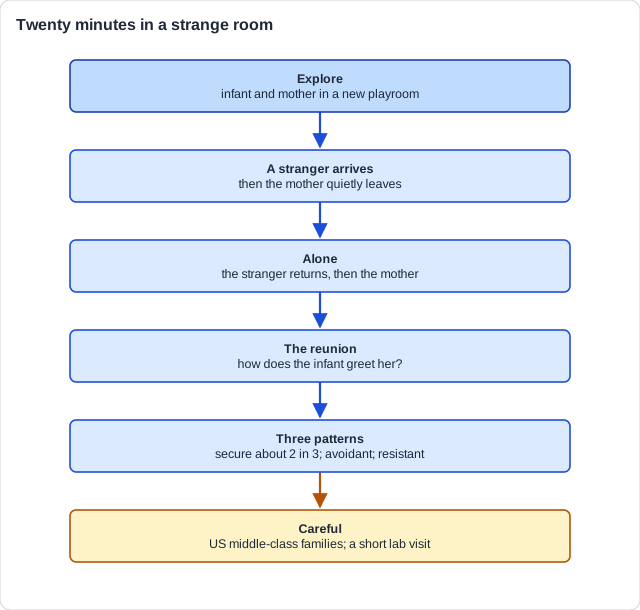
Ainsworth and colleagues (1978) measured attachment with the Strange Situation, a short observation of infants aged about one year with their mothers.
See how examiners mark answers
Answer exam-style questions with model answers. Learn exactly what earns marks and what doesn't.
Key idea: Attachment theory is influential and well evidenced but risks over-determinism and cultural bias.
Strengths
- Supported by observation of infant behaviour, such as the Strange Situation
- Explains later relationships and emotional development
- Attachment appears across cultures
Limitations
- Often correlational: early attachment is linked to, not proven to cause, later outcomes
- Risk of over-determinism (ignoring later change)
- 'Secure' defined by Western norms: possible cultural bias
So attachment research offers a powerful account of early development, but a good evaluation notes it is often correlational, can be over-deterministic, and may impose Western definitions of 'good' attachment on other cultures, an imposed-etic problem.
Watch out: Correlation again. A link between early attachment and later outcomes does not prove attachment caused them: other factors across childhood matter too.