Key idea: Theory of mind lets a child understand that other people can believe something different from them, even something false.
Theory of mind usually appears around age four. In the Sally-Anne test, a child must say where a doll will look for a marble that was moved while she was away (Baron-Cohen and colleagues 1985).
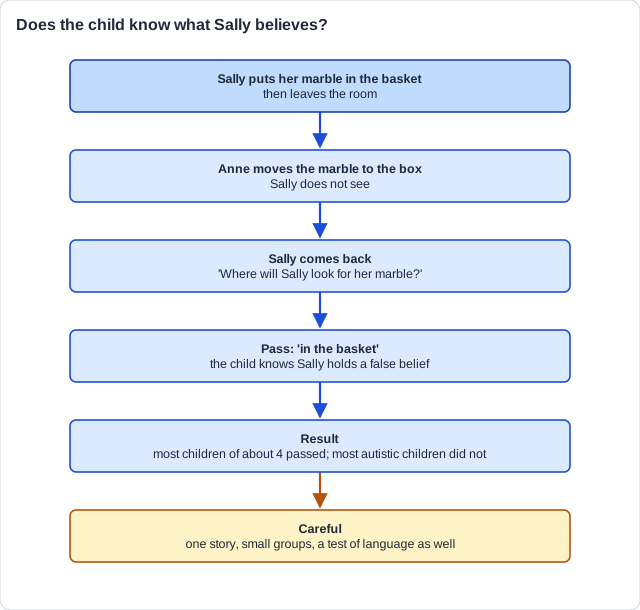
Wimmer and Perner (1983) told children a story in which a boy's chocolate is moved while he is out. Most children under four said he would look where it now is; most older children said where he left it.
Go further: higher-level insight: Theory of mind is the start of empathy: to share someone's feelings, you first have to know they see things differently.
Free preview
This is the free notes preview
You're reading the free notes. Aimnova Pro unlocks the full study experience — and you can try it with your first topic free to keep:
- FlashcardsLock in vocabulary and key terms with spaced repetition.
- Practice questionsAnswer exam-style questions and get instant AI marking.
- Mock exams & past-paper vaultSit full mocks and see exactly how examiners award marks.
- Personalised study planA daily plan built around your exam date and weak areas.
Key idea: Theory of mind opens the door to empathy, friendship, cooperation and even lying.
What theory of mind makes possible
Empathy
Knowing a friend feels left out, even if you do not.
Cooperation
Planning a game with someone who knows different things.
Secrets and lies
Understanding that someone can be fooled.
Teaching
Explaining what another person does not yet know.
Feel · Share · Trick · Teach
What supports its role
- Clear change at about age four
- Most autistic children failed Sally-Anne
- Links to empathy and friendship
Where to be careful
- Stories also test language and memory
- Infants may understand earlier
- One task is not the whole ability
Watch out: Failing a task is not lacking the ability. Say what else the task tests.