aımnova
DashboardMy LearningCrash CoursesStudy Plan

Aimnova site navigation

Stay in the loop

Get the latest study resources and updates

New features, study tips and exam insights — straight to your inbox.

IB Diploma

  • IB Past Papers
  • IB Study Notes
  • IB Question Bank
  • IB Mock Exams
  • IB Revision

IB Subjects

  • IB Math AA
  • IB Math AI
  • IB Economics
  • IB Business Management
  • IB Physics
  • IB Biology
  • View all IB subjects→

IB Past Papers

  • IB Math AA HL Past Papers
  • IB Math AA SL Past Papers
  • IB Math AI HL Past Papers
  • IB Math AI SL Past Papers
  • IB Economics HL Past Papers
  • IB Economics SL Past Papers
  • IB ESS Past Papers
  • View all past papers→

Study Resources

  • Study Notes
  • Question Bank
  • Mock Exams
  • Crash Courses
  • Flashcards
  • Revision Guide
  • Exam Skills
  • Command Terms
  • Grade Calculator
  • Exam Timetable 2026

Aimnova

  • Features
  • Pricing
  • For Teachers
  • For Schools
  • For Parents
  • About Us
  • Blog
  • Contact
aımnova

IB study, practice and feedback built around the real exam.

TermsPrivacyCookies·© 2026 Aimnova. All rights reserved.afd6316

Aimnova is not affiliated with or endorsed by the International Baccalaureate Organization (IB).

NotesPsychologyTopic 3.2Stage theories and continuous models
Back to Psychology Topics
3.2.32 min read

Stage theories and continuous models

IB Psychology · Unit 3

Smart study tools

Turn reading into results

Move beyond passive notes. Answer exam-style questions, get AI feedback, and build the skills that earn top marks.

Get Started Free

Contents

  1. 1Stages or a continuous climb?
  2. 2Testing the stages
Key idea: Stage theories say thinking changes in steps; continuous models say it grows gradually with help.

Piaget: stages

  • Development in four set stages
  • The child discovers alone, like a scientist
  • A child cannot be taught past their stage

Vygotsky: continuous

  • Development is gradual, with no fixed stages
  • Learning happens with more skilled others
  • Help within the zone of proximal development

Piaget's four stages

1

Sensorimotor (0 to 2)

Learning through the senses and movement; object permanence develops.

2

Preoperational (2 to 7)

Words and pretend play, but egocentric thinking; cannot yet conserve.

3

Concrete operational (7 to 11)

Logical thinking about real objects; conservation is understood.

4

Formal operational (11 and over)

Abstract and hypothetical reasoning.

Sense · Symbol · Concrete · Abstract

Free preview

This is the free notes preview

You're reading the free notes. Aimnova Pro unlocks the full study experience — and you can try it with your first topic free to keep:

  • FlashcardsLock in vocabulary and key terms with spaced repetition.
  • Practice questionsAnswer exam-style questions and get instant AI marking.
  • Mock exams & past-paper vaultSit full mocks and see exactly how examiners award marks.
  • Personalised study planA daily plan built around your exam date and weak areas.
Start Studying Free Full access to Aimnova Pro · cancel anytime
Key idea: Piaget's preoperational children fail to conserve: they think spreading out a row of counters makes more. But was it the child's stage, or the way the question was asked?

McGarrigle and Donaldson (1974) repeated Piaget's counters task with children aged 4 to 6. When a 'Naughty Teddy' messed up the row by accident, far more children said the number was still the same.
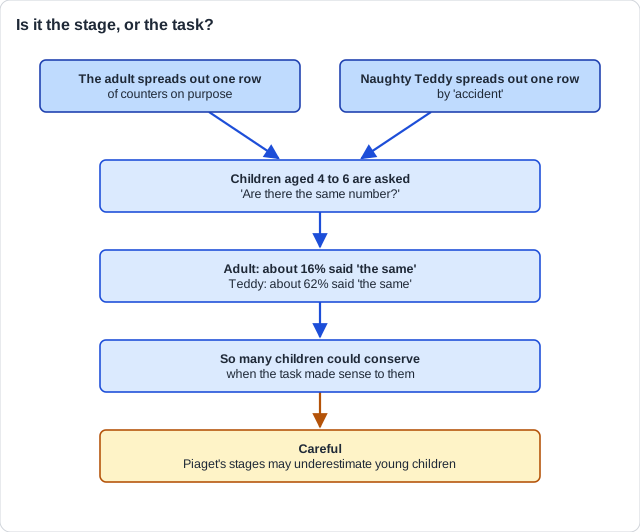
An adult spreads one row of counters on purpose, or Naughty Teddy spreads it by accident; children aged 4 to 6 are asked if there are the same number; about 16% against 62% say yes; so many could conserve when the task made sense; a caution box says Piaget's stages may underestimate young children.
Follow a test of Piaget's conservation task.

Stage theory (Piaget)

  • Clear map of how thinking changes
  • Children as active learners
  • Shaped discovery learning

Where it struggles

  • Children can do more than it predicts
  • Stages look less fixed
  • Leaves out help from others
Watch out: Evaluate the theory, not just the task. Say what the finding means for the idea of fixed stages.

IB Exam Questions on Stage theories and continuous models

Practice with IB-style questions filtered to Topic 3.2.3. Get instant AI feedback on every answer.

Practice Topic 3.2.3 QuestionsBrowse All Psychology Topics

How Stage theories and continuous models Appears in IB Exams

Examiners use specific command terms when asking about this topic. Here's what to expect:

  • Define

    Give the precise meaning of key terms related to Stage theories and continuous models.

    AO1
  • Describe

    Give a detailed account of processes or features in Stage theories and continuous models.

    AO2
  • Explain

    Give reasons WHY — cause and effect within Stage theories and continuous models.

    AO3
  • Evaluate

    Weigh strengths AND limitations of approaches in Stage theories and continuous models.

    AO3
  • Discuss

    Present arguments FOR and AGAINST with a balanced conclusion.

    AO3

See the full IB Command Terms guide

Related Psychology Topics

Continue learning with these related topics from the same unit:

3.1.1Biological explanations of a mental health disorder3.1.2Cognitive models of a mental health disorder3.1.3Cultural differences in mental health3.1.4Environmental factors in mental health disorders
View all Psychology topics
Improve your exam techniqueCommand terms, paper structure, and mark-scheme tips for Psychology
Previous3.2.2Sociocultural factors in developmentNextTheory of mind3.2.4

6 exam-style questions ready for you

Students who practice on Aimnova improve their scores by 15% on average. Get instant feedback that shows exactly how to improve your answers.

Practice Now — FreeView All Psychology Topics