Key idea: Socio-economic status is a sociocultural factor. Poverty affects development mainly through what it does to family life.
How poverty reaches a child
Stress
Money worries and insecure housing keep the family under strain.
Resources
Fewer books, toys and activities; poorer diet.
Parenting
Tired, stressed parents have less time and patience.
Stress · Resources · Parenting
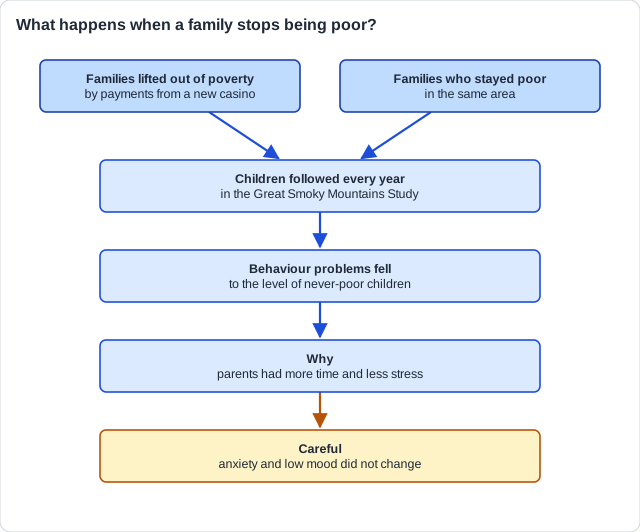
Costello and colleagues (2003) were following children in the Great Smoky Mountains, USA, when a casino opened on a Cherokee reservation and shared its profits with every family. Children whose families rose out of poverty showed fewer behaviour problems.
Free preview
This is the free notes preview
You're reading the free notes. Aimnova Pro unlocks the full study experience — and you can try it with your first topic free to keep:
- FlashcardsLock in vocabulary and key terms with spaced repetition.
- Practice questionsAnswer exam-style questions and get instant AI marking.
- Mock exams & past-paper vaultSit full mocks and see exactly how examiners award marks.
- Personalised study planA daily plan built around your exam date and weak areas.
Key idea: Most poverty research is correlational. A natural experiment, where income changes for reasons families do not choose, gets closer to cause.
Strengths
- Income changed for reasons outside the family
- Children followed every year
- Shows the route: time and stress
Limitations
- One rural area of the USA
- Anxiety and low mood did not change
- Not every poor child is affected
Protective factors change the effect: a caring adult, a good school or a supportive community help many children in poverty do well (see 3.2.8).
Watch out: Poverty raises risk; it does not decide the outcome. Say what protects children.