In one line: Who we become is shaped by our biology, our thinking, and the people and culture around us, all at once.
In the human development context, a key area of study is the many influences on how a person develops: biological maturation, cognitive development, and sociocultural factors such as peers, family and culture.
This is the nature and nurture debate, and the answer is 'both, interacting'. It links to the concept of perspective: each approach highlights a different influence.
Remember: Nature and nurture, together. Development is shaped by many interacting influences.
Free preview
This is the free notes preview
You're reading the free notes. Aimnova Pro unlocks the full study experience — and you can try it with your first topic free to keep:
- FlashcardsLock in vocabulary and key terms with spaced repetition.
- Practice questionsAnswer exam-style questions and get instant AI marking.
- Mock exams & past-paper vaultSit full mocks and see exactly how examiners award marks.
- Personalised study planA daily plan built around your exam date and weak areas.
Key idea: Biological, cognitive and sociocultural influences interact throughout development.
Influences on development
Biological maturation
The brain and body develop on a rough timetable: the planning region matures into the mid-20s, shaping abilities.
Cognitive development
Thinking becomes more complex with age and experience: memory, reasoning and understanding grow.
Sociocultural influence
Peers, family and culture shape behaviour through enculturation, social learning and norms.
Maturation · Thinking · Others
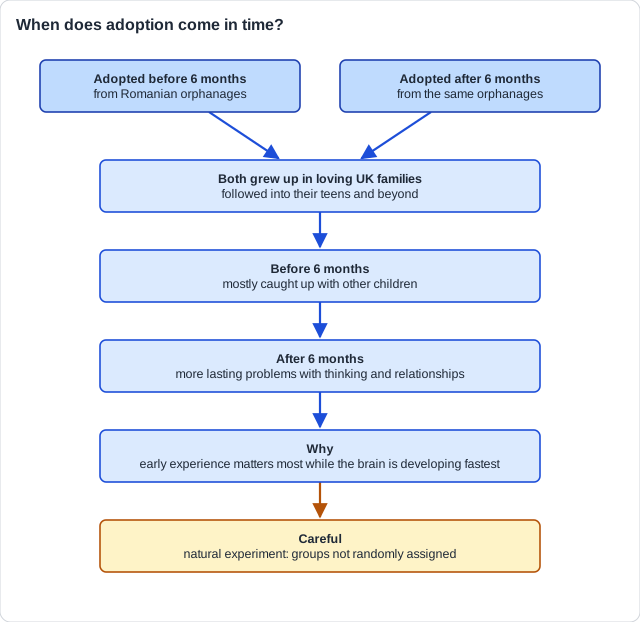
Go further: higher-level insight: A critical period shows nature and nurture meeting: the brain is ready, but only experience completes it.
Rutter and colleagues followed children adopted from Romanian orphanages, where care had been very poor, into UK families: the English and Romanian Adoptees study.
Learn what examiners really want
See exactly what to write to score full marks. Our AI shows you model answers and the key phrases examiners look for.
Key idea: The brain keeps maturing until the mid-20s. Use shapes it: connections that are used stay, the rest are pruned. That is neuroplasticity in development.
How the brain matures
Growth
In childhood the brain makes far more connections than it will keep.
Pruning
Connections that are used grow stronger; unused ones are removed: neuroplasticity at work.
Myelination
A fatty layer insulates the busy pathways, so signals travel faster.
Grow · Prune · Insulate
Giedd and colleagues (1999) scanned 145 children and teenagers again and again over several years. Grey matter in the frontal lobes grew through childhood, peaked at about age 11 to 12, then fell as unused connections were pruned.
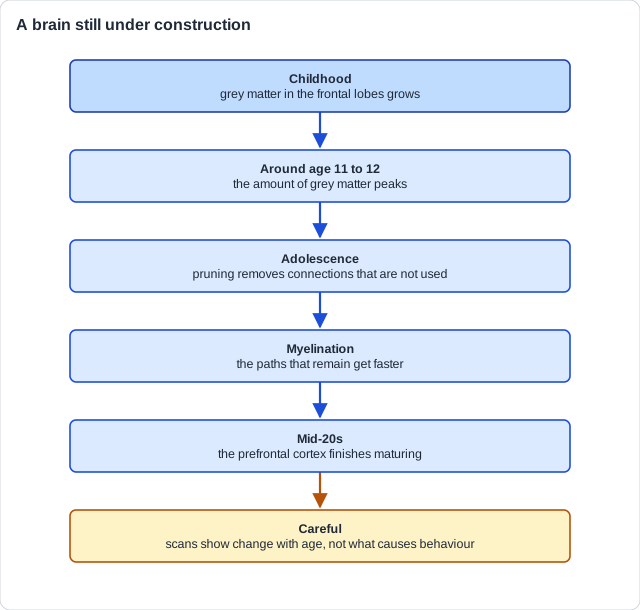
Go further: higher-level insight: The prefrontal cortex, for planning and self-control, matures last. This helps explain why teenagers take more risks, especially with friends watching (see 3.2.7).
Key idea: The influences interact, so isolating any single one is difficult; the best account is integrative.
Strengths
- Biological: explains age-linked patterns, such as sensitive periods
- Cognitive: explains growth in reasoning and understanding
- Sociocultural: explains peer and cultural differences
Limitations
- Biological: ignores how experience shapes the brain (plasticity)
- Cognitive: can underplay emotion and social context
- Sociocultural: hard to isolate from biology; varies by culture
So each perspective captures part of development but none alone is complete. A strong evaluation stresses that the influences interact, as in the Romanian adoptees, where experience and brain development shaped each other.
Watch out: Nature or nurture is a false choice. Genes and environment continually interact.