Key idea: Prevention is judged like treatment: did behaviour actually change?
Health promotion aims at a health problem before it starts. England's Change4Life campaign against obesity reached millions, but Croker and colleagues (2012) found families who saw it changed neither their attitudes nor their eating.
Programmes that work tend to
- Change the setting (school meals, safe play)
- Last years, not weeks
- Involve families
Programmes that fail tend to
- Only give information
- Run briefly
- Ignore cost and culture
Free preview
This is the free notes preview
You're reading the free notes. Aimnova Pro unlocks the full study experience — and you can try it with your first topic free to keep:
- FlashcardsLock in vocabulary and key terms with spaced repetition.
- Practice questionsAnswer exam-style questions and get instant AI marking.
- Mock exams & past-paper vaultSit full mocks and see exactly how examiners award marks.
- Personalised study planA daily plan built around your exam date and weak areas.
Key idea: Strategies that change the setting, such as prices or school meals, change behaviour more reliably than information alone.
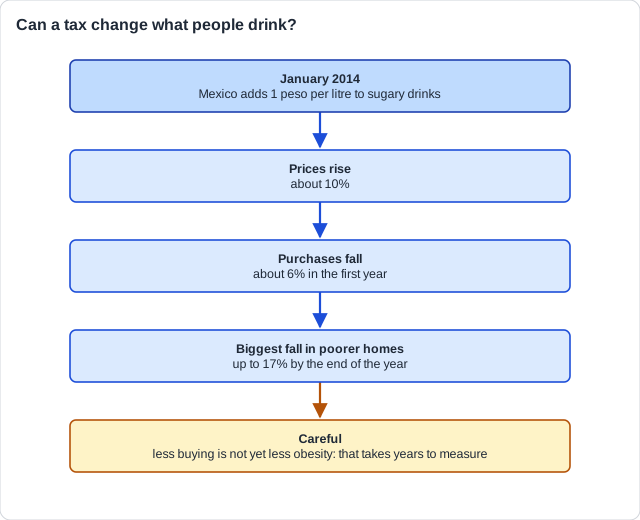
In January 2014 Mexico added one peso per litre to sugary drinks. Colchero and colleagues (2016) analysed household shopping: purchases of taxed drinks fell by about 6% in the first year, and by up to 17% in poorer homes by the end of the year.
Why changing the setting works
Price
Unhealthy choices cost more, healthy ones less.
Access
Fewer sugary drinks in schools and shops near schools.
Defaults
The easy option becomes the healthy one, such as water with school meals.
Price · Access · Defaults
Watch out: Behaviour change is not yet health change. Say what was measured: buying, eating or weight.