aımnova
DashboardMy LearningCrash CoursesStudy Plan

Aimnova site navigation

Stay in the loop

Get the latest study resources and updates

New features, study tips and exam insights — straight to your inbox.

IB Diploma

  • IB Past Papers
  • IB Study Notes
  • IB Question Bank
  • IB Mock Exams
  • IB Revision

IB Subjects

  • IB Math AA
  • IB Math AI
  • IB Economics
  • IB Business Management
  • IB Physics
  • IB Biology
  • View all IB subjects→

IB Past Papers

  • IB Math AA HL Past Papers
  • IB Math AA SL Past Papers
  • IB Math AI HL Past Papers
  • IB Math AI SL Past Papers
  • IB Economics HL Past Papers
  • IB Economics SL Past Papers
  • IB ESS Past Papers
  • View all past papers→

Study Resources

  • Study Notes
  • Question Bank
  • Mock Exams
  • Crash Courses
  • Flashcards
  • Revision Guide
  • Exam Skills
  • Command Terms
  • Grade Calculator
  • Exam Timetable 2026

Aimnova

  • Features
  • Pricing
  • For Teachers
  • For Schools
  • For Parents
  • About Us
  • Blog
  • Contact
aımnova

IB study, practice and feedback built around the real exam.

TermsPrivacyCookies·© 2026 Aimnova. All rights reserved.afd6316

Aimnova is not affiliated with or endorsed by the International Baccalaureate Organization (IB).

NotesPsychologyTopic 3.1Psychological treatment of a disorder
Back to Psychology Topics
3.1.93 min read

Psychological treatment of a disorder

IB Psychology · Unit 3

Smart study tools

Turn reading into results

Move beyond passive notes. Answer exam-style questions, get AI feedback, and build the skills that earn top marks.

Get Started Free

Contents

  1. 1From explanation to treatment
  2. 2Treatments and prevention
  3. 3Evaluating treatments
In one line: How you explain a disorder shapes how you treat it. A psychological treatment changes thinking and behaviour.

In the health and well-being context, treatment and prevention are key areas of study. Each explanation points to a matching treatment: biological to medication, cognitive to therapy, sociocultural to social support. We keep depression as the running example.

This links to responsibility (effective, ethical care is a duty) and to change (treatment aims to change behaviour and well-being).

How CBT works

1

Spot the thought

Notice the automatic thought behind a low moment: 'I always fail'.

2

Check the evidence

Ask what supports the thought and what goes against it.

3

Replace it

Write a fairer thought: 'I failed this test, not everything.'

4

Test it in life

Plan an activity and see what really happens: a behavioural experiment.

Spot · Check · Replace · Test

Remember: Explain it, then treat it. Each approach suggests a treatment; CBT targets the thoughts.

Free preview

This is the free notes preview

You're reading the free notes. Aimnova Pro unlocks the full study experience — and you can try it with your first topic free to keep:

  • FlashcardsLock in vocabulary and key terms with spaced repetition.
  • Practice questionsAnswer exam-style questions and get instant AI marking.
  • Mock exams & past-paper vaultSit full mocks and see exactly how examiners award marks.
  • Personalised study planA daily plan built around your exam date and weak areas.
Start Studying Free Full access to Aimnova Pro · cancel anytime
Key idea: Treatments match the explanation; prevention (health promotion) tackles problems before they start.

Approaches to treatment

1

Biological treatment

Medication (such as antidepressants) that alters neurotransmission. Fast for some, but side effects, and it does not address causes.

2

Psychological treatment

Therapy (such as CBT) that challenges and changes negative thinking. Needs effort and time.

3

Sociocultural treatment

Building social support, reducing isolation, tackling stigma so people seek help.

4

Prevention

Health promotion: education, screening, reducing risk factors, to stop problems before they start.

Medicate · Retrain thinking · Support · Prevent

Take treating depression. Medication may lift mood; CBT changes the self-blaming thoughts; social support reduces isolation; and prevention (stress education, early screening) lowers risk in the first place.

Go further: higher-level insight: Combined treatment usually works best. Because the causes interact, combining medication, therapy and support often beats any one alone.

March and colleagues (2004), the TADS trial, tested this with teenagers with depression in the United States.
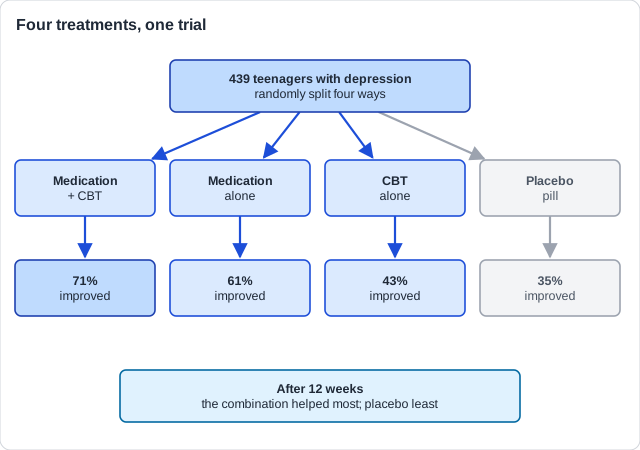
Teenagers with depression randomly split into medication plus CBT, medication, CBT or placebo; after 12 weeks 71%, 61%, 43% and 35% had improved.
Follow the four groups through the trial.

Study smarter, not longer

Most students waste 40% of study time on topics they already know. Our AI tracks your progress and optimizes every minute.

Try Smart Study FreeYour first topic is free to keep • No credit card required
Key idea: Each treatment has strengths and limits; effectiveness depends on the person and is judged with evidence.

Strengths

  • Medication: can work quickly; widely available
  • Therapy (CBT): tackles thinking; lasting skills
  • Social support: reduces isolation; low harm

Limitations

  • Medication: side effects; may not address causes; relapse
  • Therapy: takes time and effort; access varies
  • Social support: hard to measure; not a full treatment alone

So no single treatment is best for everyone. A strong evaluation compares treatments, notes that effectiveness varies between people, stresses that combining approaches often helps most, and judges effectiveness with evidence, while respecting the duty to do no harm.

Watch out: 'Effective' must be measured. Claiming a treatment works needs evidence, ideally controlled trials with follow-up, not testimonials.

IB Exam Questions on Psychological treatment of a disorder

Practice with IB-style questions filtered to Topic 3.1.9. Get instant AI feedback on every answer.

Practice Topic 3.1.9 QuestionsBrowse All Psychology Topics

How Psychological treatment of a disorder Appears in IB Exams

Examiners use specific command terms when asking about this topic. Here's what to expect:

  • Define

    Give the precise meaning of key terms related to Psychological treatment of a disorder.

    AO1
  • Describe

    Give a detailed account of processes or features in Psychological treatment of a disorder.

    AO2
  • Explain

    Give reasons WHY — cause and effect within Psychological treatment of a disorder.

    AO3
  • Evaluate

    Weigh strengths AND limitations of approaches in Psychological treatment of a disorder.

    AO3
  • Discuss

    Present arguments FOR and AGAINST with a balanced conclusion.

    AO3

See the full IB Command Terms guide

Related Psychology Topics

Continue learning with these related topics from the same unit:

3.1.1Biological explanations of a mental health disorder3.1.2Cognitive models of a mental health disorder3.1.3Cultural differences in mental health3.1.4Environmental factors in mental health disorders
View all Psychology topics
Improve your exam techniqueCommand terms, paper structure, and mark-scheme tips for Psychology
Previous3.1.8Biological treatment of a disorderNextPrevention and treatment of a health problem3.1.10

11 exam-style questions ready for you

Students who practice on Aimnova improve their scores by 15% on average. Get instant feedback that shows exactly how to improve your answers.

Practice Now — FreeView All Psychology Topics