aımnova
DashboardMy LearningCrash CoursesStudy Plan

Aimnova site navigation

Stay in the loop

Get the latest study resources and updates

New features, study tips and exam insights — straight to your inbox.

IB Diploma

  • IB Past Papers
  • IB Study Notes
  • IB Question Bank
  • IB Mock Exams
  • IB Revision

IB Subjects

  • IB Math AA
  • IB Math AI
  • IB Economics
  • IB Business Management
  • IB Physics
  • IB Biology
  • View all IB subjects→

IB Past Papers

  • IB Math AA HL Past Papers
  • IB Math AA SL Past Papers
  • IB Math AI HL Past Papers
  • IB Math AI SL Past Papers
  • IB Economics HL Past Papers
  • IB Economics SL Past Papers
  • IB ESS Past Papers
  • View all past papers→

Study Resources

  • Study Notes
  • Question Bank
  • Mock Exams
  • Crash Courses
  • Flashcards
  • Revision Guide
  • Exam Skills
  • Command Terms
  • Grade Calculator
  • Exam Timetable 2026

Aimnova

  • Features
  • Pricing
  • For Teachers
  • For Schools
  • For Parents
  • About Us
  • Blog
  • Contact
aımnova

IB study, practice and feedback built around the real exam.

TermsPrivacyCookies·© 2026 Aimnova. All rights reserved.afd6316

Aimnova is not affiliated with or endorsed by the International Baccalaureate Organization (IB).

NotesPsychology HLTopic 3.4Cognitive models of a cognitive process
Back to Psychology HL Topics
3.4.73 min read

Cognitive models of a cognitive process (Psychology HL)

IB Psychology · Unit 3

Your first topic is free to keep

Know exactly what to write for full marks

Practice with exam questions and get AI feedback that shows you the perfect answer — what examiners want to see.

Start Free

Contents

  1. 1Memory is not a recording
  2. 2How memory works, and fails
  3. 3A case that challenged a model
  4. 4Evaluating memory research
Key idea: Memory doesn't replay the past like a video — it rebuilds it, which is why it can be confidently wrong.

In the learning and cognition context, memory is a core cognitive process, and understanding it means seeing that it is reconstructive, not a perfect recording. This links to the concepts of measurement (models make memory testable) and bias (schemas distort what we recall).

Remember: Rebuild, don't replay. Memory is reconstructed, so it can be distorted.

Free preview

This is the free notes preview

You're reading the free notes. Aimnova Pro unlocks the full study experience — and you can try it with your first topic free to keep:

  • FlashcardsLock in vocabulary and key terms with spaced repetition.
  • Practice questionsAnswer exam-style questions and get instant AI marking.
  • Mock exams & past-paper vaultSit full mocks and see exactly how examiners award marks.
  • Personalised study planA daily plan built around your exam date and weak areas.
Start Studying Free Full access to Aimnova Pro · cancel anytime
Key idea: Models describe memory's structure; schemas explain why recall is distorted.

Memory at a glance

1

The multi-store model

Memory as sensory, short-term and long-term stores, linked by attention and rehearsal — a testable cognitive model.

2

Reconstruction

Recall rebuilds an event using existing knowledge, so gaps get filled and details shift.

3

Schema distortion

Schemas make us add expected details and drop inconsistent ones — a source of memory bias.

Stores · Rehearsal · Schemas

Take an eyewitness to a robbery. The multi-store model describes how they encoded and stored the event; but at recall, their schema of 'a robbery' fills gaps — they may confidently 'remember' a weapon that wasn't there. Memory is reconstructive, so it is vulnerable to bias. This is why measuring memory carefully matters.

Go further — higher-level insight: Reconstruction explains why confidence isn't accuracy. A witness can feel certain yet be wrong, because the schema-filled memory feels just as vivid as a true one. This has huge real-world importance for eyewitness testimony — a strong applied point.

Study smarter, not longer

Most students waste 40% of study time on topics they already know. Our AI tracks your progress and optimizes every minute.

Try Smart Study FreeYour first topic is free to keep • No credit card required
Key idea: A model is valuable when evidence can challenge it. A single patient showed that short-term memory is not one store.

Shallice and Warrington (1970) studied KF, whose short-term memory for heard words was very poor after brain damage, yet who could still learn new information into long-term memory.
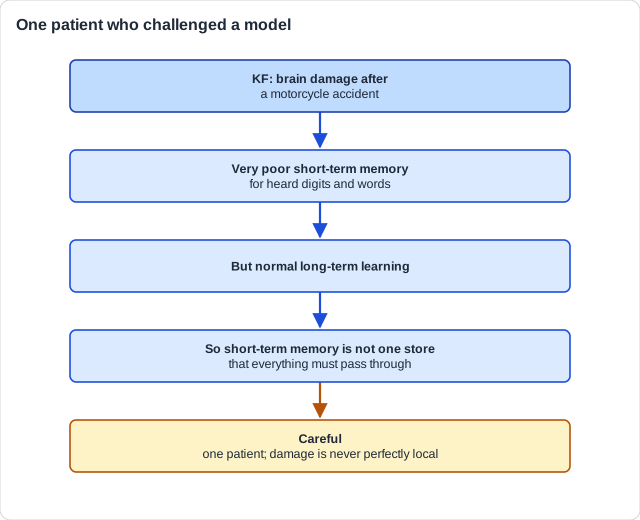
KF had brain damage after a motorcycle accident; very poor short-term memory for heard digits and words but normal long-term learning; so short-term memory is not one store that everything must pass through; a caution box notes one patient.
Follow a case study that challenged a model.
What HL adds: Paper 3 sources often use case studies. Say what one case can disprove, and why it cannot prove a general rule on its own.
Key idea: Memory research is well-evidenced and applicable but relies on models and lab tasks.

Strengths and limitations

Strengths and limitationsStrengthsLimitations
ModelsMake invisible memory testable and predictableModels oversimplify (memory is more than boxes)
ReconstructionStrong evidence for schema-driven errorsSchemas hard to measure directly
ApplicationExplains eyewitness errors; improves justiceLab word-list tasks may lack ecological validity

So memory research offers a powerful, testable account and has real-world value (e.g. for eyewitness testimony), but a good evaluation notes models simplify, schemas are hard to measure directly, and some lab tasks are artificial. The reconstructive nature of memory is well-supported and practically important.

Watch out: Vivid ≠ accurate. A detailed, confident memory can still be a reconstruction. Never treat certainty as proof of accuracy.

IB Exam Questions on Cognitive models of a cognitive process

Practice with IB-style questions filtered to Topic 3.4.7. Get instant AI feedback on every answer.

Practice Topic 3.4.7 QuestionsBrowse All Psychology HL Topics

How Cognitive models of a cognitive process Appears in IB Exams

Examiners use specific command terms when asking about this topic. Here's what to expect:

  • Define

    Give the precise meaning of key terms related to Cognitive models of a cognitive process.

    AO1
  • Describe

    Give a detailed account of processes or features in Cognitive models of a cognitive process.

    AO2
  • Explain

    Give reasons WHY — cause and effect within Cognitive models of a cognitive process.

    AO3
  • Evaluate

    Weigh strengths AND limitations of approaches in Cognitive models of a cognitive process.

    AO3
  • Discuss

    Present arguments FOR and AGAINST with a balanced conclusion.

    AO3

See the full IB Command Terms guide

Related Psychology HL Topics

Continue learning with these related topics from the same unit:

3.1.1Biological explanations of a mental health disorder3.1.2Cognitive models of a mental health disorder3.1.3Cultural differences in mental health3.1.4Environmental factors in mental health disorders
View all Psychology HL topics
Improve your exam techniqueCommand terms, paper structure, and mark-scheme tips for Psychology HL
Previous3.4.6Biological factors in cognitive processesNextCultural factors in a cognitive process3.4.8

9 questions to test your understanding

Reading is just the start. Students who tested themselves scored 82% on average — try IB-style questions with AI feedback.

Start FreeView All Psychology HL Topics