aımnova
DashboardMy LearningCrash CoursesStudy Plan

Aimnova site navigation

Stay in the loop

Get the latest study resources and updates

New features, study tips and exam insights — straight to your inbox.

IB Diploma

  • IB Past Papers
  • IB Study Notes
  • IB Question Bank
  • IB Mock Exams
  • IB Revision

IB Subjects

  • IB Math AA
  • IB Math AI
  • IB Economics
  • IB Business Management
  • IB Physics
  • IB Biology
  • View all IB subjects→

IB Past Papers

  • IB Math AA HL Past Papers
  • IB Math AA SL Past Papers
  • IB Math AI HL Past Papers
  • IB Math AI SL Past Papers
  • IB Economics HL Past Papers
  • IB Economics SL Past Papers
  • IB ESS Past Papers
  • View all past papers→

Study Resources

  • Study Notes
  • Question Bank
  • Mock Exams
  • Crash Courses
  • Flashcards
  • Revision Guide
  • Exam Skills
  • Command Terms
  • Grade Calculator
  • Exam Timetable 2026

Aimnova

  • Features
  • Pricing
  • For Teachers
  • For Schools
  • For Parents
  • About Us
  • Blog
  • Contact
aımnova

IB study, practice and feedback built around the real exam.

TermsPrivacyCookies·© 2026 Aimnova. All rights reserved.afd6316

Aimnova is not affiliated with or endorsed by the International Baccalaureate Organization (IB).

NotesPsychology HLTopic 3.4Cultural factors in a cognitive process
Back to Psychology HL Topics
3.4.82 min read

Cultural factors in a cognitive process (Psychology HL)

IB Psychology · Unit 3

Smart study tools

Turn reading into results

Move beyond passive notes. Answer exam-style questions, get AI feedback, and build the skills that earn top marks.

Get Started Free

Contents

  1. 1Culture and memory skills
  2. 2How strong is the evidence?
Key idea: Cultures differ in what people need to remember, and memory skills grow to meet those needs.

Culture and cognition

1

Culture teaches

Each culture teaches what is important to notice and remember.

2

Attention

People learn to attend to the main object, or to the whole scene and its context.

3

Memory

Skills that matter in daily life, such as finding the way, become stronger.

Teach · Attend · Remember

Kearins (1981) compared Aboriginal children from desert areas with white Australian children. The Aboriginal children remembered where objects had been placed on a grid better.
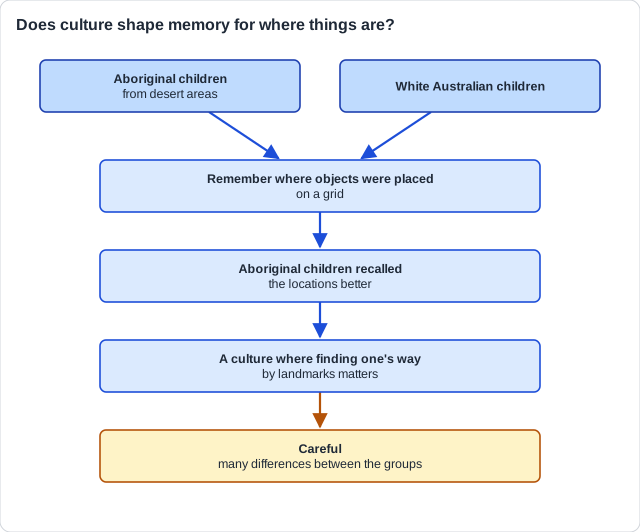
Aboriginal children from desert areas and white Australian children remembered where objects were placed on a grid; Aboriginal children recalled the locations better, in a culture where finding one's way by landmarks matters; a caution box notes many differences between the groups.
Follow a study of culture and spatial memory.
What HL adds: The culture extension: culture cannot be randomly assigned. HL essays judge which other differences, such as schooling or language, might explain a result.

Free preview

This is the free notes preview

You're reading the free notes. Aimnova Pro unlocks the full study experience — and you can try it with your first topic free to keep:

  • FlashcardsLock in vocabulary and key terms with spaced repetition.
  • Practice questionsAnswer exam-style questions and get instant AI marking.
  • Mock exams & past-paper vaultSit full mocks and see exactly how examiners award marks.
  • Personalised study planA daily plan built around your exam date and weak areas.
Start Studying Free Full access to Aimnova Pro · cancel anytime
Key idea: Culture shapes what people notice and remember, but culture is hard to separate from other differences between groups.

Strengths

  • Shows cognition is not universal
  • Links to daily life
  • Replicated with other tasks

Limitations

  • Groups differ in many ways
  • Tasks may suit one culture
  • Students or children only

Strong evaluation asks whether culture, schooling or familiarity with the task explains the result.

Watch out: Name the cultural factor. Say what in the culture would cause the difference.

IB Exam Questions on Cultural factors in a cognitive process

Practice with IB-style questions filtered to Topic 3.4.8. Get instant AI feedback on every answer.

Practice Topic 3.4.8 QuestionsBrowse All Psychology HL Topics

How Cultural factors in a cognitive process Appears in IB Exams

Examiners use specific command terms when asking about this topic. Here's what to expect:

  • Define

    Give the precise meaning of key terms related to Cultural factors in a cognitive process.

    AO1
  • Describe

    Give a detailed account of processes or features in Cultural factors in a cognitive process.

    AO2
  • Explain

    Give reasons WHY — cause and effect within Cultural factors in a cognitive process.

    AO3
  • Evaluate

    Weigh strengths AND limitations of approaches in Cultural factors in a cognitive process.

    AO3
  • Discuss

    Present arguments FOR and AGAINST with a balanced conclusion.

    AO3

See the full IB Command Terms guide

Related Psychology HL Topics

Continue learning with these related topics from the same unit:

3.1.1Biological explanations of a mental health disorder3.1.2Cognitive models of a mental health disorder3.1.3Cultural differences in mental health3.1.4Environmental factors in mental health disorders
View all Psychology HL topics
Improve your exam techniqueCommand terms, paper structure, and mark-scheme tips for Psychology HL
Previous3.4.7Cognitive models of a cognitive processNextEnvironmental influences on a cognitive process3.4.9

3 questions to test your understanding

Reading is just the start. Students who tested themselves scored 82% on average — try IB-style questions with AI feedback.

Start FreeView All Psychology HL Topics