Key idea: Biology gives a vulnerability, thinking keeps the low mood going, circumstances trigger it.
Explaining depression
Biological
Differences in neurotransmitter signalling (such as serotonin) and genetic vulnerability.
Cognitive
Negative thinking patterns: events are read pessimistically and dwelt on, deepening low mood.
Sociocultural
Social factors: isolation, loss, poverty, discrimination, and stigma that discourages help-seeking.
Biology · Thinking · Society
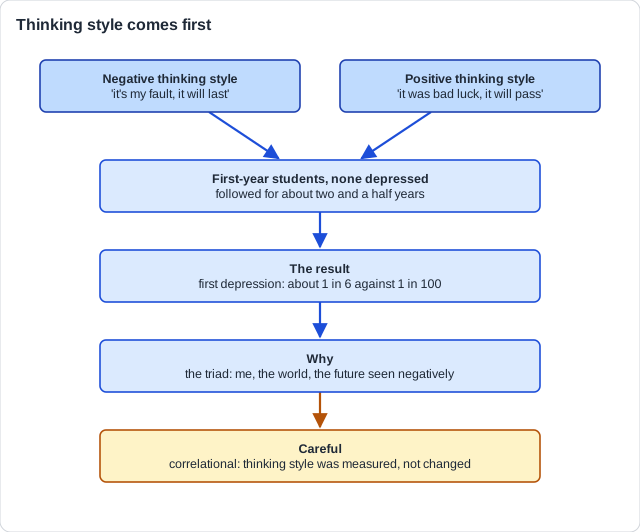
The cognitive explanation rests on Beck's model: three negative views that filter every experience. Alloy and colleagues (1999) tested whether such a thinking style comes before depression, by measuring first-year students' thinking styles and following them.
Beck's cognitive triad
Me
'I am worthless.' A negative view of the self.
The world
'Nothing goes right for me.' A negative view of experiences.
The future
'It will always be like this.' A negative view of what is to come.
Me · The world · The future
Free preview
This is the free notes preview
You're reading the free notes. Aimnova Pro unlocks the full study experience — and you can try it with your first topic free to keep:
- FlashcardsLock in vocabulary and key terms with spaced repetition.
- Practice questionsAnswer exam-style questions and get instant AI marking.
- Mock exams & past-paper vaultSit full mocks and see exactly how examiners award marks.
- Personalised study planA daily plan built around your exam date and weak areas.
Key idea: A model is valuable if it explains how the disorder works and points to a treatment that helps.
Its value
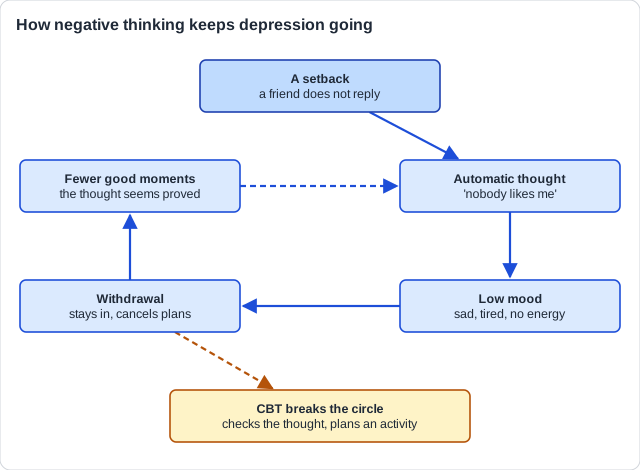
- Explains why low mood keeps going
- Thinking measured first predicts depression (Alloy)
- Led to CBT, which helps many people
Its limits
- Does not say where the triad comes from
- Leaves out genes and chemistry
- Built mainly on Western samples
What HL adds: The culture extension: Beck's model was built and tested mainly in Western samples. Where distress is described mainly through the body, a questionnaire about negative thoughts may miss it.