Key idea: Hard experiences early in life raise the risk of depression in adulthood: the more kinds of adversity, the higher the risk.
Adverse childhood experiences
Abuse
Physical, emotional or sexual abuse by an adult.
Neglect
Basic needs or affection not met.
Home life
A parent with mental illness, addiction or in prison; violence at home; a parent leaving.
Abuse · Neglect · Home life
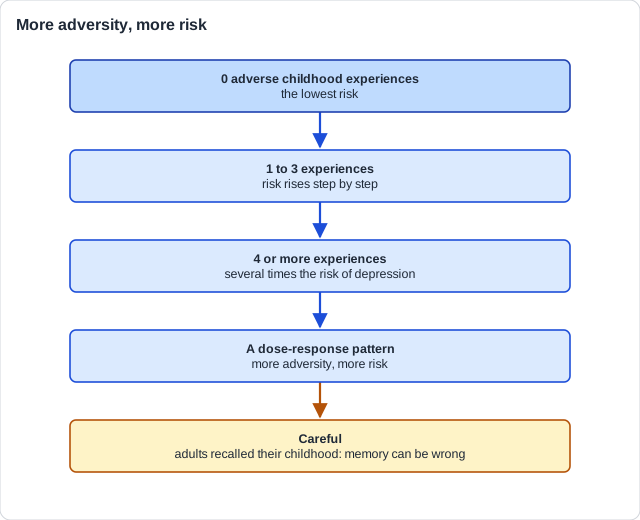
Felitti and colleagues (1998) asked more than 9,500 adults in the United States about seven kinds of childhood adversity and about their health. People who reported four or more kinds had several times the risk of depression of those who reported none.
What HL adds: The culture extension: the ACE list was built in the United States. Elsewhere, experiences such as war or forced migration may matter as much, and family conflict may be counted differently.
Free preview
This is the free notes preview
You're reading the free notes. Aimnova Pro unlocks the full study experience — and you can try it with your first topic free to keep:
- FlashcardsLock in vocabulary and key terms with spaced repetition.
- Practice questionsAnswer exam-style questions and get instant AI marking.
- Mock exams & past-paper vaultSit full mocks and see exactly how examiners award marks.
- Personalised study planA daily plan built around your exam date and weak areas.
Key idea: A clear dose-response pattern suggests the link is real; recall and confounds limit how far it shows cause.
What supports it
- Large sample, found again in many countries
- More adversity, more risk
- Points to prevention: protect children
Where to be careful
- Adults recalled their childhood
- Poverty and genes travel with adversity
- Many with high scores never become depressed
Resilience matters: one trusted adult, coping skills and later relationships protect many children. The factor raises risk; it does not decide the outcome.
Watch out: A dose-response pattern is still a correlation. Say what else could explain it.