Key idea: Blocking a stress hormone's effect removes the memory boost of an emotional event. That shows a biological cause.
Emotion and memory
1
Emotional event
Stress hormones such as adrenaline are released.
2
Amygdala
A brain area for emotion signals the hippocampus to strengthen storage.
3
Result
Emotional events are often remembered more vividly, though not always more accurately.
Arouse · Amygdala · Store
Cahill and colleagues (1994) gave people propranolol, which blocks adrenaline's effect, or a placebo, before an emotional story. Only the placebo group remembered the emotional part best.
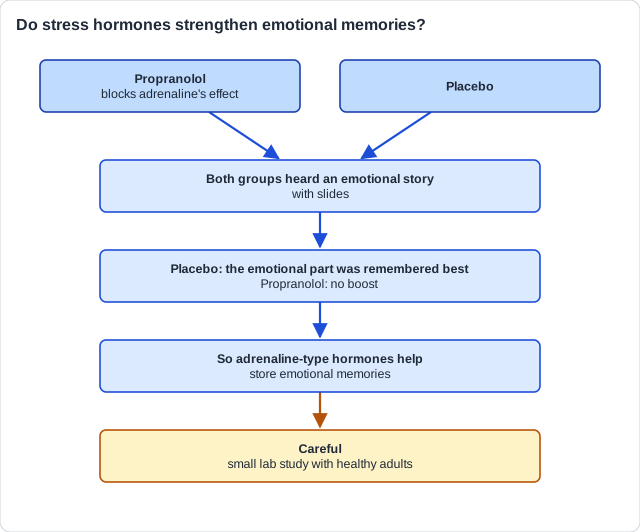
What HL adds: HL essays can link the hormone, the brain area and the memory in one chain, then judge whether a drug study in a lab tells us about real emotional events.
Free preview
This is the free notes preview
You're reading the free notes. Aimnova Pro unlocks the full study experience — and you can try it with your first topic free to keep:
- FlashcardsLock in vocabulary and key terms with spaced repetition.
- Practice questionsAnswer exam-style questions and get instant AI marking.
- Mock exams & past-paper vaultSit full mocks and see exactly how examiners award marks.
- Personalised study planA daily plan built around your exam date and weak areas.
Start Studying Free Full access to Aimnova Pro · cancel anytime
Key idea: Emotion clearly changes how memories feel, and stress hormones help store them; whether it makes them more accurate is less clear.
Strengths
- Biological mechanism tested
- Explains vivid emotional memories
- Real events studied
Limitations
- Vivid is not accurate
- Lab stories are mild emotions
- Drug studies raise ethical issues
The best-supported claim is that emotion raises vividness and confidence more than accuracy.
Watch out: Vivid is not accurate. Separate how a memory feels from whether it is correct.