In one line: Relationships start with chance and chemistry, and last or fail through how partners think and talk.
Relationships form, last and end partly because of how partners think: what they weigh up, and how they explain each other's behaviour. This page covers those cognitive explanations.
What HL adds: The culture extension: in many cultures partners are chosen with families, so explanations built on individual choice may not apply.
HL essays should link each explanation to a study.
Free preview
This is the free notes preview
You're reading the free notes. Aimnova Pro unlocks the full study experience — and you can try it with your first topic free to keep:
- FlashcardsLock in vocabulary and key terms with spaced repetition.
- Practice questionsAnswer exam-style questions and get instant AI marking.
- Mock exams & past-paper vaultSit full mocks and see exactly how examiners award marks.
- Personalised study planA daily plan built around your exam date and weak areas.
Key idea: Partners weigh what a relationship gives and costs, and explain each other's behaviour in ways that keep it good or push it towards an end.
Cognitive explanations
Social exchange
Partners weigh rewards against costs, and against what they could have elsewhere.
Investment
Time, shared friends and plans make leaving costly, so commitment grows.
Attributions
How partners explain each other's behaviour keeps the relationship good or bad.
Weigh · Commit · Explain
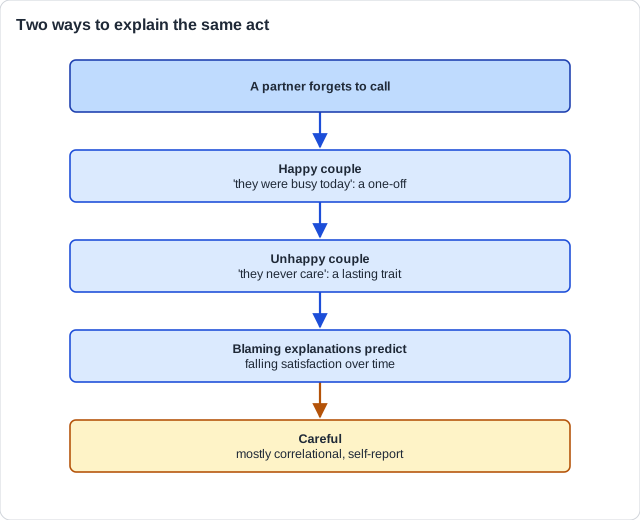
Go further: higher-level insight: Bradbury and Fincham (1990): happy couples explain a partner's bad behaviour as a one-off ('tired today'); unhappy couples as a trait ('always selfish'). Attributions keep a relationship good or bad.
What HL adds: The culture extension: where families help choose a partner, the weighing of rewards and alternatives may include the family's view, not only the couple's.
See how examiners mark answers
Answer exam-style questions with model answers. Learn exactly what earns marks and what doesn't.
Key idea: Strong prediction from communication, weaker proof of cause.
What supports it
- Gottman's patterns predicted divorce over 14 years
- Attributions differ between happy and unhappy couples
- Oxytocin changed behaviour in a controlled study
Where to be careful
- Prediction is not cause: patterns may reflect deeper problems
- Lab conflict talks are not daily life
- Mostly Western, married couples
So communication, attributions and chemistry each explain part of why relationships last or end, but most evidence is correlational, and samples are culturally narrow.
Watch out: One spray is not love. The oxytocin study measured distance in one meeting.