aımnova
DashboardMy LearningCrash CoursesStudy Plan

Aimnova site navigation

Stay in the loop

Get the latest study resources and updates

New features, study tips and exam insights — straight to your inbox.

IB Diploma

  • IB Past Papers
  • IB Study Notes
  • IB Question Bank
  • IB Mock Exams
  • IB Revision

IB Subjects

  • IB Math AA
  • IB Math AI
  • IB Economics
  • IB Business Management
  • IB Physics
  • IB Biology
  • View all IB subjects→

IB Past Papers

  • IB Math AA HL Past Papers
  • IB Math AA SL Past Papers
  • IB Math AI HL Past Papers
  • IB Math AI SL Past Papers
  • IB Economics HL Past Papers
  • IB Economics SL Past Papers
  • IB ESS Past Papers
  • View all past papers→

Study Resources

  • Study Notes
  • Question Bank
  • Mock Exams
  • Crash Courses
  • Flashcards
  • Revision Guide
  • Exam Skills
  • Command Terms
  • Grade Calculator
  • Exam Timetable 2026

Aimnova

  • Features
  • Pricing
  • For Teachers
  • For Schools
  • For Parents
  • About Us
  • Blog
  • Contact
aımnova

IB study, practice and feedback built around the real exam.

TermsPrivacyCookies·© 2026 Aimnova. All rights reserved.afd6316

Aimnova is not affiliated with or endorsed by the International Baccalaureate Organization (IB).

NotesPsychology HLTopic 3.3Strategies for improving relationships
Back to Psychology HL Topics
3.3.102 min read

Strategies for improving relationships (Psychology HL)

IB Psychology · Unit 3

AI-powered feedback

Stop guessing — know where you lost marks

Get instant, examiner-style feedback on every answer. See exactly how to improve and what the markscheme expects.

Try It Free

Contents

  1. 1Therapy for couples
  2. 2How well do the strategies work?
Key idea: Strategies follow explanations: change the talk, change the blame, or learn to accept what will not change.

What couples learn

1

Speaker and listener

One talks about one problem; the other repeats it back before answering.

2

Soft start

Begin with 'I feel' rather than an attack on the partner.

3

Time out

Take a break when anger rises, and agree to come back.

4

Repair

Small gestures after conflict: a joke, an apology, a touch.

Speak · Listen · Pause · Repair

A strategy for improving relationships: Communication-skills programmes for couples teach softer starts to arguments, listening, and repairing after conflict: the opposite of the four warning signs.

Christensen and colleagues (2004) randomly gave 134 seriously distressed couples one of two therapies: traditional behavioural therapy, or an integrative therapy that adds acceptance. Most couples in both improved.
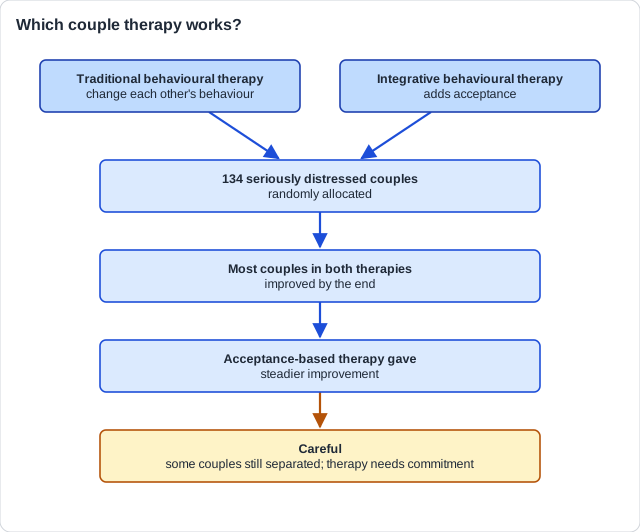
Seriously distressed couples were randomly given traditional behavioural couple therapy or integrative therapy that adds acceptance; most couples in both improved; acceptance-based therapy gave steadier improvement; a caution box notes some still separated.
Follow a randomised trial of couple therapy.

Free preview

This is the free notes preview

You're reading the free notes. Aimnova Pro unlocks the full study experience — and you can try it with your first topic free to keep:

  • FlashcardsLock in vocabulary and key terms with spaced repetition.
  • Practice questionsAnswer exam-style questions and get instant AI marking.
  • Mock exams & past-paper vaultSit full mocks and see exactly how examiners award marks.
  • Personalised study planA daily plan built around your exam date and weak areas.
Start Studying Free Full access to Aimnova Pro · cancel anytime
Key idea: Randomised trials show that couple therapy helps many couples; it needs commitment and may need adapting.

Strengths

  • Random allocation: cause can be shown
  • Seriously distressed couples
  • Most couples improved

Limitations

  • Some still separated
  • Needs commitment and therapists
  • Mostly Western couples

Strategies can target talk, blame or acceptance; the best choice may depend on the couple.

What HL adds: The culture extension: where families are closely involved in a marriage, a strategy aimed only at the couple may miss key influences.

IB Exam Questions on Strategies for improving relationships

Practice with IB-style questions filtered to Topic 3.3.10. Get instant AI feedback on every answer.

Practice Topic 3.3.10 QuestionsBrowse All Psychology HL Topics

How Strategies for improving relationships Appears in IB Exams

Examiners use specific command terms when asking about this topic. Here's what to expect:

  • Define

    Give the precise meaning of key terms related to Strategies for improving relationships.

    AO1
  • Describe

    Give a detailed account of processes or features in Strategies for improving relationships.

    AO2
  • Explain

    Give reasons WHY — cause and effect within Strategies for improving relationships.

    AO3
  • Evaluate

    Weigh strengths AND limitations of approaches in Strategies for improving relationships.

    AO3
  • Discuss

    Present arguments FOR and AGAINST with a balanced conclusion.

    AO3

See the full IB Command Terms guide

Related Psychology HL Topics

Continue learning with these related topics from the same unit:

3.1.1Biological explanations of a mental health disorder3.1.2Cognitive models of a mental health disorder3.1.3Cultural differences in mental health3.1.4Environmental factors in mental health disorders
View all Psychology HL topics
Improve your exam techniqueCommand terms, paper structure, and mark-scheme tips for Psychology HL
Previous3.3.9Communication in relationshipsNextCognitive biases in decision-making3.4.1

3 exam-style questions ready for you

Students who practice on Aimnova improve their scores by 15% on average. Get instant feedback that shows exactly how to improve your answers.

Practice Now — FreeView All Psychology HL Topics