Key idea: Early deprivation harms development, and the earlier good care starts, the more children recover.
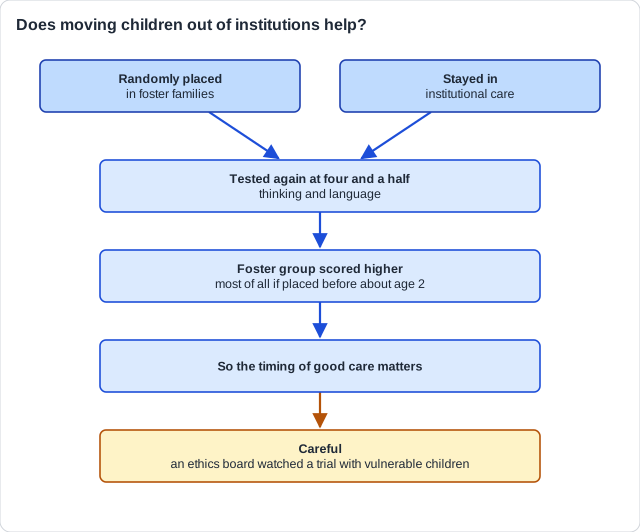
Nelson and colleagues (2007) randomly placed young children living in Romanian institutions in foster families or left them in institutional care. The foster group scored higher on thinking and language at four and a half, most of all if placed before about age 2.
What supports it
- Random allocation: cause can be shown
- Adoptee study agrees on timing
- Long follow-up
Where to be careful
- Ethics of a trial with vulnerable children
- Extreme cases may not transfer
- Some children recover even late
What HL adds: The culture extension: what counts as good care differs between cultures, from extended families to boarding schools. Ask whether a finding from Romanian institutions transfers.
Free preview
This is the free notes preview
You're reading the free notes. Aimnova Pro unlocks the full study experience — and you can try it with your first topic free to keep:
- FlashcardsLock in vocabulary and key terms with spaced repetition.
- Practice questionsAnswer exam-style questions and get instant AI marking.
- Mock exams & past-paper vaultSit full mocks and see exactly how examiners award marks.
- Personalised study planA daily plan built around your exam date and weak areas.
Key idea: Resilience is doing well despite serious adversity. Protective factors make the difference.
Protective factors
In the child
An easy temperament, problem-solving skills, hope.
In the family
At least one caring adult.
In the community
A supportive school, a mentor, a faith or sports group.
Person · Family · Community
Werner and Smith followed every child born in 1955 on Kauai, Hawaii, for 40 years: about one in three high-risk children became competent, caring adults, usually with one adult who cared for them.
Watch out: Risk is not fate. Say what protected the children who did well.