Key idea: People who live between two cultures can keep one, both or neither. Research asks which strategy goes with the best outcomes.
Berry's four strategies
1
Integration
Keep your heritage culture and join the new one.
2
Assimilation
Give up the heritage culture, join the new one.
3
Separation
Keep the heritage culture, stay apart from the new one.
4
Marginalisation
Lose touch with both cultures.
Integration · Assimilation · Separation · Marginalisation
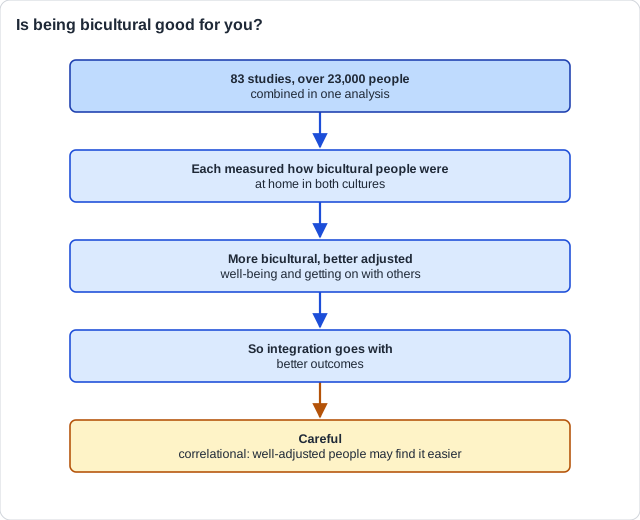
Nguyen and Benet-Martínez (2013) combined 83 studies with over 23,000 people. The more bicultural people were, the better their psychological and social adjustment.
What HL adds: The culture extension: the same strategy can work differently depending on how welcoming the receiving culture is, so ask about both groups in any Paper 3 source.
Free preview
This is the free notes preview
You're reading the free notes. Aimnova Pro unlocks the full study experience — and you can try it with your first topic free to keep:
- FlashcardsLock in vocabulary and key terms with spaced repetition.
- Practice questionsAnswer exam-style questions and get instant AI marking.
- Mock exams & past-paper vaultSit full mocks and see exactly how examiners award marks.
- Personalised study planA daily plan built around your exam date and weak areas.
Start Studying Free Full access to Aimnova Pro · cancel anytime
Key idea: Many studies agree that integration goes with better adjustment; the direction of cause is less clear.
Strengths
- 83 studies, over 23,000 people
- Same pattern in ICSEY
- Many different groups
Limitations
- Correlational
- Self-report
- Discrimination limits choice
Well-adjusted people may find it easier to join two cultures, so good adjustment could come first.
Watch out: Correlation, not cause. Say what else could explain the link.