Key idea: Theory of mind is measured with false-belief tasks.
Influences on development
Biological maturation
The brain and body develop on a rough timetable: the planning region matures into the mid-20s, shaping abilities.
Cognitive development
Thinking becomes more complex with age and experience: memory, reasoning and understanding grow.
Sociocultural influence
Peers, family and culture shape behaviour through enculturation, social learning and norms.
Maturation · Thinking · Others
Baron-Cohen, Leslie and Frith (1985) gave the Sally-Anne test to typically developing children, children with Down syndrome, and autistic children of similar mental age.
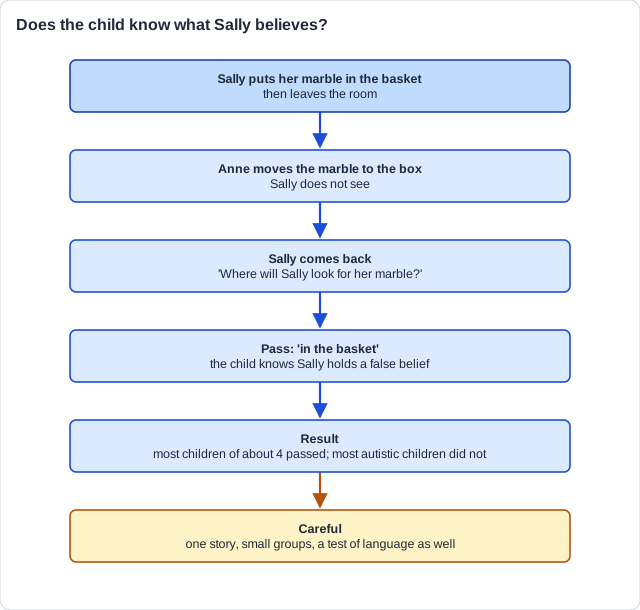
Go further: higher-level insight: Theory of mind underlies empathy. Later tasks without words, such as watching where a child looks, suggest some understanding appears earlier than four.
Free preview
This is the free notes preview
You're reading the free notes. Aimnova Pro unlocks the full study experience — and you can try it with your first topic free to keep:
- FlashcardsLock in vocabulary and key terms with spaced repetition.
- Practice questionsAnswer exam-style questions and get instant AI marking.
- Mock exams & past-paper vaultSit full mocks and see exactly how examiners award marks.
- Personalised study planA daily plan built around your exam date and weak areas.
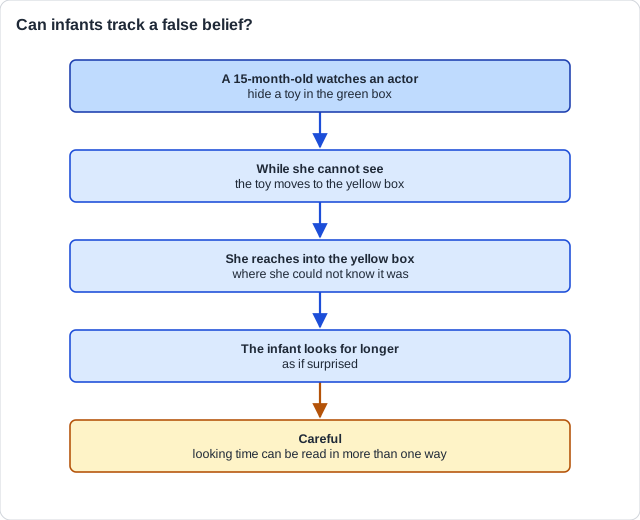
Key idea: Story tasks need language. Measuring where infants look tests understanding of false belief without words.
Onishi and Baillargeon (2005) showed 15-month-olds an actor hiding a toy. When the toy moved while she could not see, infants looked longer if she then searched in its new place, as if they expected her to hold a false belief.
Story tasks (Sally-Anne)
- Clear pass or fail
- Easy to repeat
- Need language and memory
Looking-time tasks
- No words needed
- Show earlier understanding
- Looking can mean many things
What HL adds: Paper 1 Section C has asked how developmental psychologists measure abilities such as theory of mind: know the task, what it shows, and its limits.