Key idea: Piaget: the child discovers alone, stage by stage. Vygotsky: the child learns with help.
Piaget: stages
- Development in four set stages
- The child discovers alone, like a scientist
- A child cannot be taught past their stage
Vygotsky: continuous
- Development is gradual, with no fixed stages
- Learning happens with more skilled others
- Help within the zone of proximal development
Wood, Bruner and Ross (1976) watched a tutor help children aged 3 to 5 build a pyramid of blocks. The best help, scaffolding, gave more support when a child struggled and less as they succeeded, which fits Vygotsky's zone of proximal development.
Go further: higher-level insight: Stage theories describe what changes; continuous models explain how others help it change.
Free preview
This is the free notes preview
You're reading the free notes. Aimnova Pro unlocks the full study experience — and you can try it with your first topic free to keep:
- FlashcardsLock in vocabulary and key terms with spaced repetition.
- Practice questionsAnswer exam-style questions and get instant AI marking.
- Mock exams & past-paper vaultSit full mocks and see exactly how examiners award marks.
- Personalised study planA daily plan built around your exam date and weak areas.
Key idea: A stage theory predicts jumps; a continuous model predicts gradual change with help. The evidence points to more gradual change than Piaget thought.
Piaget's four stages
Sensorimotor (0 to 2)
Learning through the senses and movement; object permanence develops.
Preoperational (2 to 7)
Words and pretend play, but egocentric thinking; cannot yet conserve.
Concrete operational (7 to 11)
Logical thinking about real objects; conservation is understood.
Formal operational (11 and over)
Abstract and hypothetical reasoning.
Sense · Symbol · Concrete · Abstract
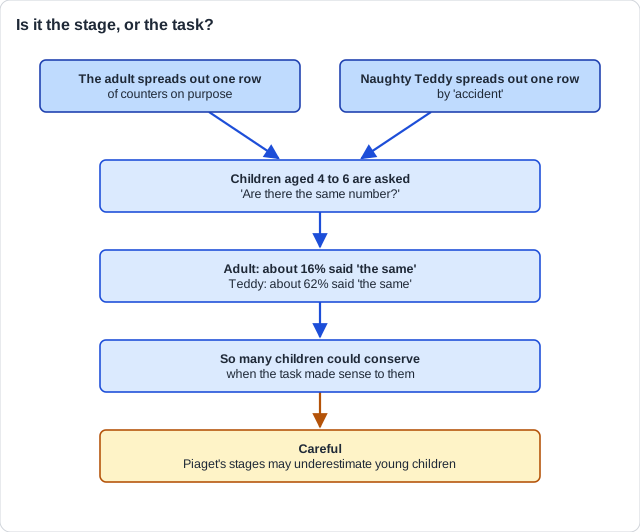
Children often use several strategies at once and shift between them slowly, rather than jumping a whole stage. In McGarrigle and Donaldson (1974), far more 4- to 6-year-olds conserved when a 'Naughty Teddy' moved the counters by accident: the task, not only the stage, decided success.
What HL adds: The culture extension: for Vygotsky, the tools of thinking, such as language and counting systems, come from culture, so the pace of development can differ between cultures. A universal stage theory struggles to explain this.