In one line: The first bond becomes a mental template of what love is like, and that template travels into adult life.
Attachment shapes the developing self: whether a person sees themselves as worth caring for, and others as trustworthy.
What HL adds: The culture extension: van IJzendoorn and Kroonenberg (1988) combined 32 Strange Situation studies from 8 countries. Secure attachment was the most common pattern everywhere, but avoidant was more common in West Germany and resistant in Israel and Japan.
Free preview
This is the free notes preview
You're reading the free notes. Aimnova Pro unlocks the full study experience — and you can try it with your first topic free to keep:
- FlashcardsLock in vocabulary and key terms with spaced repetition.
- Practice questionsAnswer exam-style questions and get instant AI marking.
- Mock exams & past-paper vaultSit full mocks and see exactly how examiners award marks.
- Personalised study planA daily plan built around your exam date and weak areas.
Key idea: The internal working model links infant experience to adult relationships.
Attachment at a glance
Secure attachment
The infant uses the caregiver as a safe base: comforted by them, confident to explore. Linked to sensitive caregiving.
Insecure attachment
Avoidant or resistant patterns, often where caregiving is inconsistent or unresponsive.
Three explanations
Biological (an innate drive to bond, Bowlby), cognitive (an internal working model), sociocultural (caregiving norms vary by culture).
Secure · Insecure · Shaped by care
Hazan and Shaver (1987) printed a 'love quiz' in a US newspaper. Readers chose which description fitted their adult relationships and answered questions about their childhood.
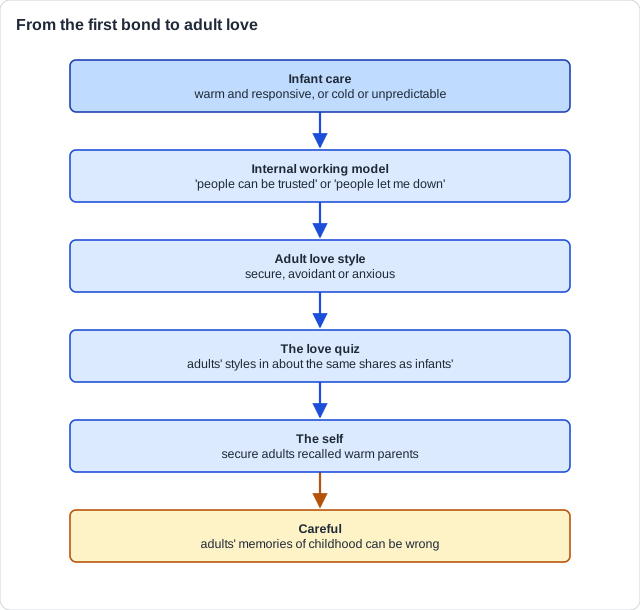
Go further: higher-level insight: Adult styles came in shares close to infants': about 56% secure, 25% avoidant, 19% anxious. The working model may carry the first bond forward.
See how examiners mark answers
Answer exam-style questions with model answers. Learn exactly what earns marks and what doesn't.
Key idea: Strong links between early and later bonds, weak proof of cause.
What supports it
- Infant and adult styles come in similar shares
- Secure attachment is the most common pattern in every culture studied
- Explains how the self-image starts
Where to be careful
- A newspaper quiz: a self-selected sample
- Adults' memories of childhood can be wrong
- Variation within countries is larger than between them
So attachment helps explain the developing self, but the evidence linking infancy to adulthood is correlational and partly based on memory, and patterns differ by culture.
Watch out: Not destiny. Many insecure infants become secure adults through later relationships.