In one line: Development is a conversation between a growing brain and the world around it.
Models of development ask how change happens: in fixed stages (Piaget) or continuously with help from others (Vygotsky). The self also develops through peers and childhood experiences.
What HL adds: Paper 3 sources may show brain data by age. Read the trend first, then the limit: a scan shows how the brain is built, not which behaviour it causes.
Free preview
This is the free notes preview
You're reading the free notes. Aimnova Pro unlocks the full study experience — and you can try it with your first topic free to keep:
- FlashcardsLock in vocabulary and key terms with spaced repetition.
- Practice questionsAnswer exam-style questions and get instant AI marking.
- Mock exams & past-paper vaultSit full mocks and see exactly how examiners award marks.
- Personalised study planA daily plan built around your exam date and weak areas.
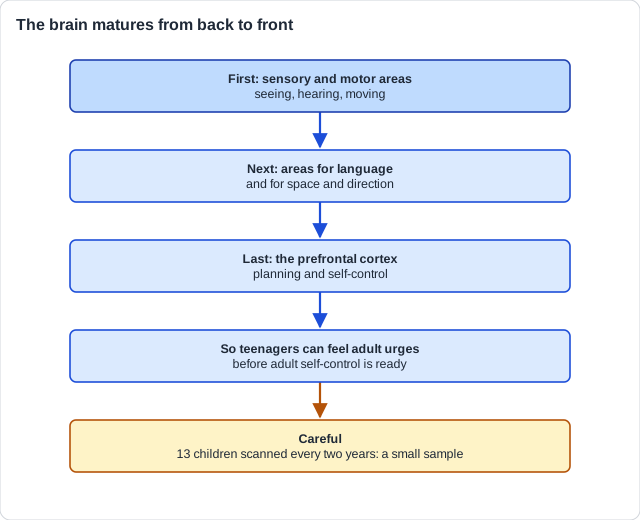
Key idea: Brain areas mature in an order. The ones for planning and self-control come last, in the mid-20s.
How the brain matures
Growth
In childhood the brain makes far more connections than it will keep.
Pruning
Connections that are used grow stronger; unused ones are removed: neuroplasticity at work.
Myelination
A fatty layer insulates the busy pathways, so signals travel faster.
Grow · Prune · Insulate
Gogtay and colleagues (2004) scanned 13 healthy children every two years for about ten years. Grey matter matured from the back of the brain to the front: sensory and motor areas first, the prefrontal cortex last.
Go further: higher-level insight: A critical period is where maturation and experience meet: the Romanian adoptees caught up best when adopted early.
Learn what examiners really want
See exactly what to write to score full marks. Our AI shows you model answers and the key phrases examiners look for.
Key idea: Developmental evidence is strongest where it follows children over time.
What supports it
- False-belief tasks show a clear change around four
- Adoption studies show the timing of experience matters
- Scaffolding supports learning with others
Where to be careful
- Tasks also test language and attention
- Brain-income links are correlational
- Natural experiments lack random allocation
So development is best seen as biology and experience shaping each other over time, measured with tasks that each capture only part of an ability.
Watch out: One task is not the ability. Failing Sally-Anne may reflect language, not mind-reading.