Key idea: Prevention works better when it changes what people want, or what is easy, than when it only gives facts.
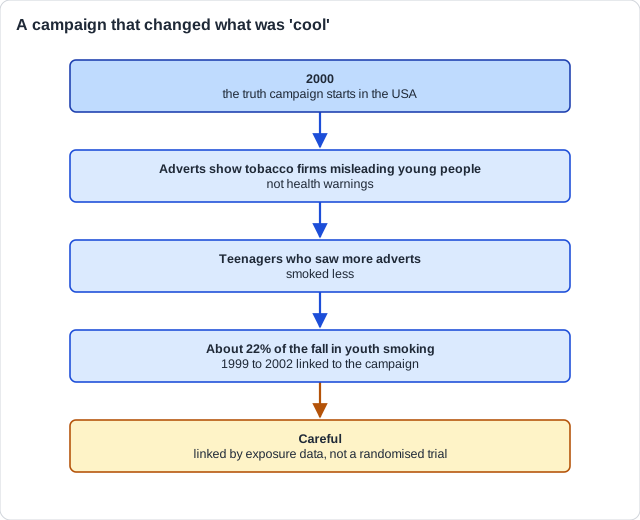
The truth campaign in the USA, from 2000, showed tobacco companies misleading young people instead of warning about health. Farrelly and colleagues (2005) linked about 22% of the fall in youth smoking between 1999 and 2002 to the campaign.
Health promotion: Campaigns that only give information, such as England's Change4Life against obesity, often change little; programmes that change the setting and involve families do better.
What makes prevention work
Change the setting
Prices, school meals, smoke-free places.
Change the norm
Make the healthy choice what peers do and admire.
Keep going
Programmes that last years beat one-off campaigns.
Setting · Norms · Time
What HL adds: The motivation extension: the truth campaign used teenagers' wish for independence. Smoking became doing what the companies wanted, not rebelling.
Free preview
This is the free notes preview
You're reading the free notes. Aimnova Pro unlocks the full study experience — and you can try it with your first topic free to keep:
- FlashcardsLock in vocabulary and key terms with spaced repetition.
- Practice questionsAnswer exam-style questions and get instant AI marking.
- Mock exams & past-paper vaultSit full mocks and see exactly how examiners award marks.
- Personalised study planA daily plan built around your exam date and weak areas.
Key idea: Ask three things: did behaviour change, did health change, and would the change have happened anyway?
Strengths of the evidence
- National data on real smoking
- More exposure, less smoking
- Fits other campaign successes
Where to be careful
- Not randomised: other changes at the time
- Smoking self-reported by teenagers
- One country, one period
Youth smoking was falling for other reasons too, such as higher prices. The study linked the size of the fall to how much of the campaign each area saw, which makes a link more credible.
Watch out: Reach is not effect. Millions seeing a campaign says nothing until behaviour is measured.