In one line: A treatment is only as good as the evidence that it works, and keeps working.
Treatments follow explanations: biological treatments change brain chemistry, psychological treatments change thinking and behaviour, sociocultural ones change the person's situation.
Effectiveness has two parts: does it help now, and does the help last?
How CBT works
Spot the thought
Notice the automatic thought behind a low moment: 'I always fail'.
Check the evidence
Ask what supports the thought and what goes against it.
Replace it
Write a fairer thought: 'I failed this test, not everything.'
Test it in life
Plan an activity and see what really happens: a behavioural experiment.
Spot · Check · Replace · Test
What HL adds: The culture extension: who delivers a treatment, and in what words, can matter as much as the method.
HL essays should weigh short-term against long-term effectiveness.
Free preview
This is the free notes preview
You're reading the free notes. Aimnova Pro unlocks the full study experience — and you can try it with your first topic free to keep:
- FlashcardsLock in vocabulary and key terms with spaced repetition.
- Practice questionsAnswer exam-style questions and get instant AI marking.
- Mock exams & past-paper vaultSit full mocks and see exactly how examiners award marks.
- Personalised study planA daily plan built around your exam date and weak areas.
Key idea: Medication and therapy can help equally at first; the difference shows after they stop.
Approaches to treatment
Biological treatment
Medication (such as antidepressants) that alters neurotransmission. Fast for some, but side effects, and it does not address causes.
Psychological treatment
Therapy (such as CBT) that challenges and changes negative thinking. Needs effort and time.
Sociocultural treatment
Building social support, reducing isolation, tackling stigma so people seek help.
Prevention
Health promotion: education, screening, reducing risk factors, to stop problems before they start.
Medicate · Retrain thinking · Support · Prevent
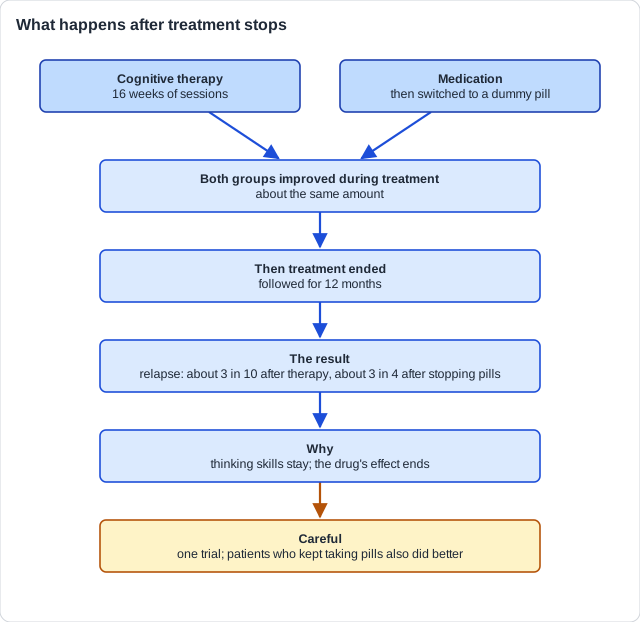
Hollon and colleagues (2005) treated adults with moderate to severe depression with cognitive therapy or medication, then followed them after treatment ended.
Study smarter, not longer
Most students waste 40% of study time on topics they already know. Our AI tracks your progress and optimizes every minute.
Key idea: Good evaluation asks how big, how lasting, and for whom.
What supports it
- Randomised trials compare treatments fairly
- Follow-up shows which gains last (Hollon)
- Culturally fitted care reaches more people
Where to be careful
- Placebo effects are large (Kirsch)
- Trials exclude many real patients
- Who funds a trial can shape its results
So both medication and therapy can be effective, but therapy's gains last longer for many people, drug effects over placebo are smaller than often thought, and fit with the culture matters.
Watch out: 'Better than nothing' is not the test. Compare with a placebo or another treatment.