What 'die Migration' covers: Migration (die Migration) is part of the theme Experiences. Learn the words below as a deck, then use them in the reading and writing sections.
What you need words for
- Moving to another country.
- Cultural differences.
- Integration and the challenges immigrants face.
- Your opinion about them.
- die Migration / migrieren
- migration / to migrate
- auswandern — einwandern
- to emigrate (leave) — to immigrate (arrive)
- der/die Einwanderer/in
- the immigrant
- umziehen
- to move (house/country)
- sich einleben in
- to settle in
- auf der Suche nach einem besseren Leben
- in search of a better life
- sich anpassen / die Anpassung
- to adapt / adaptation
- sich integrieren / die Integration
- to integrate / integration
- der Kulturschock
- culture shock
- vermissen
- to miss (someone/something)
- die Sprachbarriere
- the language barrier
- das Aufnahmeland / das Gastland
- the host country
- zwischen zwei Kulturen leben
- to live between two cultures
| Useful expression (German) | English |
|---|---|
| Meine Familie ist auf der Suche nach einem besseren Leben ausgewandert. | My family emigrated in search of a better life. |
| Am Anfang erlebte ich einen Kulturschock. | At first I experienced culture shock. |
| Die Sprachbarriere war das Schwierigste. | The language barrier was the hardest thing. |
| Nach und nach gelang es mir, mich zu integrieren. | Little by little I managed to integrate. |
| Ich vermisse meine Familie und meine Gewohnheiten. | I miss my family and my customs. |
Why this matters: This vocabulary turns up in every skill — a reading text about an immigrant's experience, a listening interview about living abroad, a Paper 1 email advising a friend who is moving, or your oral. Reusing the right topic words is how you score Criterion A (Language).
Free preview
Reading it is one thing — hearing it is another
You're reading the free notes. Aimnova Pro unlocks the full study experience — and you can try it with your first topic free to keep:
- Audio on every wordTap any vocabulary word or example to hear it read aloud in natural German.
- FlashcardsLock in vocabulary and key terms with spaced repetition.
- Practice questionsAnswer exam-style questions and get instant AI marking.
- Mock exams & past-paper vaultSit full mocks and see exactly how examiners award marks.
- Personalised study planA daily plan built around your exam date and weak areas.
Have something to say: Examiners reward developed ideas, not just vocabulary. Take a position and back it up.
The common debates
- The difficulties immigrants face in a new city, and how to help them.
- The cultural differences of living abroad.
- The advice you'd give a friend who is moving.
Opinion phrases (use these to introduce a view)
- Meiner Meinung nach… / Aus meiner Sicht… — In my opinion… / From my point of view…
- Mir scheint, dass… / Ich glaube, dass… — It seems to me that… / I think that…
- Das Wichtigste ist… — The most important thing is…
- Einerseits… andererseits… — On the one hand… on the other hand…
- Ich bin (völlig) einverstanden mit… — I (completely) agree with…
Schwierigkeiten des Auswanderns (drawbacks)
- Die Sprachbarriere erschwert das tägliche Leben.
- Viele Einwanderer vermissen ihre Familie.
- Der Kulturschock kann Einsamkeit verursachen.
Vorteile des Lebens im Ausland (benefits)
- Man lernt eine andere Sprache und eine andere Kultur kennen.
- Man lernt Menschen aus aller Welt kennen.
- Man wird offener und toleranter.
Arriving
- eine Familie zieht für die Arbeit nach Österreich
- der erste Schultag in einem neuen Land
- ein Sprachtandem: Ich lerne deine Sprache, du meine.
Integration
- eine Ausbildung für junge Geflüchtete
- Fußballtraining mit Geflüchteten und Einheimischen
- eine Unterkunft für Geflüchtete im Dorf
Between two cultures
- Unterschiede im Alltag: Begrüßung, Wetter, Frühstück
- die Gastarbeiter und ihre Enkel
- Heimat: Wo ist man zu Hause?
Big questions behind this topic (IB guide, theme Experiences)
- Wie würde das Leben in einer anderen Kultur unsere Sicht auf die Welt verändern?
- Was braucht man, um sich in einem neuen Land zu Hause zu fühlen?
- Kann man zwei Heimaten haben?
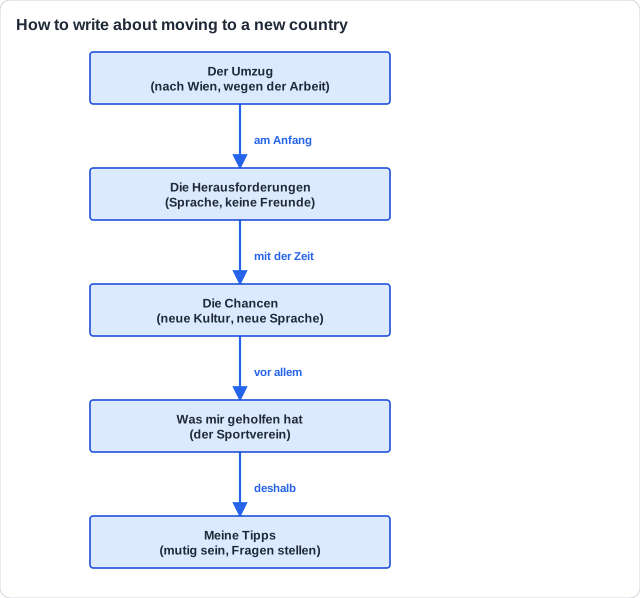
Link your ideas: Connectors lift your answer from a list into an argument: außerdem (besides), jedoch / aber (however), deshalb (therefore), obwohl (although). Use at least two or three in any written answer.
Memorize terms 3x faster
Smart flashcards show you cards right before you forget them. Perfect for definitions and key concepts.
Read like Paper 2: Here is a short blog — the kind of text Paper 2 (Reading) gives you.
How to read it
- Read it once just for the general idea; don't worry about every word.
- Tap the audio button to hear it.
- Tap Übersetzung anzeigen if you get stuck.
- Then we'll do one exam question together.
Zwischen zwei Welten leben: Vor zwei Jahren sind meine Familie und ich auf der Suche nach einem besseren Leben in ein anderes Land ausgewandert. Am Anfang kam mir alles fremd vor: die Sprache, die Sitten und sogar das Essen.
Am schwersten fiel es mir, meine Großeltern zu vermissen und die Leute im Unterricht nicht richtig zu verstehen.
Zwischen zwei Welten leben (Fortsetzung)
Nach und nach schloss ich jedoch neue Freundschaften und begann, mich als Teil des Viertels zu fühlen. Die Schule organisierte ein Willkommensprogramm, und einige Mitschüler halfen mir mit der Sprache. Heute spreche ich zwei Sprachen, kenne zwei Kulturen und fühle mich glücklich, zwischen zwei Welten leben zu können – auch wenn ich meine Heimat manchmal vermisse.
- jemandem kommt etwas fremd vor
- to feel/seem strange to someone
- das Willkommensprogramm
- the welcome programme
- Freundschaften schließen
- to make friends
- sich glücklich fühlen
- to feel fortunate / happy
- zwischen zwei Welten
- between two worlds
IB-style task — eine Frage aus Paper 2
Eine Frage, Schritt für Schritt
- The question — „Wer half der Person dem Text zufolge mit der Sprache?“
- Find it in the text. Look for „Sprache“: „Die Schule organisierte ein Willkommensprogramm, und einige Mitschüler halfen mir mit der Sprache.“
- The answer — Einige Mitschüler halfen ihr, dank des Willkommensprogramms der Schule.
Reading technique: For a „dem Text zufolge“ (according to the text) question, find the exact line that proves your answer — don't rely on memory or general knowledge.
Die Aufgabe — your task: Dein Freund Daniel zieht zum Leben und Studium in ein anderes Land und ist nervös. Schreib ihm eine E-Mail.
Der Auftrag — what to do
- Erzähl ihm von deiner eigenen Erfahrung beim Umzug.
- Gib ihm Tipps, wie man sich einlebt und integriert.
- Schreibe zwischen 250 und 400 Wörtern.
Email structure — 6 steps
Subject line
A short subject line that tells Daniel what the email is about. „Betreff: Keine Panik vor dem Umzug!“
Greeting
A friendly greeting with a comma; the next line starts with a small letter. „Hallo Daniel,“
Body: your experience + tips
Tell your own move in the past (Perfekt/Präteritum), then give two or three tips in the du-imperative. „Als ich ausgewandert bin, …“ · „Lern die Sprache …“
Request
Ask Daniel for something concrete. „Schreib mir bitte, sobald du angekommen bist.“
Friendly close
An encouraging closing line. „Ich drücke dir die Daumen!“
Name
Sign off warmly with your name. „Liebe Grüße, dein Jonas“
Subject → Greeting → Body → Request → Friendly close → Name
Modell: die 6 Schritte in ~110 Wörtern
Die fertige E-Mail, Schritt für Schritt
- Betreff: Keine Panik vor dem Umzug!
- Hallo Daniel,
- ich habe gehört, dass du bald im Ausland studierst und ein bisschen nervös bist. Das kenne ich gut: Als ich ausgewandert bin, verstand ich die Sprache kaum und vermisste meine Familie sehr. Deshalb gebe ich dir drei Tipps: Lern die Sprache vom ersten Tag an, melde dich für Aktivitäten an, um Leute kennenzulernen, und bleib in Kontakt mit deiner Familie! Sich einzuleben braucht jedoch Zeit, also sei geduldig.
- Schreib mir bitte, sobald du angekommen bist, und schick mir ein Foto von deinem neuen Zimmer!
- Ich drücke dir die Daumen – bald wirst du dich dort wie zu Hause fühlen!
- Liebe Grüße, dein Jonas
Warum es funktioniert — what makes it strong: A strong email does these things for each of the three Paper 1 criteria:
A — Language /12
- Perfekt and Präteritum for your story: „ausgewandert bin“, „verstand“
- du-imperatives for the tips: „lern“, „melde dich an“, „bleib“
- Connectors: „deshalb“, „jedoch“, „sobald“
B — Message /12
- Task fully done: shares an experience AND gives advice
- Three concrete tips, plus a clear request to stay in touch
C — Conceptual /6
- Email conventions: a subject line, „Hallo Daniel,“ and „Liebe Grüße, dein Jonas“
- The du-form all the way through, a warm tone
- A concrete request: „Schreib mir bitte, sobald …“
Know your predicted grade
Take timed mock exams and get detailed feedback on every answer. See exactly where you're losing marks.
Hör zu wie in Paper 2: Paper 2 also tests listening (25 marks): you hear short clips and answer questions — but you never see the words. Here's one, simplified. Play it, answer, then reveal the transcript to check.
Hörverstehen — Mehmets Erfahrung
Listen to Mehmet look back on the day he came to Germany and the life he built there. Try to answer before you reveal the transcript — that's how Paper 2 Listening works.
- Wie lange wollte Mehmet ursprünglich in Deutschland bleiben? (How long did Mehmet originally plan to stay in Germany?)
Guten Tag, ich heiße Mehmet und bin vierundsiebzig Jahre alt. Im Jahr 1971 kam ich als junger Arbeiter aus der Türkei nach Köln, um in einer Autofabrik zu arbeiten. Eigentlich wollte ich nur zwei Jahre bleiben und dann mit dem Ersparten zurückkehren. Am Anfang lebte ich mit fünf Kollegen in einem kleinen Zimmer und verstand kaum ein Wort Deutsch. Doch dann lernte ich meine Frau kennen, und unsere Kinder wurden hier geboren. Heute habe ich Enkel, die besser Deutsch als Türkisch sprechen. Für mich ist Köln längst meine zweite Heimat.
Good afternoon, my name is Mehmet and I'm seventy-four years old. In 1971 I came from Turkey to Cologne as a young worker to work in a car factory. Actually, I only wanted to stay for two years and then go back with my savings. At first I lived with five colleagues in a small room and hardly understood a word of German. But then I met my wife, and our children were born here. Today I have grandchildren who speak German better than Turkish. For me, Cologne has long been my second home.
- Nur zwei Jahre; dann wollte er mit dem Ersparten zurückkehren.
Listening technique: Read the question first, then listen for that one detail — you don't need to catch every word. In the real exam you hear each clip twice.