What 'Gesundheit und Wohlbefinden' covers: Health and well-being (die Gesundheit und das Wohlbefinden) is part of the theme Identities. Learn the words below as a deck, then use them in the reading and writing sections.
You need vocabulary to talk about
- diet and sleep
- exercise and stress
- physical and mental health
- your opinion about them
- die Gesundheit
- health
- das Wohlbefinden
- well-being
- die Ernährung / die Diät
- diet / eating habits
- eine ausgewogene Ernährung
- a balanced diet
- Sport treiben
- to exercise / to do sport
- der Schlaf / gut schlafen
- sleep / to sleep well
- fit sein / in Form sein
- to be fit
- die psychische Gesundheit
- mental health
- der Stress / gestresst sein
- stress / to be stressed
- das Fast Food / die süßen Teilchen
- fast food / pastries
- auf sich achten / sich pflegen
- to look after yourself
- gesunde Gewohnheiten
- healthy habits
- an der frischen Luft
- in the fresh air / outdoors
| Useful expression (German) | English |
|---|---|
| Ich versuche, mich ausgewogen zu ernähren. | I try to eat a balanced diet. |
| Ich treibe Sport, um fit zu bleiben. | I do sport to keep fit. |
| Gut zu schlafen ist grundlegend für die Gesundheit. | Sleeping well is essential for your health. |
| Ich achte auf meine psychische Gesundheit so sehr wie auf die körperliche. | I look after my mental health as much as my physical health. |
| Ich esse zu viel Fast Food. | I eat too much fast food. |
Why this matters: This vocabulary turns up in every skill — a reading text on diet or sleep, a listening interview about routines, a Paper 1 article on health, or your oral. Reusing the right topic words is how you score Criterion A (Language).
Free preview
Reading it is one thing — hearing it is another
You're reading the free notes. Aimnova Pro unlocks the full study experience — and you can try it with your first topic free to keep:
- Audio on every wordTap any vocabulary word or example to hear it read aloud in natural German.
- FlashcardsLock in vocabulary and key terms with spaced repetition.
- Practice questionsAnswer exam-style questions and get instant AI marking.
- Mock exams & past-paper vaultSit full mocks and see exactly how examiners award marks.
- Personalised study planA daily plan built around your exam date and weak areas.
Have something to say: Examiners reward developed ideas, not just vocabulary. Take a position and back it up.
The common debates (health)
- fast food and diet
- the importance of sleep
- exercise and the outdoors
- looking after your mental health, not only the body
Opinion phrases (use these to introduce a view)
- Meiner Meinung nach… / Aus meiner Sicht… — In my opinion… / From my point of view…
- Mir scheint, dass… / Ich glaube, dass… — It seems to me that… / I think that…
- Das Wichtigste ist… — The most important thing is…
- Einerseits… andererseits… — On the one hand… on the other hand…
- Ich bin (völlig) einverstanden mit… — I (completely) agree with…
Schlechte Gewohnheiten (drawbacks)
- Viele Menschen essen Fast Food und schlafen zu wenig.
- Der Stress schadet der psychischen Gesundheit.
- Ein bewegungsarmes Leben raubt uns Energie.
Gesunde Gewohnheiten (benefits)
- Eine ausgewogene Ernährung gibt uns mehr Energie.
- Gut zu schlafen verbessert die Konzentration und die Laune.
- Bewegung an der frischen Luft baut Stress ab.
Eating well
- „Superfoods“: Werbung und Wirklichkeit
- ein Fast-Food-Restaurant gegenüber der Schule
- gesundes Essen in der Schulkantine
Stress and sleep
- genug Schlaf trotz Hausaufgaben
- Prüfungsstress und Zeitmanagement
- der Boom der Achtsamkeitskurse
Exercise and risks
- samstags 5 km laufen beim parkrun
- freie Zeit ohne Termine für Kinder
- Einweg-E-Zigaretten auf dem Schulhof
Big questions behind this topic (IB guide, theme Identities)
- Wer ist für unsere Gesundheit verantwortlich: wir selbst, die Schule oder der Staat?
- Wie viel Stress ist normal?
- Warum glauben wir der Werbung für „gesunde“ Produkte?
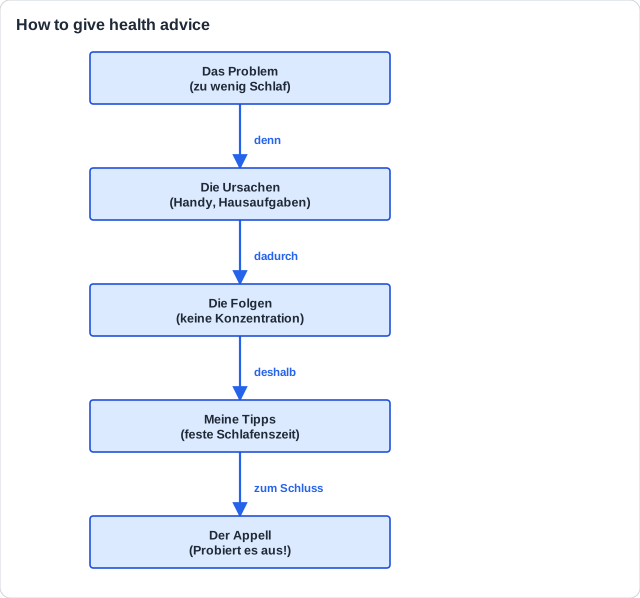
Link your ideas: Connectors lift your answer from a list into an argument: außerdem (besides), jedoch / aber (however), deshalb (therefore), obwohl (although). Use at least two or three in any written answer.
Practice with exam-style questions
Answer exam-style questions and get AI feedback that shows you exactly what examiners want to see in a full-marks response.
Read like Paper 2: Here is a short blog — the kind of text Paper 2 (Reading) gives you.
How to work through it
- Read it once just for the general idea; don't worry about every word.
- Tap the audio button to hear it.
- Tap Übersetzung anzeigen if you get stuck.
- Then we'll do one exam question together.
Kleine Gewohnheiten, mehr Energie (1/3): Als ich in die Oberstufe kam, schlief ich sehr wenig: Ich lernte bis spät in die Nacht und am nächsten Tag war ich erschöpft und konnte mich im Unterricht nicht konzentrieren.
Kleine Gewohnheiten, mehr Energie (2/3)
Dann erklärte mir meine Ärztin, dass der Schlaf genauso wichtig ist wie das Essen oder die Bewegung. Jetzt versuche ich, vor elf Uhr ins Bett zu gehen, und zum Frühstück esse ich Obst und Haferflocken statt süßer Teilchen.
Kleine Gewohnheiten, mehr Energie (3/3)
Außerdem gehe ich jeden Nachmittag eine halbe Stunde an der frischen Luft spazieren. Ich habe mein Leben nicht von heute auf morgen verändert, aber mit diesen kleinen Gewohnheiten habe ich mehr Energie und bin besserer Laune.
- erschöpft
- exhausted
- sich konzentrieren
- to concentrate
- die Haferflocken
- oats / porridge oats
- von heute auf morgen
- all at once / overnight
- guter/schlechter Laune sein
- to be in a good/bad mood
IB-style task — eine Frage aus Paper 2
Eine Frage, Schritt für Schritt
- The question — „Was isst die Person dem Text zufolge jetzt zum Frühstück?“
- Find it in the text. Look for „Frühstück“: „…zum Frühstück esse ich Obst und Haferflocken statt süßer Teilchen.“
- The answer — Sie isst Obst und Haferflocken (statt süßer Teilchen).
Reading technique: For a „dem Text zufolge“ (according to the text) question, find the exact line that proves your answer — don't rely on memory or general knowledge.
Die Aufgabe — your task: Deine Schule veranstaltet eine Gesundheitswoche. Schreibe eine formelle E-Mail an die Schulleiterin, Frau Becker.
Der Auftrag — what to do
- Beschreibe die Gesundheitsgewohnheiten vieler Schülerinnen und Schüler.
- Schlage zwei Maßnahmen vor, wie die Schule Körper und Geist fördern kann.
- Schreibe zwischen 250 und 400 Wörtern.
Formal email structure — 6 steps
Subject line
„Betreff:“ + what the email is about in a few words. „Betreff: Vorschläge für die Gesundheitswoche“
Formal greeting
„Sehr geehrte Frau …,“ / „Sehr geehrter Herr …,“ with a comma; the next line starts with a small letter. „Sehr geehrte Frau Becker,“
Reason for writing
Say who you are and why you write, in the Sie-form. „Ich schreibe Ihnen, weil viele Schüler zu wenig schlafen…“
Request or proposal
Make the proposals polite with Konjunktiv II. „Erstens könnte die Mensa … Zweitens wäre ein Ruheraum sinnvoll.“
Polite close
Thank the reader and offer to talk. „Ich wäre Ihnen sehr dankbar, wenn …“
Sign-off + name
„Mit freundlichen Grüßen“ (no comma), then your full name and class.
Subject → Greeting → Reason → Request → Polite close → Signature
Modell: die 6 Schritte in ~100 Wörtern
Die fertige E-Mail, Schritt für Schritt
- Betreff: Vorschläge für die Gesundheitswoche
- Sehr geehrte Frau Becker,
- ich heiße Lucia Romero und gehe in die Klasse 10b. Ich schreibe Ihnen, weil viele Schülerinnen und Schüler zu wenig schlafen, mittags nur Chips essen und sich in der Prüfungszeit sehr gestresst fühlen.
- Deshalb möchte ich Ihnen zwei Maßnahmen vorschlagen: Erstens könnte die Mensa jeden Tag ein günstiges, gesundes Menü anbieten. Zweitens wäre ein Ruheraum sinnvoll, in dem man in der Pause abschalten kann.
- Ich wäre Ihnen sehr dankbar, wenn Sie meine Vorschläge prüfen könnten, und stehe gern für ein Gespräch zur Verfügung.
- Mit freundlichen Grüßen – Lucia Romero, Klasse 10b
Warum es funktioniert — what makes it strong: A strong formal email does these things for each of the three Paper 1 criteria:
A — Language /12
- Konjunktiv II for polite proposals: „könnte“, „wäre“
- Connectors: „weil“, „deshalb“, „erstens … zweitens“
- Health vocabulary: „die Mensa“, „der Ruheraum“, „gestresst“
B — Message /12
- Task fully done: describes the habits AND proposes two measures
- Each measure is concrete and has a reason
C — Conceptual /6
- Formal-email conventions: „Betreff:“ and „Sehr geehrte Frau Becker,“
- Sie-form all the way through: „Ich schreibe Ihnen“
- A clear request and „Mit freundlichen Grüßen“
Feeling unprepared for exams?
Get a clear study plan, practice with real questions, and know exactly where you stand before exam day. No more guessing.
Hör zu wie in Paper 2: Paper 2 also tests listening (25 marks): you hear short clips and answer questions — but you never see the words. Here's one, simplified. Play it, answer, then reveal the transcript to check.
Hörverstehen — Saras Gesundheitsgewohnheiten
Listen to Sara describe how she looks after her health. Try to answer before you reveal the transcript — that's how Paper 2 Listening works.
- Was macht Sara, um fit zu bleiben? (What does Sara do to stay fit?)
Hallo, ich heiße Sara. Seit einem Jahr achte ich sehr auf meine Gesundheit. Ich ernähre mich ausgewogen, mit viel Obst und Gemüse, und ich esse fast nie Fast Food. Um fit zu bleiben, fahre ich mit dem Rad zur Schule und spiele zweimal pro Woche Basketball. Um meine psychische Gesundheit zu pflegen, versuche ich, acht Stunden zu schlafen, und ich schalte vor dem Schlafengehen das Handy aus. Für mich ist das Gleichgewicht zwischen Körper und Geist das Wichtigste.
Hi, I'm Sara. For a year now I've been taking good care of my health. I eat a balanced diet, with lots of fruit and vegetables, and I almost never eat fast food. To stay fit, I cycle to school and play basketball twice a week. To look after my mental health, I try to sleep eight hours and I switch off my phone before going to bed. For me, the balance between body and mind is the most important thing.
- Sie fährt mit dem Rad zur Schule und spielt zweimal pro Woche Basketball.
Listening technique: Read the question first, then listen for that one detail — you don't need to catch every word. In the real exam you hear each clip twice.