What 'la loi et l'ordre' covers: Law & order (la loi et l'ordre) is part of the theme Social Organization. Learn the words below as a deck, then use them in the reading and writing sections.
You need vocabulary to talk about
- rules and rights
- justice and safety
- the fairness of punishments
- your opinion about them
- la loi — une règle
- the law — a rule
- le règlement (intérieur)
- the (school / internal) rules
- respecter / enfreindre une règle
- to respect / to break a rule
- un droit — un devoir
- a right — a duty
- la justice — juste / injuste
- justice — fair / unfair
- la sécurité — protéger
- safety — to protect
- une sanction / une punition
- a sanction / a punishment
- la citoyenneté — un(e) citoyen(ne)
- citizenship — a citizen
- l'ordre — le désordre
- order — disorder
- interdit(e) / autorisé(e)
- forbidden / allowed
- l'égalité — traiter tout le monde de la même façon
- equality — to treat everyone the same way
- la liberté — être responsable
- freedom — to be responsible
- le vivre-ensemble
- living together (in society)
| Useful expression (French) | English |
|---|---|
| Il faut respecter le règlement intérieur. | We must respect the school rules. |
| Cette sanction me semble injuste. | This punishment seems unfair to me. |
| Chacun a des droits et des devoirs. | Everyone has rights and duties. |
| Les règles servent à protéger tout le monde. | Rules exist to protect everyone. |
| Le respect des lois, c'est la citoyenneté. | Respecting the laws is citizenship. |
Why this matters: This vocabulary turns up in every skill — a reading text on school rules, a listening interview about a fair punishment, a Paper 1 opinion letter, or your oral. Reusing the right topic words is how you score Criterion A (Language).
Free preview
Reading it is one thing — hearing it is another
You're reading the free notes. Aimnova Pro unlocks the full study experience — and you can try it with your first topic free to keep:
- Audio on every wordTap any vocabulary word or example to hear it read aloud in natural French.
- FlashcardsLock in vocabulary and key terms with spaced repetition.
- Practice questionsAnswer exam-style questions and get instant AI marking.
- Mock exams & past-paper vaultSit full mocks and see exactly how examiners award marks.
- Personalised study planA daily plan built around your exam date and weak areas.
Have something to say: Examiners reward developed ideas, not just vocabulary. Take a position and back it up.
The common debates (around law & order)
- whether strict rules make a school or society better
- whether punishments are fair
- how to balance freedom with responsibility
Opinion phrases (use these to introduce a view)
- À mon avis… / De mon point de vue… — In my opinion… / From my point of view…
- Il me semble que… / Je pense que… — It seems to me that… / I think that…
- Le plus important, c'est… — The most important thing is…
- D'un côté… de l'autre côté… — On the one hand… on the other hand…
- Je suis (tout à fait) d'accord avec… — I (completely) agree with…
Trop de règles ? (drawbacks)
- Certaines sanctions sont trop sévères et injustes.
- Trop de règles limitent notre liberté.
- On punit parfois sans écouter l'élève.
Pourquoi des règles ? (benefits)
- Les règles protègent la sécurité de tous.
- Une société sans règles ne protège personne.
- Respecter les règles, c'est respecter les autres.
Rules at school
- des règles plus strictes sur le portable
- le vandalisme dans le lycée
- témoin sans réagir
Rules in society
- le casque à vélo obligatoire
- l'amende, la sanction
- les incivilités dans la rue
Justice
- le travail d'intérêt général (TIG)
- réparer plutôt que punir
- un procès joué par des lycéens
Big questions behind this topic (IB guide, theme Social organization)
- Quel rôle les règles et les lois jouent-elles dans la formation d'une société ?
- Vaut-il mieux punir ou réparer ?
- Que doit faire un témoin face à une incivilité ?
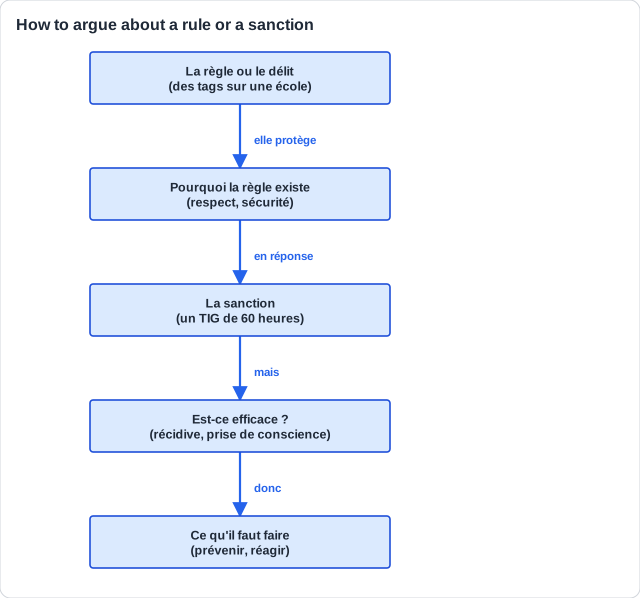
Link your ideas: Connectors lift your answer from a list into an argument: de plus (besides), cependant (however), par conséquent (therefore), bien que (although). Use at least two or three in any written answer.
Know your predicted grade
Take timed mock exams and get detailed feedback on every answer. See exactly where you're losing marks.
Read like Paper 2: Here is a short blog, the kind of text Paper 2 (Reading) gives you. Read it once just for the general idea; don't worry about every word.
How to work through it
- Tap the audio button to hear it.
- Tap Voir la traduction if you get stuck.
- Then we'll do one exam question together.
Au conseil des élèves (1/2): Cette année, j'ai été élue au conseil des élèves de mon lycée. Notre rôle est simple : veiller à ce que le règlement intérieur soit juste et respecté par tous.
Au début, je trouvais qu'il y avait trop de règles. Mais en discutant avec les autres élèves, j'ai compris qu'une société sans règles ne protège personne.
Au conseil des élèves (2/2)
Le mois dernier, nous avons changé une sanction que tout le monde jugeait injuste : avant, un élève en retard perdait une heure de récréation, même s'il avait une bonne raison. Désormais, le professeur écoute d'abord l'élève. Pour moi, le respect des règles et le respect des droits de chacun vont ensemble : c'est ça, la citoyenneté.
- le conseil des élèves
- the student council
- le règlement intérieur
- the school rules
- juste / injuste
- fair / unfair
- une sanction
- a punishment / sanction
- les droits de chacun
- everyone's rights
- la citoyenneté
- citizenship
IB-style task — Vrai ou Faux, et justifie
Une question, étape par étape
- The statement — Dès le début, la narratrice pensait qu'il n'y avait pas assez de règles. Vrai ou Faux ?
- Decide, then hunt for proof. Scan for her first opinion: Au début, je trouvais qu'il y avait trop de règles.
- The answer — Faux. Justification : Au début, je trouvais qu'il y avait trop de règles. Copy the exact words that prove it — that quote is what earns the mark, not the word 'Faux' on its own.
Reading technique: For Vrai/Faux + justifiez, a tick alone scores zero — you must quote the exact words from the text that prove it. The same rule applies to selon le texte questions: find the line, don't rely on memory.
La tâche — your task: Le conseil de la vie lycéenne (CVL) accueille les nouveaux élèves de seconde. Beaucoup trouvent le règlement intérieur injuste, parce qu'ils ne le comprennent pas.
Ce que tu écris — what you write: Écris un dépliant pour les nouveaux élèves : explique à quoi servent les règles, présente leurs droits et leurs devoirs et dis-leur à qui s'adresser en cas de problème.
Écris entre 450 et 600 mots.
Brochure (dépliant) structure — 4 steps
Titre accrocheur
A big title or slogan that grabs attention. BIENVENUE AU LYCÉE ! Le règlement : pas une punition, une protection
Sections avec sous-titres
Break the leaflet into short labelled sections. POURQUOI DES RÈGLES ? — sub-headings guide the eye.
Puces (infos clés)
List rights and duties as bullet points so they are easy to scan. • être écouté avant une sanction ; • arriver à l'heure.
Infos pratiques + appel à l'action
End with where and when to find help, and a call to act. Parles-en au CVL, salle B12… Ta voix compte !
Titre → Sections → Puces → Infos + appel
Modèle : les 4 étapes en ~90 mots
Le dépliant rédigé, étape par étape
- BIENVENUE AU LYCÉE ! Le règlement : pas une punition, une protection
- POURQUOI DES RÈGLES ? Elles protègent tout le monde et garantissent l'égalité : la même règle pour chaque élève, quel que soit son nom ou sa classe.
- TES DROITS : • être écouté avant une sanction ; • élire tes délégués. TES DEVOIRS : • arriver à l'heure ; • respecter les autres et le matériel.
- UN PROBLÈME ? UNE RÈGLE INJUSTE ? Parles-en au CVL, salle B12, chaque mardi à midi, ou dépose un mot dans notre boîte aux lettres. Ta voix compte : aide-nous à rendre les règles plus justes !
Why it works: A strong leaflet does this for each of the three Paper 1 criteria:
A — Language /12
- Persuasive structures: imperative parles-en, aide-nous; infinitives in the lists être écouté, élire
- Layout cues instead of long connectors: TES DROITS, TES DEVOIRS
- Topic vocabulary, used accurately
B — Message /12
- Task fully done: explains the purpose of rules, rights AND duties, and who to contact
- Ideas developed with concrete details (room B12, Tuesday at noon)
C — Conceptual /6
- Brochure conventions: a catchy title or slogan
- Sub-headings and bullet points: a layout readers can scan
- Practical information + a call to action at the end
Ready to ace Law & order?
You've seen the preview. Here's what you'll unlock:
Bite-Sized Study Notes
Full syllabus broken into chunks that stick
Exam Practice
See exactly how to score full marks
AI Feedback
Know exactly what examiners want
Smart Study Plan
Know exactly what to study next