Both kinds of value at Higher Level: Nature does not have to be either useful or valued for itself: it can be both. This page shows how to find both values in one case, and when they support or clash with each other.
Practise this as you read
- Discuss how both values apply to one species, from a fact file [2].
- Explain when the two values support each other and when they clash.
- Evaluate combining both arguments to win support for conservation.
Free preview
This is the free notes preview
You're reading the free notes. Aimnova Pro unlocks the full study experience — and you can try it with your first topic free to keep:
- FlashcardsLock in vocabulary and key terms with spaced repetition.
- Practice questionsAnswer exam-style questions and get instant AI marking.
- Mock exams & past-paper vaultSit full mocks and see exactly how examiners award marks.
- Personalised study planA daily plan built around your exam date and weak areas.
Not either-or: Instrumental and intrinsic value are not exclusive. The same whale can be loved for what it is and also earn money for the people who show it to visitors. This debate runs through environmental ethics and environmental economics.
Both values at once
- Instrumental and intrinsic value are not exclusive: one thing can have both.
- Whales have intrinsic value from their aesthetic appeal: their size, grace and song.
- The same whales have instrumental value as a tourist attraction.
- People may protect a species for either reason, or for both at once.
- Saying a thing is useful does not stop it being valued for what it is.
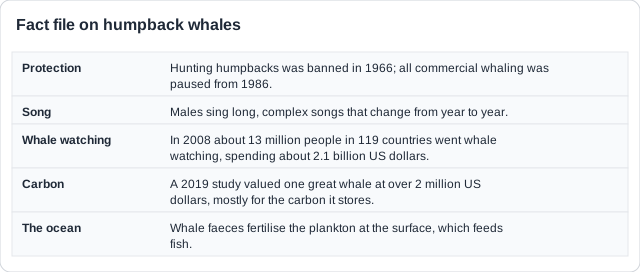
Real example: humpback whales have aesthetic appeal: their song changes every year, and people feel they matter for what they are. Since the whaling moratorium of 1986 they are also a tourist attraction: in 2008 whale watching drew about 13 million people in 119 countries.
Memorize terms 3x faster
Smart flashcards show you cards right before you forget them. Perfect for definitions and key concepts.
To show the two values are not exclusive, take one species and find a point for each side.
What counts on each side
- Instrumental (one use to people): tourism and the money it brings, food, medicine, services.
- Intrinsic: a native or endemic species, found nowhere else.
- Intrinsic: its right to exist (biorights); it is wild or beautiful.
- Intrinsic: it is culturally important, e.g. a national symbol.
- Intrinsic: it takes part in ecological interactions in its ecosystem.
- Give one point from each side, about the same species.
Remember it as: One species, two columns: what it does for us, and what it is.
Instrumental: whales
- Whale-watching boats and guides earn money
- Their dung feeds plankton, then fish
- They store carbon in their bodies
Intrinsic: whales
- Beautiful, with an ever-changing song
- Wild animals with a right to exist
- Part of the ocean's food webs
Cultural value goes on the intrinsic side: A species on a national flag, or endemic to one country, is valued for what it is, so it counts as intrinsic. Money from visitors who come to see it is instrumental.
Because the two values can sit together, they can support each other, or pull against each other.
Together or apart
- Together: tourist money (instrumental) pays to protect a species many value for itself.
- Most real conservation combines both arguments, to reach more people.
- Apart: when the use kills or harms the species, the two values clash.
- Money values, such as cost-benefit analysis, capture only the instrumental side.
- An intrinsic view says protect it even when the money figures say no.
- So species with no obvious use must not be neglected: protect whole ecosystems.
Together
- Whale watching can earn more from living whales than hunting them would.
- So tourism money protects animals that people also value for themselves.
Apart
- Japan left the whaling commission and restarted commercial whaling in 2019.
- There the use, whale meat, kills the animal valued for itself.
Beyond money
- Cost-benefit analysis counts only uses.
- An ecosystem-based approach protects the useful and the useless alike.
Weigh them, do not just list them: In Evaluate and Discuss answers, contrast the two values on the same case, and link them to money tools such as cost-benefit analysis: that is where the higher marks are.
Know your predicted grade
Take timed mock exams and get detailed feedback on every answer. See exactly where you're losing marks.
How this comes up: May 2026 HL Paper 1 asked exactly this for an endangered Chilean deer [2]: one instrumental value (tourism) and one intrinsic value (a native species, its right to exist, cultural importance on the coat of arms, or its role in the ecosystem), read from a figure and a fact file. Longer essays ask how far combining both values helps conservation [9].
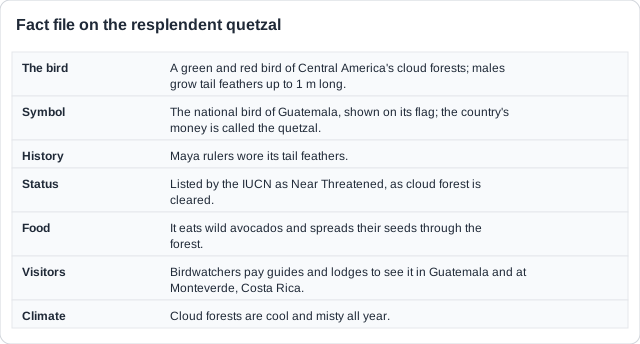
Figure 1 is a fact file on the resplendent quetzal, a bird of the cloud forests of Central America.
With reference to Figure 1, discuss how the concepts of instrumental and intrinsic value are not exclusive when applied to the quetzal.
Model answer plan
See the mark-by-mark plan — for / against / judgement, with marking guidance — in study mode.
Keep the two points in separate paragraphs, and quote the figure in each. Leave out the climate line: it is not a value.