Instrumental value at Higher Level: Much of the case for protecting nature rests on what nature does for us. This page names that value, its three sources, and why it protects some things and not others.
Practise this as you read
- Define instrumental value.
- Outline the goods, services and development opportunities a named ecosystem gives.
- Evaluate instrumental value as a reason to protect a species.
Free preview
This is the free notes preview
You're reading the free notes. Aimnova Pro unlocks the full study experience — and you can try it with your first topic free to keep:
- FlashcardsLock in vocabulary and key terms with spaced repetition.
- Practice questionsAnswer exam-style questions and get instant AI marking.
- Mock exams & past-paper vaultSit full mocks and see exactly how examiners award marks.
- Personalised study planA daily plan built around your exam date and weak areas.
Valued for what it does for us: Instrumental value is the usefulness an entity has for humans: the food, water, services or ideas it gives us.
What instrumental value is
- Instrumental value is the usefulness something has for humans.
- Nature is valued as a means to an end: for what it does for us.
- It comes from goods: food, water, timber, medicines.
- It comes from services: e.g. decomposers processing waste, pollination, flood control.
- It comes from opportunities for human development: knowledge and creative inspiration.
- It is the value at the heart of anthropocentric thinking.
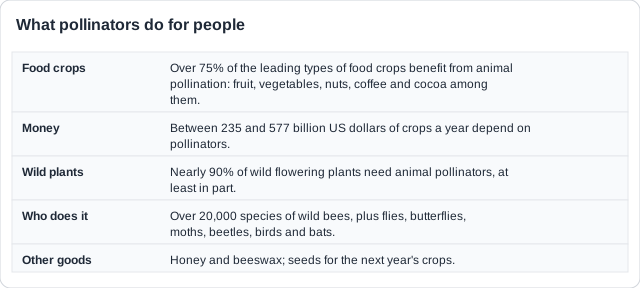
Real example: pollinators show all three kinds. Honey is a good, pollinating crops is a service, and the way bees find flowers inspires research. A world report in 2016 found that between 235 and 577 billion US dollars of crops a year depend on them.
Know your predicted grade
Take timed mock exams and get detailed feedback on every answer. See exactly where you're losing marks.
The guide names three sources of instrumental value. Each has real examples you can quote.
Goods
- Food and water, timber, fuel, medicines.
- Medicines from the rosy periwinkle of Madagascar treat childhood leukaemia.
Services
- Waste processed by decomposers, pollination, clean water.
- The East Kolkata Wetlands clean much of the city's sewage in fish ponds.
Human development
- Knowledge and creative inspiration.
- A kingfisher's beak inspired the nose of Japan's 500 Series bullet train (1997).
Goods: the rosy periwinkle
Two drugs from this Madagascar plant, vincristine and vinblastine, treat leukaemia and other cancers. Its value to us is the medicine.
Services: the East Kolkata Wetlands
In India, ponds east of Kolkata take in the city's sewage; bacteria and algae break it down, and the cleaner water raises fish. A Ramsar site since 2002.
Development: the kingfisher
Engineer Eiji Nakatsu shaped the train's nose like a kingfisher's beak, which dives into water without a splash: quieter, faster trains. This is biomimicry.
Remember it as: Goods, services, growth: what nature gives, does and teaches.
Because it is about usefulness, instrumental value makes a strong but limited ethical argument for protecting nature.
Instrumental value as an argument
- Instrumental value is easy to explain to governments and businesses.
- It can often be measured in money, so it can be weighed against the cost of protection.
- It persuades people who are not moved by nature for its own sake.
- But a species with no known use gets no protection from this argument.
- If a substitute is found, the value, and the reason to protect, disappears.
- It tends to favour charismatic or useful species over the rest.
Strength: New York's water
- In the 1990s New York chose to protect its Catskill watershed.
- It cost about 1.5 billion US dollars.
- A filtration plant would have cost 6-8 billion: the forest's service won.
Limit: no known use
- A beetle or moss with no known use has no instrumental value.
- If a cheaper substitute appears, the reason to protect goes.
- Flagship species win money; less appealing species miss out.
Instrumental is not just money: Knowledge, beauty that inspires artists, and recreation also count, when the point is what they do for people. Value for its own sake, with no benefit to anyone, is not instrumental.
Get feedback like a real examiner
Submit your answers and get instant feedback — what you did well, what's missing, and exactly what to write to score full marks.
How this comes up: Short Paper 1 parts ask you to pick out the instrumental values in a fact file; an Outline [4] wants four uses of a named place; an Evaluate [7] weighs instrumental value as a reason to protect a species. In May 2026 a [2] paired an instrumental value (tourism) with an intrinsic one.
The Sundarbans, shared by India and Bangladesh, is the largest mangrove forest in the world.
Outline the instrumental value of the Sundarbans.
Model answer plan
See the mark-by-mark plan — for / against / judgement, with marking guidance — in study mode.
Make each use a separate paragraph, and say who benefits: 'protects villages', not just 'stops storms'.