Conflicting ethical values at Higher Level: Why do people disagree about what is right for nature? Because they start from different beliefs about how humans relate to it. This page traces each belief to its framework, its judgements and its way of conserving.
Practise this as you read
- Outline three beliefs about humans and nature and the frameworks they lead to.
- Explain why the same plan, such as drilling for oil, divides people.
- Discuss how ethical views shape approaches to conservation [9].
Free preview
This is the free notes preview
You're reading the free notes. Aimnova Pro unlocks the full study experience — and you can try it with your first topic free to keep:
- FlashcardsLock in vocabulary and key terms with spaced repetition.
- Practice questionsAnswer exam-style questions and get instant AI marking.
- Mock exams & past-paper vaultSit full mocks and see exactly how examiners award marks.
- Personalised study planA daily plan built around your exam date and weak areas.
Where you start decides where you end: Each ethical framework grows from a belief about how humans relate to nature. Different beliefs give different answers to the same question: is this action right?
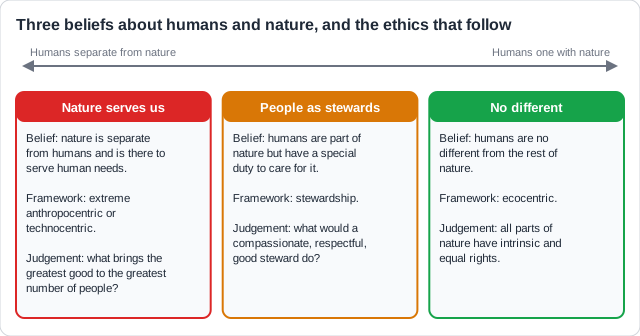
Belief, framework, judgement
- Different beliefs about humans and nature lead to different ethical frameworks.
- No different from the rest of nature: ecocentric; all of nature has intrinsic and equal rights.
- Part of nature, with a special duty: stewardship; act as a compassionate, respectful, good steward.
- Nature is separate, there to serve human needs: extreme anthropocentric or technocentric.
- That last view judges actions by the greatest good for the greatest number of people.
- Different starting beliefs give conflicting values: people disagree on what is right.
Nature serves us
- From the 1600s most of the Fens were drained to make farmland.
- Wetland was seen as wasted land, to be improved for people.
People as stewards
- Pope Francis, Laudato si' (2015): the Earth is 'our common home'.
- People are its carers, not its owners.
No different
- Deep ecology platform (Naess and Sessions, 1984).
- Human and non-human life both have value in themselves.
Memorize terms 3x faster
Smart flashcards show you cards right before you forget them. Perfect for definitions and key concepts.
The three beliefs are points on a spectrum. Between anthropocentric and ecocentric views lie many shades, and technocentric views sit near the human-centred end.
From light green to deep green
- Views sit on a spectrum, from light green to deep green.
- Light green: cut pollution and waste, mainly for human health and wealth.
- Deep green (deep ecology): all life has value in itself; humans must take far less.
- Extreme anthropocentric: nature counts only when it is useful to people.
- Moderate anthropocentric: people come first, but must manage nature for the future.
- Technocentric: new technology will solve the problems.
| View | Belief | Response to climate change (real example) |
|---|---|---|
| Extreme anthropocentric | Nature is there to use | Keep burning fuel if it grows the economy |
| Technocentric | Technology will fix it | Norway's Sleipner field: carbon capture and storage, about 1 million tonnes a year since 1996 |
| Moderate anthropocentric | Manage nature for people | Sweden's carbon tax, since 1991 |
| Light green | Reduce harm, for our sake | Recycle, insulate homes, save energy |
| Deep green | All life matters in itself | Consume far less; protect wild places |
Use the words: In a [9], name the views precisely: 'moderate anthropocentric', 'deep green'. Vague phrases such as 'people who like nature' earn little.
When people with different beliefs face the same decision, their values conflict.
Nature serves us
- About 846 million barrels of oil lie under the park.
- Oil revenue pays for schools, roads and health care: the greatest good for the most Ecuadorians.
Stewards
- In 2007 Ecuador offered to leave the oil in the ground if other countries paid 3.6 billion US dollars.
- Only about 13 million came, and drilling began in 2016.
No different
- A single hectare holds more tree species than the USA and Canada together.
- Two peoples live there in voluntary isolation; Ecuador's constitution gives nature rights.
The vote
- In August 2023, 58.95% of voters chose to stop drilling and leave the oil in the ground.
Why values conflict
- People who start from different beliefs reach different judgements about the same plan.
- Facts alone cannot settle it: both sides can agree on the facts and still disagree.
- Anthropocentric arguments weigh benefits to people: jobs, money, services.
- Ecocentric arguments weigh rights of nature: species, ecosystems, rivers.
- Stewardship arguments weigh duties: to care for nature and pass it on.
- Decisions often end in a compromise, a court ruling or a vote.
Remember it as: Same facts, different beliefs, different verdicts.
Know your predicted grade
Take timed mock exams and get detailed feedback on every answer. See exactly where you're losing marks.
Each framework also leads to a different way of conserving species.
Frameworks and conservation
- Technocentric: save species with science, often ex situ: seed banks, IVF, gene banks.
- Moderate anthropocentric / steward: managed reserves, sustainable use, trade rules (CITES).
- Anthropocentric campaigns use flagship species that attract money and visitors.
- Ecocentric / deep green: protect whole ecosystems in situ: large reserves, rewilding.
- Ecocentrics value every species, including those with no known use.
- Most real strategies mix approaches; they disagree on which comes first.
| Framework | Approach | Real example |
|---|---|---|
| Technocentric | ex situ: store genes, breed in labs | Svalbard Global Seed Vault, Norway (opened 2008) |
| Moderate anthropocentric | Regulate use and trade | CITES limits trade in 40,000+ species |
| Anthropocentric | flagship species to raise money | The giant panda on WWF's logo |
| Ecocentric, deep green | in situ: whole ecosystems, rewilding | Wolves, a keystone species, returned to Yellowstone, 1995 |
Do not just list strategies: Credit comes from the link: name the belief, the framework it gives, and why that framework prefers this approach. A list of zoos and reserves with no ethics earns little.
How this comes up: The specimen HL Paper 2 ends a Section B question with a [9] Discuss on exactly this: how different ethical views of humans and nature lead to different approaches. It is marked on bands, not points. Paper 1 may close with 'Through the lens of ethics, suggest how ...' [6].
Only two northern white rhinos are left, both female, guarded day and night at Ol Pejeta Conservancy in Kenya.
Discuss how different ethical beliefs about the relationship between humans and nature may lead to different approaches to conserving species such as the northern white rhino.
Model answer plan
See the mark-by-mark plan — for / against / judgement, with marking guidance — in study mode.
Give each framework its own paragraph, with a named example, then weigh them, then judge.