Environmental ethics at Higher Level: Environmental ethics applies ethics to nature. This page shows why it appeared in the 1960s and 1970s, and what older ethics was missing.
Practise this as you read
- Outline why environmental ethics arose in the 1960s and 1970s.
- Explain why older Western ethics was seen as inadequate.
- Name thinkers who widened ethics to nature.
Free preview
This is the free notes preview
You're reading the free notes. Aimnova Pro unlocks the full study experience — and you can try it with your first topic free to keep:
- FlashcardsLock in vocabulary and key terms with spaced repetition.
- Practice questionsAnswer exam-style questions and get instant AI marking.
- Mock exams & past-paper vaultSit full mocks and see exactly how examiners award marks.
- Personalised study planA daily plan built around your exam date and weak areas.
Ethics, widened to nature: Environmental ethics is the branch of ethics that addresses environmental issues. It grew from a worry that older Western ethics, built around interpersonal actions, could not say whether non-human or non-living things have moral status.
What environmental ethics is
- Environmental ethics is a branch of ethics that deals with environmental issues.
- It asks what is right and wrong in how humans treat nature.
- Older Western ethics focused on interpersonal actions: how people treat other people.
- Critics found this inadequate: it gave no moral status to non-human living things.
- Nor to non-living parts of nature, such as rivers, rocks and landscapes.
- So harming nature was wrong only if it harmed people.
Older Western ethics
- Moral concern for people only
- Nature is property or a resource
- Polluting a river is wrong only if people are harmed
Environmental ethics
- Asks whether animals, plants and ecosystems count
- Asks whether rivers and landscapes count
- Harming nature may be wrong in itself
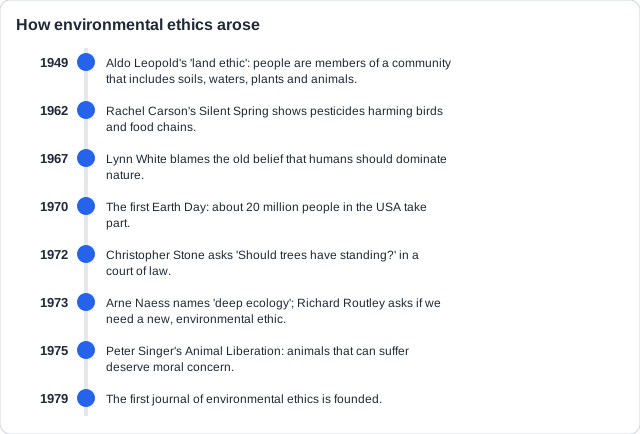
Real example: in 1973 the Australian philosopher Richard Routley used a thought experiment. The last person alive on Earth sets out to destroy every animal, plant and forest before dying. No person is harmed, so older ethics finds nothing wrong. Most people feel it is wrong: so, Routley argued, we need a new, environmental ethic.
Memorize terms 3x faster
Smart flashcards show you cards right before you forget them. Perfect for definitions and key concepts.
The new branch grew quickly once environmental problems were in the news.
Why it arose in the 1960s and 1970s
- It arose in the 1960s and 1970s.
- Environmental issues became more common: pesticides, oil spills, smog, polluted rivers.
- Awareness grew: books, protests, Earth Day (1970) and the UN Stockholm conference (1972).
- Philosophers asked whether the old ethics could cope, and many said no.
- They proposed new ideas: deep ecology, animal liberation, rights for natural things.
The problems
- DDT harming birds of prey
- Oil spills and burning rivers
- Smog in growing cities
The awareness
- Silent Spring (1962)
- First Earth Day (1970)
- UN Stockholm conference (1972)
The new ethics
- Lynn White on domination (1967)
- Naess on deep ecology (1973)
- Singer on animals (1975)
Remember it as: Problems, then awareness, then a new ethics.
Environmental ethics added new questions about who, or what, counts.
The questions it asks
- Animals: do those that can feel pain count? (Singer, 1975)
- All living things and ecosystems: do they have value in themselves? (Naess, 1973)
- Non-living nature: should rivers or forests have rights? (Stone, 1972)
- Future generations: what do we owe people not yet born?
- These questions now shape laws and policies, not just books.
The question
- In Animal Liberation (1975), Peter Singer argued that animals which are sentient deserve moral consideration.
- Their suffering counts, as ours does.
The debate
- Campaigns against battery cages and testing cosmetics on animals grew in the 1980s and 1990s.
The law
- The European Union's Lisbon Treaty (2009) recognises animals as sentient beings.
- The EU banned battery cages for hens from 2012.
Two different things: Environmental ethics asks what is right. Environmental awareness is knowing about a problem. Earth Day raised awareness; Naess and Singer gave ethical arguments.
Know your predicted grade
Take timed mock exams and get detailed feedback on every answer. See exactly where you're losing marks.
How this comes up: Expect an Outline [4] on why environmental ethics arose, short Paper 1 parts on a timeline or fact file, and an Explain [7] on why older ethics was not enough. Name thinkers and dates.
Between 1960 and 1980 several thinkers argued that ethics must widen beyond how people treat each other.
Outline how two thinkers of the 1960s and 1970s challenged older Western ethics.
Model answer plan
See the mark-by-mark plan — for / against / judgement, with marking guidance — in study mode.
Two paragraphs per thinker: what they said, then why it went beyond older ethics.