Environmental and social justice movements at Higher Level: This page looks at the environment through the lens of ethics. It traces how the environmental movement and social justice movements grew apart and came together, from Warren County in 1982 to Standing Rock in 2016.
Practise this as you read
- Outline the separate histories of the two movements.
- Explain the parallels between exploiting nature and exploiting people.
- Discuss how far the two movements now share the same goals.
Free preview
This is the free notes preview
You're reading the free notes. Aimnova Pro unlocks the full study experience — and you can try it with your first topic free to keep:
- FlashcardsLock in vocabulary and key terms with spaced repetition.
- Practice questionsAnswer exam-style questions and get instant AI marking.
- Mock exams & past-paper vaultSit full mocks and see exactly how examiners award marks.
- Personalised study planA daily plan built around your exam date and weak areas.
Two movements, now one goal: The environmental movement and social justice movements started apart. Today they increasingly fight together for societies that are fair to people and to nature.
Separate histories, common goals
- The environmental movement began by protecting nature: wildlife, forests, clean air.
- Social justice movements began by fighting for people: civil rights, women's rights, workers.
- They grew from separate histories and were often led by different people.
- They now increasingly seek common goals: equitable and just societies.
- The meeting point: environmental justice: a healthy environment for everyone.
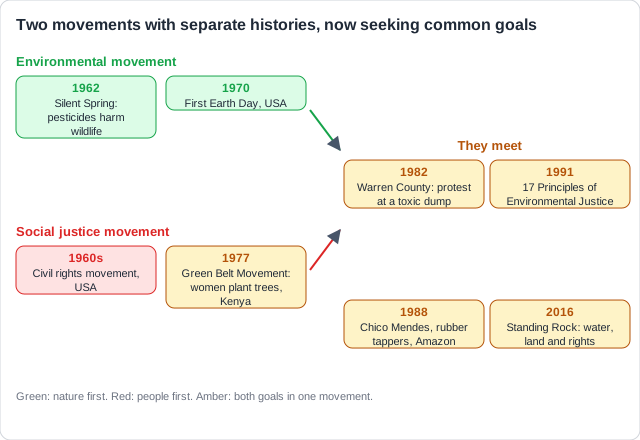
Remember it as: Fair to nature, fair to people: the two goals meet.
See how examiners mark answers
Answer exam-style questions with model answers. Learn exactly what earns marks and what doesn't.
The two movements first met in the USA, where the people living next to pollution were often poor and Black. Their cause became environmental justice.
Where they met: environmental justice
- Warren County, 1982: a toxic dump in a mainly Black county; more than 500 arrests.
- Civil rights protest and environmental protest in one campaign.
- 1991: the 17 Principles of Environmental Justice joined both goals.
- Environmental racism: hazards placed mostly in communities of colour.
- Flint, 2014: lead in the water of a mostly Black, poor city.
Warren County, North Carolina, 1982
The state chose a mainly Black county for a landfill of soil poisoned with PCBs. Civil rights leaders lay in the road in front of the trucks. The dump went ahead, but a new movement was born.
The 17 Principles, 1991
Leaders of colour met in Washington DC and wrote 17 Principles of Environmental Justice. The first joins both goals: respect for the Earth and the right to be free from ecological destruction.
Flint, Michigan, 2014
To save money, the city switched its water to the Flint River without treatment against pipe corrosion. Lead leached into homes in a city that is mostly Black and about 40% poor: environmental racism.
There is a parallel: treating nature as ours to use is like treating some groups of people as less important. Each movement now uses the other's arguments.
The parallels
- The idea that humans are superior to nature mirrors other kinds of exploitation.
- Sexism: ecofeminists link the domination of women and of nature.
- Racism: pollution is dumped where people of colour live.
- Disenfranchised groups: those with no voice carry the most harm.
- Future generations: they cannot vote today but will live with the damage.
Sexism: the Green Belt Movement, Kenya
From 1977 Wangari Maathai paid rural women to plant trees: more than 51 million so far, giving women income and a voice. She won the Nobel Peace Prize in 2004. ecofeminism names the link.
Racism: Standing Rock, 2016
The Standing Rock Sioux, joined by thousands, protested against an oil pipeline under the lake that supplies their water and near sacred sites. The pipeline opened in 2017.
Future generations: Fridays for Future
In August 2018 Greta Thunberg began school strikes for the climate. Young people argued that those who will live longest with the damage have the least say.
Climate justice: Pacific islands
Low islands such as Tuvalu face rising seas after emitting almost nothing: climate justice. Rich countries also export used clothes; unsold ones end up as waste in poorer countries.
Study smarter, not longer
Most students waste 40% of study time on topics they already know. Our AI tracks your progress and optimizes every minute.
Nowhere do the two movements meet more closely than on indigenous land, where protecting the forest and protecting the people are the same fight.
Indigenous rights: where conservation and justice meet
- Indigenous peoples manage or own at least a quarter of the world's land.
- It includes about 40% of all protected and ecologically intact land.
- Traditional ecological knowledge: harvest limits, seasons, fire management.
- Threats: land taken, green colonialism, biopiracy, youth moving to cities, climate change.
- So land rights are both a justice goal and a conservation goal.
Chico Mendes, Brazil: Mendes organised the Amazon's rubber tappers into a union to stop ranchers clearing the forest they lived from. He was murdered in December 1988; in 1990 a reserve in his name protected almost a million hectares for the tappers' use.
What traditional knowledge offers
- Generations of observing one place
- Safe harvest limits and seasons
- Cool fire-stick burning to cut wildfire fuel (Aboriginal Australia)
- Knowledge of plants used as medicines
What threatens it
- Land taken for farms, mines and parks
- Green colonialism
- Biopiracy: a 1994 European patent on a neem-tree fungicide was revoked in 2000
- Young people moving to cities; climate change
traditional ecological knowledge is why many conservation groups now see indigenous land rights as one of the best ways to protect forests.
Older conservation sometimes protected nature by pushing people out. Justice movements have changed that.
Towards just conservation
- Fortress conservation fenced people out; when it repeats colonial patterns it is green colonialism.
- FPIC: free, prior and informed consent before any project on indigenous land.
- Just conservation: community-based, co-management, benefit-sharing, legal land rights.
- 30x30: protect 30% of land and sea by 2030 with indigenous rights at its centre.
- New justice issues: loss and damage funds, a just transition, intergenerational equity.
Fortress conservation and green colonialism: When Yellowstone became the first national park in 1872, Native American peoples who used the land were pushed out. fortress conservation like this, run by outsiders, repeats colonial patterns.
Free, prior and informed consent
free, prior and informed consent: no pressure, before any decision, with all the facts. Consent from a national government on the community's behalf is not enough.
30x30, agreed in 2022
The Kunming-Montreal framework aims to protect 30% of land and sea by 2030 and recognises indigenous territories, so new parks do not repeat fortress conservation.
Loss and damage, a just transition
In 2022 (COP27) countries agreed a fund for climate-hit nations. A just transition means coal and oil workers are not left behind as energy changes.
Practice with exam-style questions
Answer exam-style questions and get AI feedback that shows you exactly what examiners want to see in a full-marks response.
How it is asked: Expect this as a Section B essay or a Paper 1 judgement on a case such as a new national park. Show both movements' goals, where they meet and where they still clash, with named examples.
In 2016 environmental groups and Native American nations protested together at Standing Rock against an oil pipeline.
To what extent are environmental movements and social justice movements now seeking the same goals?
Model answer plan
See the mark-by-mark plan — for / against / judgement, with marking guidance — in study mode.