The tragedy of the commons at Higher Level: This Higher Level statement explains why shared resources with no owner and no price are overused, why free markets cannot fix this on their own, and how communities such as Torbel in Switzerland have solved it.
Practise this as you read
- Explain how a named example demonstrates the tragedy of the commons.
- Outline why it is a limitation of free market economics.
- Evaluate property rights, government rules and Ostrom's community approach.
Free preview
This is the free notes preview
You're reading the free notes. Aimnova Pro unlocks the full study experience — and you can try it with your first topic free to keep:
- FlashcardsLock in vocabulary and key terms with spaced repetition.
- Practice questionsAnswer exam-style questions and get instant AI marking.
- Mock exams & past-paper vaultSit full mocks and see exactly how examiners award marks.
- Personalised study planA daily plan built around your exam date and weak areas.
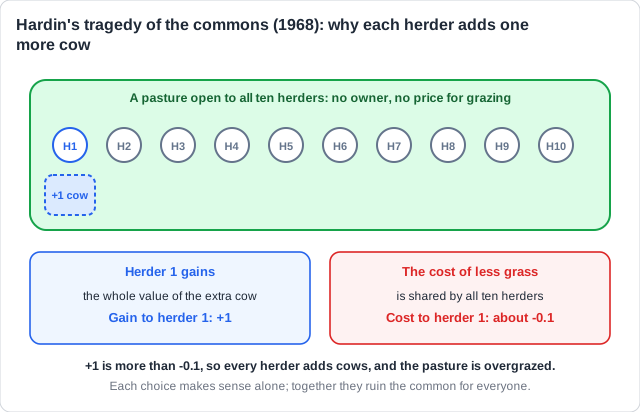
Everyone's, so no one's: The tragedy of the commons highlights the problem where property rights are not clearly delineated and no market price is attached to a common good. The result is overexploitation: each user takes more, despite the harm to others.
The points to remember
- Hardin (1968): herders share a pasture that is open to all.
- Property rights are not clearly set: no one owns the common good.
- No market price is attached to using it: grazing is free.
- Each user gains the whole benefit of taking more; the cost is shared by all.
- So each user takes more, and the resource is overexploited, harming everyone.
Remember it as: My gain is mine; the loss is shared. So I take more, and so do you.
Feeling unprepared for exams?
Get a clear study plan, practice with real questions, and know exactly where you stand before exam day. No more guessing.
The tragedy is a limitation of free market economics: markets protect what is owned and priced, and a common is neither.
Why the free market fails the commons
- A free market protects what someone owns and can sell; a common has no owner.
- With no price, the common is used as if it were free and endless.
- What one user leaves, another takes, so restraint does not pay.
- Short-term gain wins over the long-term health of the resource.
- So the commons shows a limitation of free market economics for environmental issues.
Open sea
- From the 1950s factory trawlers from many countries fished the Grand Banks, which no one owned.
Race to fish
- Any cod one fleet left would be caught by another, so each took all it could; catches peaked at about 800,000 tonnes in 1968.
Too little, too late
- In 1977 Canada took control of fishing up to 200 miles from its coast, but catch limits stayed too high.
Collapse
- In 1992 Canada declared a moratorium on cod fishing; about 30,000 people lost their jobs, and the stock is still far below its old size.
The tragedy strikes a common-access resource. It is not the same as a public good.
Commons and public goods
- Common-access resource: no one can be kept out, but use leaves less for others (rivalrous).
- Examples: ocean fish, groundwater, grazing land, the atmosphere as a dump for gases.
- Public good: no one kept out, and one person's use leaves as much for others.
- Common-access resources suffer the tragedy of the commons; public goods suffer free riders.
- Other commons: plastic in the Great Pacific Garbage Patch; carbon dioxide in the air.
Common-access resource
- No one can be kept out
- Use leaves less for others (rivalrous)
- e.g. ocean fish, groundwater
- Problem: overexploitation
Public good
- No one can be kept out
- Use leaves as much for others (non-rivalrous)
- e.g. the ozone layer, a lighthouse's light
- Problem: free riders, too little paid
Memorize terms 3x faster
Smart flashcards show you cards right before you forget them. Perfect for definitions and key concepts.
The dilemma can be got round. There are three main ways, each with limits.
Ways out of the tragedy
- Property rights: give users a share they own, e.g. tradeable quotas.
- Owners gain from a healthy stock, so they protect it for the future.
- Government rules: total catch limits, seasons, moratoria, protected areas.
- Rules only work if they are enforced and set at a safe level.
- Community management: users agree and police their own rules (Ostrom).
Real example: since 1986 New Zealand has given each fishing company a tradeable quota of the total catch for each species. Because a share is worth more when the stock is healthy, owners have a reason to keep catches safe. Critics say the shares have ended up with a few large companies.
Rules need enforcing: On the Grand Banks, catch limits existed after 1977, but they were set too high and fleets outside Canada's 200-mile zone kept fishing. A rule that is not safe or not enforced does not end the tragedy.
Hardin thought only private ownership or government control could save a common. Elinor Ostrom showed a third way. Her best-known case is a village alp.
Ostrom's commons
- Elinor Ostrom won the Nobel Prize in economics in 2009, the first woman to do so.
- She showed that communities can manage commons without private owners or the state.
- Torbel, Switzerland: villagers share their alpine pasture under rules going back to 1517.
- The 1517 rule: no one may send more cows to the pasture than they can feed through the winter.
- Her design rules: clear boundaries, users make the rules, users monitor, fair sanctions, local conflict resolution.
The common
- The village's high summer pastures are owned and used together, not by any one family.
The rule
- Since 1517: no one may send more cows to the alp than they can feed on their own hay through the winter.
Watching
- Villagers themselves count the cows and check the rule is kept.
Penalties
- Those who break the rules face sanctions, starting small.
The result
- The pastures have been grazed sustainably for about 500 years.
Know your predicted grade
Take timed mock exams and get detailed feedback on every answer. See exactly where you're losing marks.
How it is asked: The specimen Paper 2 asked how plastic in the Great Pacific Garbage Patch demonstrates the tragedy of the commons [4], with at most [2] if the example was not used. May 2026 Paper 2 named the tragedy of the commons and Ostrom in an economics-lens essay [9].
Off Newfoundland, Canada, fleets from many countries fished the Grand Banks for cod. Catches peaked at about 800,000 tonnes in 1968, and in 1992 the cod fishery collapsed and was closed.
Explain how the collapse of the Grand Banks cod demonstrates the concept of the tragedy of the commons.
Model answer plan
See the mark-by-mark plan — for / against / judgement, with marking guidance — in study mode.