Environmental economics at Higher Level: This Higher Level statement defines environmental economics and sets two perspectives against each other: technocentrics, who think it works within today's economy, and ecocentrics, who prefer ecological economics.
Practise this as you read
- Define environmental economics.
- Outline the technocentric and ecocentric views of it.
- Evaluate how far it can solve environmental problems.
Free preview
This is the free notes preview
You're reading the free notes. Aimnova Pro unlocks the full study experience — and you can try it with your first topic free to keep:
- FlashcardsLock in vocabulary and key terms with spaced repetition.
- Practice questionsAnswer exam-style questions and get instant AI marking.
- Mock exams & past-paper vaultSit full mocks and see exactly how examiners award marks.
- Personalised study planA daily plan built around your exam date and weak areas.
Economics, pointed at the environment: Environmental economics is economics applied to the environment and environmental issues. It puts money values on pollution and on nature, and uses prices to change what people and firms do.
The points to remember
- Environmental economics is economics applied to the environment and environmental issues.
- It asks what pollution costs society and what nature is worth in money.
- It designs policies that change behaviour through prices: taxes, permits, fines, subsidies.
- It weighs costs against benefits, to find the cheapest way to cut harm.
Remember it as: Count the cost, price the harm, change the choice.
Real example: the American economist William Nordhaus won the Nobel Prize in economics in 2018 for building climate change into models of the economy. His models compare the cost of cutting emissions with the cost of the damage they cause, and he argued for a carbon tax that rises over time.
Feeling unprepared for exams?
Get a clear study plan, practice with real questions, and know exactly where you stand before exam day. No more guessing.
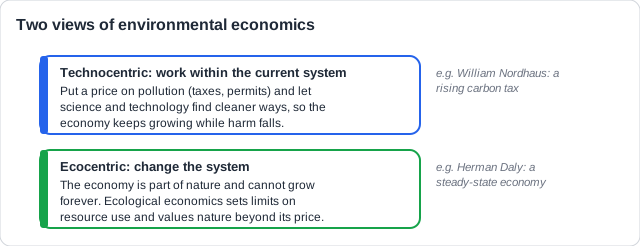
People hold different perspectives on how far environmental economics can go. A technocentric perspective sees it working inside the current economic framework.
The technocentric view
- Technocentrics trust science and technology to solve environmental problems.
- So environmental economics can work within the current economic framework: markets and growth.
- Fix the prices: make polluting cost more, so firms invest in cleaner technology.
- Growth can continue while harm falls: green growth.
Real example: the European Green Deal (December 2019) aims for net zero greenhouse gas emissions in the EU by 2050 while the economy keeps growing, with growth 'decoupled' from resource use. It relies on carbon pricing and on investment in new technology: a technocentric plan.
An ecocentric perspective tends to value the newer, more innovative approach of ecological economics.
The ecocentric view
- Ecocentrics doubt that technology and prices are enough.
- They value the more innovative approach of ecological economics.
- It sees the economy as part of nature, so it cannot grow forever on a finite planet.
- It sets limits on resource use and values nature beyond its money price.
Environmental economics
- Works within today's markets
- Growth can continue
- Prices and technology fix the harm
- Nature valued by what people will pay
Ecological economics
- Changes the system itself
- Growth must slow or stop in rich countries
- Limits on how much is used
- Nature valued beyond its price
Real example: the economist Herman Daly (1938-2022), who worked at the World Bank, argued that the economy cannot grow forever inside a finite biosphere and proposed a steady-state economy. Kate Raworth's Doughnut Economics (2017) builds on the same idea.
Memorize terms 3x faster
Smart flashcards show you cards right before you forget them. Perfect for definitions and key concepts.
For an essay, weigh what environmental economics does well against what it cannot do.
Strengths and limits
- Strength: it puts the environment into money terms that governments and firms act on.
- Strength: price tools let each firm cut pollution in its own cheapest way.
- Limit: much of nature is hard to price (a species, a view, a culture's sacred site).
- Limit: some losses cannot be undone: extinction has no price that buys it back.
- Limit: it trusts that growth and technology can go on; ecocentrics disagree.
Real example: in 1997 a team led by Robert Costanza estimated that the world's ecosystem services were worth about US$33 trillion a year, more than the world's whole GDP at the time, about US$18 trillion. The number made headlines, but critics said that pricing nature at all treats it as something that can be bought.
How it could be asked: No paper has asked this statement on its own yet. It feeds the economics-lens essays (May 2026 Paper 2: how far can economic strategies and models make communities more sustainable [9]). Likely shapes: Section B (a) outline [4], a Paper 1 part on a fact file [1-2], an essay [9].
Many governments say they can protect the environment and keep their economies growing at the same time, for example by taxing pollution and investing in new technology.
Outline how technocentric and ecocentric perspectives differ in their view of environmental economics.
Model answer plan
See the mark-by-mark plan — for / against / judgement, with marking guidance — in study mode.