What economics studies at Higher Level: This statement opens the economics lens, which is Higher Level only. It says what economics studies and how supply and demand work, so that you can explain environmental change through money: profit, prices and costs.
Practise this as you read
- Define what economics studies, individually and collectively.
- Explain how supply and demand set a price.
- Suggest, through the lens of economics, how a change in profit or labour could change biodiversity.
Free preview
This is the free notes preview
You're reading the free notes. Aimnova Pro unlocks the full study experience — and you can try it with your first topic free to keep:
- FlashcardsLock in vocabulary and key terms with spaced repetition.
- Practice questionsAnswer exam-style questions and get instant AI marking.
- Mock exams & past-paper vaultSit full mocks and see exactly how examiners award marks.
- Personalised study planA daily plan built around your exam date and weak areas.
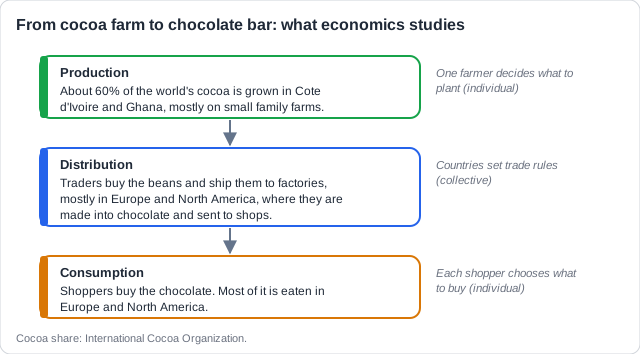
Who makes what, who gets it, who uses it: Economics studies how people produce, distribute and consume goods and services, both individually and collectively. Because resources are scarce, every choice to use them one way means not using them another way.
The points to remember
- Economics studies how people produce, distribute and consume goods and services.
- Goods are things (cocoa, phones); services are work done for people (transport, teaching).
- Individually: one farmer, one firm or one shopper makes a choice.
- Collectively: a community, a government or the whole world economy makes choices together.
- Resources are scarce, so every choice has a cost: land used for one thing cannot be used for another.
Remember it as: Make it, move it, use it: one person at a time and all of us together.
Practice with exam-style questions
Answer exam-style questions and get AI feedback that shows you exactly what examiners want to see in a full-marks response.
Economics focuses on the supply and demand of resources. In a market, buyers and sellers meet, and the outcome of their meeting is a price.
Supply and demand
- Demand: how much buyers want and can pay for. Supply: how much sellers offer.
- A market is where buyers and sellers meet; their meeting sets the price.
- Demand higher than supply: the price rises. Supply higher than demand: the price falls.
- A higher price is a signal: producers make more, buyers buy less.
- The outcome of market interaction is the price, and how much is made and sold.
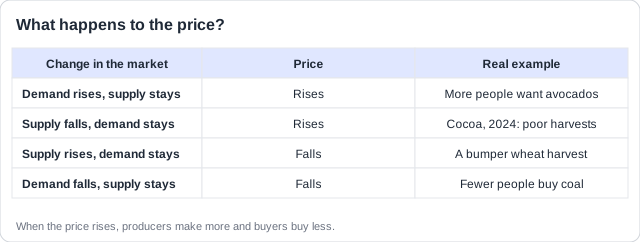
Real example: in 2023 and 2024 dry weather and plant disease cut the cocoa harvest in Cote d'Ivoire and Ghana, while people kept buying chocolate. Supply fell below demand, so the world price of cocoa rose to a record of more than US$12,000 a tonne in December 2024, several times its 2022 level.
Prices decide how land is used: In ESS, the economics lens asks how money shapes what happens to nature. Farmers, firms and countries use land and resources in the way that pays, so profit, prices and costs decide whether a forest is cleared, a field is farmed or a meadow is left.
The economics lens in three questions
- Producers ask: does it pay? Profit = money from sales minus costs.
- High prices or low costs make a use of land profitable, so more land is used that way.
- Low prices or high costs make a use unprofitable, so land is abandoned or changed.
- Costs include labour (wages), machines, fuel and land.
- Either way, the market decides how land and resources are used, and so what happens to nature.
When it pays: land is cleared
- Cote d'Ivoire: cocoa paid well, so farmers cleared forest for new farms
- The country has lost most of its forest since the 1960s, much of it to cocoa
- High prices in 2024 were another reason to plant more
When it does not pay: land is abandoned
- Japan's satoyama: small paddies and woods earn little
- Since the 1960s many have been left as young people moved to cities
- Without farming, the open habitats grow over
Feeling unprepared for exams?
Get a clear study plan, practice with real questions, and know exactly where you stand before exam day. No more guessing.
The papers ask you to follow a chain from an economic cause to an effect on nature. Japan's satoyama shows the chain, from low profit through secondary succession to lost species.
From low profit to lost species
- Small, steep fields give low yields and are hard to farm with machines: low profit.
- Cheaper food from intensive farms wins in the market, so small farms cannot compete.
- Young people leave for better-paid jobs in cities, so labour becomes scarce and costly.
- Farms go out of business and are abandoned: no more grazing, mowing or cutting.
- Secondary succession: shrubs, then trees, take over the open meadows and fields.
- The open habitats are lost, so biodiversity falls (fewer grassland plants and insects).
Low profit
- Tiny terraced paddies cannot be farmed with big machines, so rice costs more to grow there than on large, flat farms or abroad.
People leave
- Since the 1960s young people have moved to cities for better-paid jobs; the farmers left are old and labour is scarce.
Abandoned
- Paddies are no longer flooded and woods are no longer cut in turns for firewood.
Succession
- Bamboo, shrubs and dense trees spread over the old fields and banks.
Species lost
- Paddy and grassland species decline: the medaka, a small rice fish, has been on Japan's Red List since 1999.
Keep the money in the chain: An answer that only describes succession and lost species misses the lens. Name the economic link: low profit, prices that cannot compete with intensive farming, or the cost of labour when workers leave. Without it, a 6-mark answer is capped at 4.
How it is asked: May 2026 Paper 1 asked how rural depopulation in a French natural park could lead to a loss of biodiversity, through the lens of economics [6]. Marks come from a chain of linked points; without the profit or labour-cost link the answer is capped at [4].
In the hills of southern Transylvania, Romania, small farms mow their hay meadows by hand. These meadows are some of the most species-rich grasslands in Europe. Since Romania joined the European Union in 2007, many young people have left the villages to work in western Europe.
Through the lens of economics, suggest how the loss of young people from these villages could lead to a loss of biodiversity in the hay meadows.
Model answer plan
See the mark-by-mark plan — for / against / judgement, with marking guidance — in study mode.