The slow-growth model at Higher Level: This page looks at the environment through the lens of economics. It explains the slow, no or zero growth model, how it was tested for Canada, what Japan shows, and why it is hard to put into practice.
Practise this as you read
- Describe the slow-growth model and what it measures instead of GDP.
- Explain the two difficulties: embedded systems and measuring wellbeing.
- Discuss a slow-growth model as a goal for a named country.
Free preview
This is the free notes preview
You're reading the free notes. Aimnova Pro unlocks the full study experience — and you can try it with your first topic free to keep:
- FlashcardsLock in vocabulary and key terms with spaced repetition.
- Practice questionsAnswer exam-style questions and get instant AI marking.
- Mock exams & past-paper vaultSit full mocks and see exactly how examiners award marks.
- Personalised study planA daily plan built around your exam date and weak areas.
A different goal for the economy: The slow-growth model aims for a steady-state economy. It judges success by prosperity and nature's limits, not by how fast GDP grows.
The slow, no or zero growth model
- Ecological economists support a slow, no or zero growth model for rich economies.
- The aim: a steady state, using no more than nature can renew and absorb.
- Success is judged by wellbeing and by footprint within biocapacity, not by GDP.
- Prosperity means living well, not owning more.
Real example: in 'Prosperity without Growth' (2009), the British economist Tim Jackson argued that rich countries can live well without growing, if prosperity means being able to flourish within ecological limits.
Get feedback like a real examiner
Submit your answers and get instant feedback — what you did well, what's missing, and exactly what to write to score full marks.
Can a rich country stop growing without a crash? The economist Peter Victor tested this for Canada with a computer model called LowGrow.
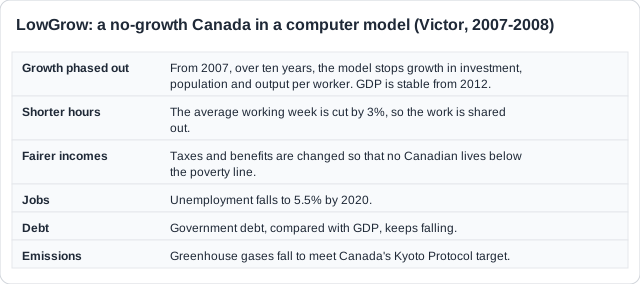
What the LowGrow model showed
- The model phased out growth over ten years; GDP stayed stable from 2012.
- The working week was cut, so the work was shared and jobs kept.
- Taxes and benefits ended poverty.
- Unemployment fell, government debt fell and greenhouse gases met the target.
- It shows slow growth is possible on paper: 'slower by design, not disaster'.
It is a model: LowGrow shows what could happen if every policy worked as planned. Real people, firms and other countries may not act as the equations assume.
Japan is the nearest real case of a rich country living with very slow growth for decades, though it did not choose it.
Real life: Japan's long low growth
- Growth averaged only about 1% a year from 1991 to 2002, and stayed low after.
- Unemployment peaked at just 5.5% in 2002; life expectancy is among the world's highest.
- So a rich society can stay stable and healthy with little growth.
- But it was unplanned, and public debt grew to more than twice the size of the economy.
- Lesson: slow growth works better by design than by accident.
What went well
- Low unemployment
- Long, healthy lives
- Safe, stable society
What went badly
- Very high public debt
- Strain on pensions as people age
- Unplanned, not chosen
Learn what examiners really want
See exactly what to write to score full marks. Our AI shows you model answers and the key phrases examiners look for.
The first difficulty: modern economies are built on growth. Jobs, public debt and pensions all assume it, so they are hard to take apart.
Difficulty 1: systems built on growth
- Jobs: machines make each worker more productive, so without growth fewer workers are needed.
- Debt: governments and firms borrow and repay with interest from future growth.
- Pensions and public services are paid from taxes that rise with growth.
- Business: firms compete to grow; shareholders expect rising profits.
- Politics: governments are judged by GDP; few voters choose less.
Remember it as: Jobs, debts, pensions, profits, politics: all expect growth.
How LowGrow answers it: a shorter working week shares out the work, and fairer taxes and benefits replace growth as the way to end poverty.
The second difficulty: if not GDP, what do we measure? Ecological economists ask whether a country's footprint is balanced by its biocapacity, or whether it runs an ecological deficit.
Difficulty 2: measuring wellbeing
- GDP is one number, easy to count and compare.
- Wellbeing (health, happiness, community) is partly subjective: hard to measure objectively.
- People value different things, so it is hard to agree what counts.
- Footprint v biocapacity gives a clear environmental test: deficit or reserve.
- Other tools: the Genuine Progress Indicator, Bhutan's Gross National Happiness, New Zealand's Wellbeing Budget (2019).
Measures beyond GDP: The Genuine Progress Indicator adds what GDP leaves out. Bhutan guides its development by Gross National Happiness, and New Zealand judged its 2019 budget by wellbeing as well as GDP.
Never wonder what to study next
Get a personalized daily plan based on your exam date, progress, and weak areas. We'll tell you exactly what to review each day.
How it could come up: The specimen HL Paper 1 asked students to discuss using a happiness index in place of GDP [6]: points for [4 max], points against [4 max], and a conclusion [1]. Expect the same shape on a slow-growth model.
Japan's economy has grown very slowly since the early 1990s.
Discuss the use of a slow-growth model, in place of GDP growth, as a goal for a high-income country such as Japan.
Model answer plan
See the mark-by-mark plan — for / against / judgement, with marking guidance — in study mode.