Degrowth, zero growth and slow growth at Higher Level: This page looks at the environment through the lens of economics. It explains why ecological economists want high-income countries to plan to produce and consume less, with France's laws against throwaway goods as the main example.
Practise this as you read
- Distinguish between degrowth, zero growth and slow growth.
- Explain why the goal is a footprint within biocapacity.
- Discuss a planned reduction in consumption in high-income countries.
Free preview
This is the free notes preview
You're reading the free notes. Aimnova Pro unlocks the full study experience — and you can try it with your first topic free to keep:
- FlashcardsLock in vocabulary and key terms with spaced repetition.
- Practice questionsAnswer exam-style questions and get instant AI marking.
- Mock exams & past-paper vaultSit full mocks and see exactly how examiners award marks.
- Personalised study planA daily plan built around your exam date and weak areas.
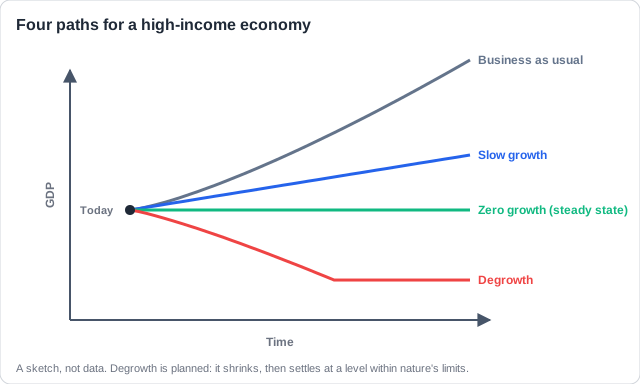
Three ways to stop growing too much: ecological economics says an economy cannot grow for ever on a finite planet. It supports degrowth, zero growth or slow growth.
Degrowth, zero growth, slow growth
- Ecological economics sees the economy as a subsystem of the biosphere: it cannot grow for ever.
- Degrowth: a planned reduction in production and consumption.
- Zero growth: the economy stops growing and stays the same size (a steady state).
- Slow growth: the economy still grows, but slowly.
- All three aim at the same goal: an economy that fits within nature's limits.
Real example: the economist Herman Daly described a steady-state economy in 1977: the same number of people and the same stock of goods, with materials and energy used no faster than nature can renew them.
Know your predicted grade
Take timed mock exams and get detailed feedback on every answer. See exactly where you're losing marks.
The goal is to balance a country's ecological footprint with its biocapacity. Today the world takes far more than nature can renew.
The goal: footprint within biocapacity
- The goal of ecological economics: ecological footprint = biocapacity.
- When footprint is larger than biocapacity, natural capital is used up: unsustainable.
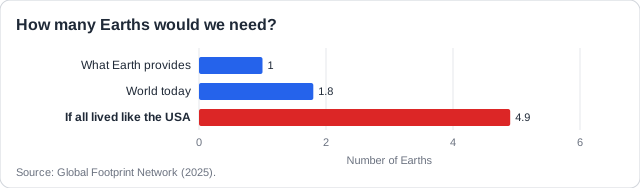
- Humanity uses about 1.8 Earths; Earth Overshoot Day 2025 was 24 July.
- Growth that raises the footprint makes the overshoot worse.
- So the economy must stop growing in what it takes from nature, or shrink.
Remember it as: Take no more than nature can give back.
Ecological economists ask for cuts particularly in high-income countries. The reason is who uses most.
Why high-income countries first
- High-income countries have the biggest footprints: the USA's way of life would need about 5 Earths.
- The richest 10% of people cause about half of consumption emissions.
- Low-income countries still need growth to meet basic needs: food, water, homes, health.
- So cuts should come first and most in rich countries, leaving room for poorer ones to grow.
- This is also a question of fairness (environmental justice).
High-income countries
- Footprint far above biocapacity
- Basic needs already met
- Plan to consume and produce less
Low-income countries
- Footprint often within biocapacity
- Basic needs not yet met
- Still need growth for food, homes, health
Get feedback like a real examiner
Submit your answers and get instant feedback — what you did well, what's missing, and exactly what to write to score full marks.
In his book 'Less is More' (2020), the economist Jason Hickel set out how a planned reduction could work in rich countries.
What a planned reduction looks like
- Cut less-needed production first: SUVs, fast fashion, private jets, constant new gadgets.
- End planned obsolescence: goods built to last and be repaired.
- Shorter working week: the same work shared, so fewer jobs are lost.
- Public services for all (transport, health, housing), so people need less income to live well.
- It is planned and fair, not a sudden crash.
2015
- Planned obsolescence became an offence.
2021
- Phones, laptops and televisions must show a repair score out of 10 when sold.
2022
- Brands may no longer destroy unsold clothes and goods; a bonus cuts repair prices.
Result
- Goods last longer, so fewer are made and bought: less material and energy used.
Critics say less production would hurt jobs and incomes. Supporters answer that degrowth is planned and shared, unlike a recession.
The arguments against, and the reply
- Less production can mean lost jobs and lower tax income for schools and hospitals.
- Debts and pensions are planned on the hope of growth.
- It is politically hard: few voters choose to consume less.
- Technocentrics say decoupling and new technology make it unnecessary.
- Supporters reply: a planned reduction is not a recession.
Unplanned falls: 2009 and 2020: World emissions fell after the 2008 financial crisis and by about 5-7% in the 2020 pandemic. But millions lost their jobs, and emissions rose again as soon as growth came back. A crash is not degrowth.
Learn what examiners really want
See exactly what to write to score full marks. Our AI shows you model answers and the key phrases examiners look for.
How it could come up: No paper has asked this statement on its own yet; May 2026 HL Paper 2 named zero growth in a [9] on economic models. Expect Section B (a) outline [4], an essay [9] on growth, or a Paper 1 'through the lens of economics' [6].
In his book 'Less is More' (2020), Jason Hickel argues that rich countries should plan to produce and consume less.
Outline four features of degrowth as proposed by ecological economists.
Model answer plan
See the mark-by-mark plan — for / against / judgement, with marking guidance — in study mode.