Circular and doughnut economics at Higher Level: This page looks at the environment through the lens of economics. It treats the circular economy and doughnut economics as applications of ecological economics: product stewardship, how the doughnut is measured for countries, and how well both work.
Practise this as you read
- Outline product stewardship and who shares the responsibility.
- Describe what measuring the doughnut for countries has shown.
- Evaluate how far these models make communities more sustainable.
Free preview
This is the free notes preview
You're reading the free notes. Aimnova Pro unlocks the full study experience — and you can try it with your first topic free to keep:
- FlashcardsLock in vocabulary and key terms with spaced repetition.
- Practice questionsAnswer exam-style questions and get instant AI marking.
- Mock exams & past-paper vaultSit full mocks and see exactly how examiners award marks.
- Personalised study planA daily plan built around your exam date and weak areas.
Two models of ecological economics: The circular economy and doughnut economics both put ecological economics into practice: the economy must serve people without breaking nature's limits.
Why these are ecological economics
- Ecological economics: the economy sits inside the biosphere and must respect its limits.
- The circular economy applies this to materials: nothing wasted, everything kept in use.
- Doughnut economics applies it to the whole economy: needs met, limits respected.
- Both judge success by people and planet, not by GDP growth.
- Their effectiveness varies: it depends on laws, prices and who takes part.
Circular economy
- Focus: materials and products
- Goal: no waste, nature regenerated
- Promoted by the Ellen MacArthur Foundation
Doughnut economics
- Focus: the whole economy
- Goal: needs met within planetary limits
- Kate Raworth, 2012 and 2017
Know your predicted grade
Take timed mock exams and get detailed feedback on every answer. See exactly where you're losing marks.
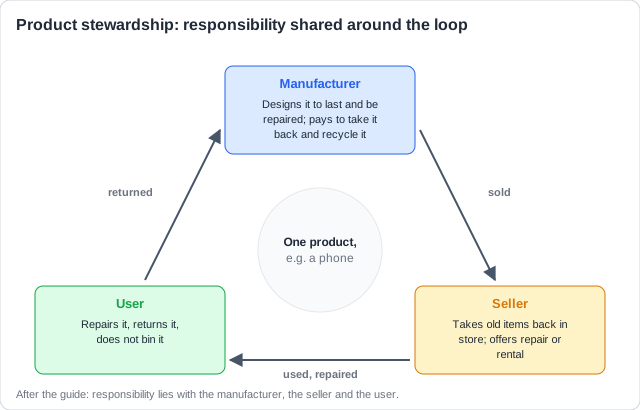
The guide links the circular economy to product stewardship. Responsibility does not end when a product is sold.
Product stewardship
- Product stewardship: responsibility for a product's whole life is shared.
- Manufacturer: designs it to last and be repaired; pays to take it back.
- Seller: takes old items back; offers repair, rental or refills.
- User: repairs, returns and recycles it instead of binning it.
- Economic tools make it happen: take-back laws, deposits, renting instead of selling.
EU law on electrical waste
Under the EU's WEEE rules, a form of extended producer responsibility, makers of electrical goods pay to collect and recycle them, and shops must take old items back.
Philips at Schiphol Airport
Since 2015 the airport pays for light, not lamps. Philips keeps ownership of the fittings, so it designs them to last and takes them back to reuse.
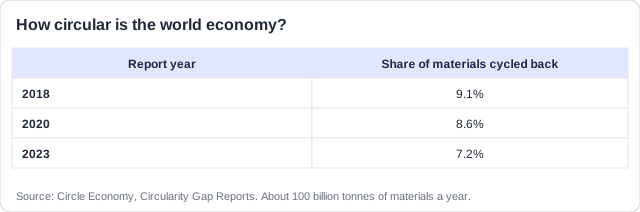
How well does it work? Each year the report 'Circularity Gap' measures the share of cycled materials in the world economy.
How effective is the circular economy?
- Only about 7% of materials in the world economy are cycled back; the share is falling.
- Extraction keeps rising, so recycling cannot keep up with growth.
- Much 'recycling' is downcycling into lower-value products, or is exported.
- Works best with laws (take-back, design rules) and prices that reward reuse.
- Risk of greenwashing: a 'circular' label with little real change.
Remember it as: Loops need laws and prices, or the line wins.
Get feedback like a real examiner
Submit your answers and get instant feedback — what you did well, what's missing, and exactly what to write to score full marks.
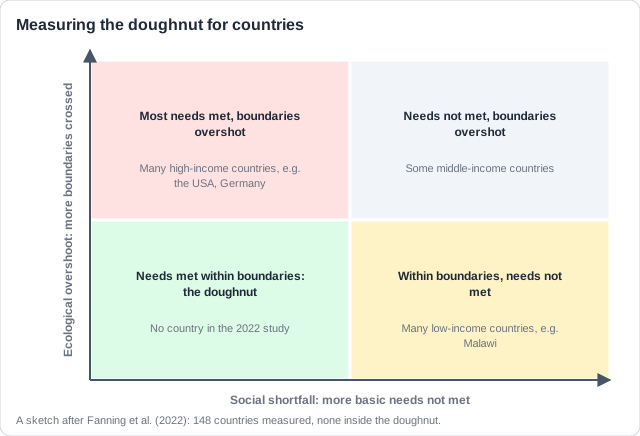
The guide says there are attempts to quantify the doughnut for countries. Each country is scored for social shortfall and ecological overshoot.
Measuring the doughnut for countries
- Raworth's doughnut: 12 social foundations and 9 planetary boundaries.
- Researchers have measured it for about 150 countries (2018, 2022).
- No country met its people's basic needs within a fair share of the planet's limits.
- Rich countries overshoot the ceiling; poorer countries fall short of the foundation.
- Countries crossed boundaries faster than they met social needs.
Those results show why the doughnut is about inequality and injustice, not only the environment.
The doughnut, inequality and injustice
- The doughnut is fundamentally about justice: no one below the social foundation.
- Overshoot is caused mostly by the rich; shortfall is suffered mostly by the poor.
- So the fix is distributive: share resources more fairly, within and between countries.
- It also asks for regenerative design, so the economy restores nature.
- Limits: a vision, not a plan; hard to measure and enforce; voluntary.
A city uses it: Amsterdam, 2020: Amsterdam was the first city to adopt the doughnut to guide its decisions. Its portrait found tenants who could not afford basic needs after rent: a shortfall the city can act on.
The verdict on both models: strong as a compass, weaker as a plan. They work best when turned into laws, prices and targets.
Learn what examiners really want
See exactly what to write to score full marks. Our AI shows you model answers and the key phrases examiners look for.
How it is asked: May 2026 HL Paper 2 asked: to what extent can economic strategies and models be useful in increasing the sustainability of human communities? [9]. Name the models, show what they achieve with real examples, weigh the limits, then judge.
The circular economy and doughnut economics are often described as ways to put ecological economics into practice.
To what extent are these two models effective in achieving sustainability?
Model answer plan
See the mark-by-mark plan — for / against / judgement, with marking guidance — in study mode.
Other strategies to weigh in a [9]: Show breadth with other tools from this lens: polluter pays (Sweden's carbon tax since 1991), decoupling (the UK), payments for forest (Costa Rica since 1997) and Ostrom's shared pastures. Then weigh them against greenwashing and falling circularity.