Decoupling at Higher Level: This page looks at the environment through the lens of economics. It asks whether an economy can keep growing while the damage it does falls, with the United Kingdom as the main example.
Practise this as you read
- Distinguish between relative and absolute decoupling.
- Describe how decoupling might reduce a named environmental problem.
- Evaluate claims that countries have decoupled growth from damage.
Free preview
This is the free notes preview
You're reading the free notes. Aimnova Pro unlocks the full study experience — and you can try it with your first topic free to keep:
- FlashcardsLock in vocabulary and key terms with spaced repetition.
- Practice questionsAnswer exam-style questions and get instant AI marking.
- Mock exams & past-paper vaultSit full mocks and see exactly how examiners award marks.
- Personalised study planA daily plan built around your exam date and weak areas.
Growth without the damage?: eco-economic decoupling is the idea that an economy can keep growing without more environmental degradation.
What decoupling means
- For most of history, a growing economy meant more damage: growth and harm were coupled.
- Eco-economic decoupling = separating economic growth from environmental degradation.
- The aim: GDP keeps rising while pollution and resource use stop rising or fall.
- It is how technocentrics hope to keep growth and protect the planet.
Real example: Sweden brought in a carbon tax in 1991. By 2018 the greenhouse gases released inside Sweden had fallen by 27% since 1990, while its economy kept growing.
Know your predicted grade
Take timed mock exams and get detailed feedback on every answer. See exactly where you're losing marks.
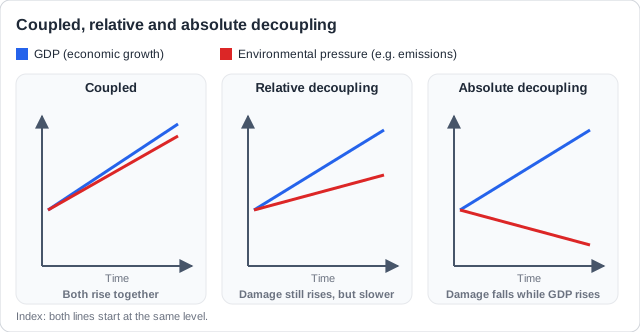
Decoupling comes in two strengths: relative decoupling and absolute decoupling.
Relative and absolute decoupling
- Relative decoupling: damage still rises, but slower than GDP.
- Less damage per unit of GDP, but some degradation still happens.
- Absolute decoupling: damage falls while GDP rises.
- The world today: relative only. Some single countries: absolute for carbon, for now.
- Only absolute decoupling actually cuts the total pressure on the planet.
The world: relative only: Each dollar of world GDP now releases less carbon dioxide than in 1990. But the world economy grew so much that total fossil emissions reached a record, about 37 billion tonnes, in 2024.
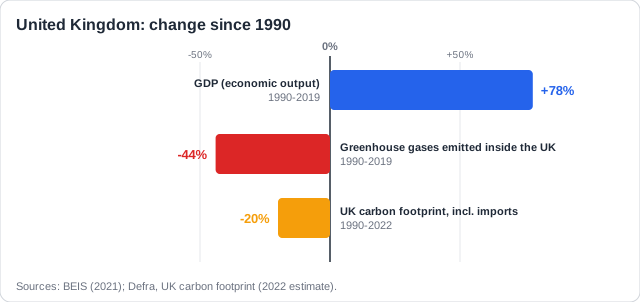
Some rich countries claim absolute decoupling of their territorial emissions. The United Kingdom is the best-known case.
How countries decouple
- Switch energy from coal to renewables (wind, solar) and nuclear.
- Use energy and materials more efficiently.
- Shift the economy from heavy industry to services (banking, software, health).
- Put a price on pollution: carbon taxes and tradeable permits.
- Circular economy: recycle, reuse and design out waste, so fewer new resources are needed.
The UK's coal story: Coal made most of the UK's electricity in 1990. Wind, gas and solar replaced it, and the last coal power station, Ratcliffe-on-Soar, closed on 30 September 2024.
Get feedback like a real examiner
Submit your answers and get instant feedback — what you did well, what's missing, and exactly what to write to score full marks.
Ecological economists question these claims. The UK's carbon footprint fell by only about 20%, less than half the 44% fall in its territorial emissions.
Remember it as: Count the imports, count everything, count the world.
Why the claims are doubted
- Imports: emissions made abroad for a country's goods are left out of territorial figures.
- One measure only: carbon fell, but materials, water and habitats may not.
- Too slow: cuts are far slower than climate targets need.
- Rebound effect: efficiency makes things cheaper, so people use more.
- Globally: total emissions and material use are still rising.
The rebound effect: LED bulbs use far less electricity than old bulbs, so lighting became cheap. People now light more rooms, gardens and screens for longer: a rebound effect.
The deepest question is whether decoupling can last. The world already takes about 100 billion tonnes of materials from nature every year, and the total is still rising.
Can decoupling last for ever?
- Absolute decoupling for ever seems impossible to most ecological economists.
- Endless growth would seem to need endless resources on a finite planet.
- Technocentrics argue technology can keep cutting the damage per unit of GDP.
- So decoupling may slow the damage (relative), but cannot by itself make growth sustainable.
- This doubt is why some economists call for slow growth or degrowth instead.
Technocentric view
- Renewables and efficiency keep improving
- The UK cut emissions while growing
- So green growth is possible
Ecological economist view
- A finite planet cannot supply endless growth
- Cuts are relative or too slow
- So rich countries must also slow growth
Real example: in 2020 the economists Jason Hickel and Giorgos Kallis reviewed the evidence in a paper called 'Is green growth possible?'. They concluded that absolute decoupling of resource use is unlikely, and carbon cuts are unlikely to be fast enough.
Learn what examiners really want
See exactly what to write to score full marks. Our AI shows you model answers and the key phrases examiners look for.
How it is asked: May 2026 HL Paper 2 asked how eco-economic decoupling might help reduce future coral bleaching [2]. One mark for an idea of decoupling, one for a strategy linked to the problem. Decoupling also appears in [9] essays on economic models.
Swiss glaciers lost about a third of their ice volume between 2001 and 2022, mainly because of global warming.
Describe how the concept of eco-economic decoupling might help reduce future loss of glacier ice.
Model answer plan
See the mark-by-mark plan — for / against / judgement, with marking guidance — in study mode.
Strategies to link, by problem: Air pollution: wind and solar power, electric buses. Forest loss: more food from land already cleared, buying only deforestation-free soy and beef. Plastic: deposit-return schemes for bottles, refill packaging.