Legal and economic strategies together at Higher Level: This statement links the environmental law lens to the economics lens, at Higher Level only. It compares laws with economic tools, names each one's challenge, and shows why combining them, as with fines for oil spills, often works best.
Practise this as you read
- Outline the challenges of legal and of economic strategies.
- Suggest, through the lens of law, how combined strategies lead to change.
- Evaluate, to what extent, law against economics.
Free preview
This is the free notes preview
You're reading the free notes. Aimnova Pro unlocks the full study experience — and you can try it with your first topic free to keep:
- FlashcardsLock in vocabulary and key terms with spaced repetition.
- Practice questionsAnswer exam-style questions and get instant AI marking.
- Mock exams & past-paper vaultSit full mocks and see exactly how examiners award marks.
- Personalised study planA daily plan built around your exam date and weak areas.
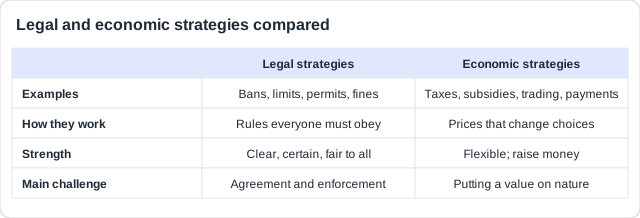
Rules and prices: Two kinds of strategy keep the use of the environment sustainable. Laws set rules that everyone must obey; economic tools change prices so that people choose to do less harm.
The two strategies
- Legal strategies: bans, limits, permits, protected areas, fines.
- Economic strategies: taxes, subsidies, tradable permits, payments for nature.
- Law makes rules everyone must obey; economics changes prices, so choices change.
- They contribute differently: certainty from law, flexibility and money from economics.
- The best results often come from integrating the two.
Remember it as: Law says 'must'; economics says 'it pays'.
Memorize terms 3x faster
Smart flashcards show you cards right before you forget them. Perfect for definitions and key concepts.
Each strategy has a typical weakness. Economics struggles to price ecosystem services; law struggles to win agreement and secure compliance.
The challenges
- Economics: hard to put a value on ecosystem services and their loss.
- Without a price, nature is treated as free, so it is overused.
- Law: hard to get agreement between stakeholders with different interests.
- Law: hard to enforce compliance: monitoring costs money; fines may be too low.
- Together: law sets the rule, economics sets a price that makes obeying it pay.
Valuing nature
- One estimate (2014): ecosystem services worth about US$125 trillion a year
- That is more than world GDP
- Yet most have no market price
Enforcing law
- Inspectors and monitoring cost money
- Fines too low are just a cost of business
- Powerful firms lobby against new laws
The guide's own example is fines for oil spills: a law that works through money.
Oil spills: law and economics together
- Law: the Clean Water Act fines a company for every barrel spilled.
- Law: the Oil Pollution Act (1990) makes polluters pay for clean-up and damages.
- Economics: a large fine makes prevention cheaper than a spill.
- Economics: a tax per barrel of oil pays into a fund for clean-ups.
- Result: double hulls on tankers; safety spending; money to restore coasts.
1989: Exxon Valdez
A tanker ran aground in Alaska, spilling oil along hundreds of kilometres of coast.
1990: Oil Pollution Act
Polluters pay for clean-up and damages; new tankers need a double hull; a tax on each barrel of oil pays into a clean-up fund.
2010: Deepwater Horizon
A BP rig exploded in the Gulf of Mexico; oil flowed for 87 days.
2015-2016: BP pays
About US$20.8 billion, including a US$5.5 billion fine; much of it restores Gulf wetlands and fisheries.
Know your predicted grade
Take timed mock exams and get detailed feedback on every answer. See exactly where you're losing marks.
Costa Rica lost much of its forest to cattle ranching by the 1980s. It then combined a ban with payments for ecosystem services.
Costa Rica's forests: a ban plus payments
- Law (1996): Costa Rica banned clearing natural forest.
- Economics (from 1997): landowners are paid to keep and plant forest.
- Paid for mainly by 3.5% of a tax on fossil fuels: polluters fund the forest.
- Result: forest cover rose from about 21% in the 1980s to close to 60%.
Why both were needed: The ban alone gave landowners no income from standing forest, so some cleared it illegally. The payments made keeping forest pay, so the law was easier to enforce.
The EU Emissions Trading System, started in 2005, is cap and trade: law and market in one scheme.
The EU Emissions Trading System
- Law sets a cap on total emissions from power stations and heavy industry.
- Economics: firms trade allowances, so cuts happen where they are cheapest.
- Law again: a firm short of allowances pays a fine and must still hand them in.
- Result: emissions from the sectors covered are about 50% below 2005.
Strengths
- A legal cap makes the total cut certain
- Trading keeps the cost of cutting low
- Fines make cheating more costly than obeying
Limits
- Too many free allowances at first, so the price crashed
- Firms may move abroad (carbon leakage)
- Covers only some sectors
Get feedback like a real examiner
Submit your answers and get instant feedback — what you did well, what's missing, and exactly what to write to score full marks.
How this could come up: No paper has asked this statement on its own yet. Likely shapes: a Paper 1 lens question, 'Through the lens of environmental law, suggest how ...' [6]; Paper 2 Section B (a), outline the challenges of each strategy [4]; a Section B (c) essay on law versus economics [9].
In 1996 Costa Rica banned the clearing of natural forest, and from 1997 it paid landowners to keep and plant forest, using money from a fuel tax.
Through the lens of environmental law, suggest how combining these strategies could lead to more forest in Costa Rica.
Model answer plan
See the mark-by-mark plan — for / against / judgement, with marking guidance — in study mode.