Institutions that implement agreements at Higher Level: This statement is part of the environmental law lens, studied at Higher Level only. It looks at the organizations that agreements create, such as CITES's secretariat and the IUCN, and how they turn promises into action.
Practise this as you read
- Outline how CITES or the IUCN helps an agreement work.
- Suggest, through the lens of law, how a CITES listing protects a species.
- Evaluate how successful these institutions are.
Free preview
This is the free notes preview
You're reading the free notes. Aimnova Pro unlocks the full study experience — and you can try it with your first topic free to keep:
- FlashcardsLock in vocabulary and key terms with spaced repetition.
- Practice questionsAnswer exam-style questions and get instant AI marking.
- Mock exams & past-paper vaultSit full mocks and see exactly how examiners award marks.
- Personalised study planA daily plan built around your exam date and weak areas.
Agreements need someone to run them: An agreement on paper does nothing by itself. Agreements create institutions, such as a secretariat and a Conference of the Parties, that put them into practice.
What these institutions do
- A secretariat runs the agreement: records, reports, organizes meetings.
- A Conference of the Parties (COP) of all members makes decisions and updates the rules.
- Scientific bodies give the evidence: which species are at risk, how fast the climate changes.
- Funds pay poorer countries to take part.
- They monitor, report, train officials and raise awareness.
Remember it as: Run it, meet, measure, pay, check.
CITES
- Agreement: 1973
- Secretariat in Geneva
- CoP about every 3 years
Montreal Protocol
- Agreement: 1987
- Multilateral Fund, 1991
- Pays poorer countries to switch
UN climate convention
- Agreement: 1992
- COP every year
- IPCC gives the science
Study smarter, not longer
Most students waste 40% of study time on topics they already know. Our AI tracks your progress and optimizes every minute.
CITES, the Convention on International Trade in Endangered Species (1973), has 185 parties and lists more than 40,000 species. Each species sits on an Appendix; trade needs a permit.
CITES: the five-point card
- Aim: stop international trade from pushing species towards extinction.
- Mechanism: species go on Appendices (I = most protected); trade needs permits or is banned.
- Compliance: border checks, seizures and national laws; success depends on each country.
- Evidence: legal trade pressure has dropped for many threatened species; monitoring has improved.
- Limitations: illegal trade is still huge; corruption and high demand undermine the rules.
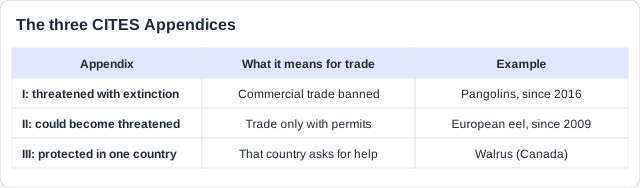
Real example: in 1989 the CITES parties moved African elephants to Appendix I, banning the ivory trade from 1990, and poaching fell. One-off legal sales of stored ivory in 1999 and 2008 were followed by a surge: about 100,000 elephants were killed in 2010-2012.
The International Union for Conservation of Nature (IUCN) is unusual: its members are both governments and NGOs. It does not make laws, but its science shapes them.
The IUCN
- Founded 1948; members are governments and NGOs together.
- Runs the Red List of Threatened Species: the world's measure of extinction risk.
- Red List status guides CITES listings and national laws on protected species.
- A 1963 IUCN resolution led to CITES itself.
- Advises UNESCO on natural World Heritage Sites; sets protected-area categories.
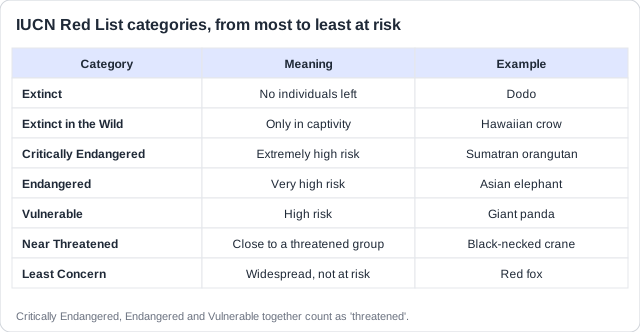
The Red List in numbers: By October 2025 the IUCN had assessed 172,620 species, and 48,646 of them were threatened with extinction. Governments use these assessments to decide which species to protect by law.
Practice with exam-style questions
Answer exam-style questions and get AI feedback that shows you exactly what examiners want to see in a full-marks response.
Other UN bodies support many agreements at once. Know what each one does.
UNEP (1972)
The UN Environment Programme, set up after the 1972 Stockholm conference, based in Nairobi. It hosts the secretariats of several agreements, including CITES, and runs the Environment Fund from voluntary contributions.
IPCC (1988)
The Intergovernmental Panel on Climate Change, set up by the World Meteorological Organization and UNEP. Its reports give the science that the UN climate convention's COPs use to set goals such as 1.5 °C.
Multilateral Fund (1991)
Created under the Montreal Protocol. Developed countries pay into it; it pays developing countries the extra cost of switching away from CFCs, so every country could join.
Global Environment Facility (1991)
A fund that pays for projects under several conventions, including those on biodiversity, climate change and desertification.
Link the body to its agreement: Say which agreement each body serves and what it does for it: the IPCC gives the science for the climate convention; the Multilateral Fund pays for the Montreal Protocol.
These institutions make agreements work better, but they cannot force countries to obey.
How well do they work?
- Strengths: shared science, regular review, money and training, a place to settle disputes.
- No police power: they depend on each country to enforce the rules.
- Funding: they rely on member countries' contributions.
- Loopholes: countries can enter a 'reservation' and opt out of one listing.
- Demand: high prices drive illegal trade and poaching whatever the rules.
Pangolins: what CITES did
- All eight species moved to Appendix I in 2016
- Commercial trade banned from 2017
- China raised their protection and removed scales from its medicine list (2020)
What it could not stop
- Still called the most trafficked wild mammal
- Singapore seized nearly 26 tonnes of scales in April 2019
- Smugglers use countries with weak checks
Feeling unprepared for exams?
Get a clear study plan, practice with real questions, and know exactly where you stand before exam day. No more guessing.
How this could come up: No paper has asked this statement on its own yet. Likely shapes: a Paper 1 lens question, 'Through the lens of environmental law, suggest how ...' [6]; Paper 2 Section B (a), outline how an organization helps an agreement work [4]; a Section B (c) essay on how successful these institutions are [9].
In 1989 African elephants were moved to Appendix I of CITES, banning the international ivory trade from 1990.
Through the lens of environmental law, suggest how this listing could lead to an increase in elephant numbers.
Model answer plan
See the mark-by-mark plan — for / against / judgement, with marking guidance — in study mode.