UN conventions and protocols at Higher Level: This statement is part of the environmental law lens, studied at Higher Level only. It explains how UN conferences turn into conventions and protocols, why they take so long, and how well the Montreal and Kyoto Protocols and the Paris Agreement have worked.
Practise this as you read
- Distinguish between a convention and a protocol.
- Outline reasons for and against countries paying into a UN environmental fund.
- Evaluate, to what extent, how far agreements have protected the atmosphere.
Free preview
This is the free notes preview
You're reading the free notes. Aimnova Pro unlocks the full study experience — and you can try it with your first topic free to keep:
- FlashcardsLock in vocabulary and key terms with spaced repetition.
- Practice questionsAnswer exam-style questions and get instant AI marking.
- Mock exams & past-paper vaultSit full mocks and see exactly how examiners award marks.
- Personalised study planA daily plan built around your exam date and weak areas.
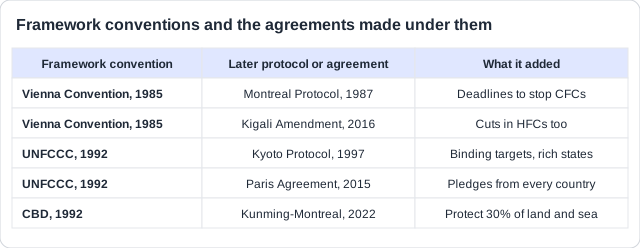
How UN agreements are built: UN conferences produce a convention, legally binding on its parties, and later a protocol with exact targets, which may become binding. Countries sign first, then ratify.
The words to know
- A treaty is a formal, binding agreement between countries under international law.
- A convention is a broad treaty: shared goals, a framework, regular meetings (COPs).
- A protocol is added later, with exact targets; it binds each country that ratifies it.
- Signing agrees the text; ratifying makes it binding; it enters into force after enough ratify.
- A multilateral environmental agreement (MEA) is one between three or more countries.
Why agreements are needed
- Pollution and climate change cross national borders.
- The atmosphere and oceans are global commons: no single country owns them.
- Biodiversity loss is a global crisis needing joint action.
- Developing countries need support to grow sustainably.
Real example: the High Seas Treaty was adopted in 2023 but bound no one until 60 countries had ratified it. The 60th ratification came in September 2025, so it entered into force on 17 January 2026.
Know your predicted grade
Take timed mock exams and get detailed feedback on every answer. See exactly where you're losing marks.
To judge any agreement, use five points. They turn a list of facts into an evaluation.
The five-point card
- Aim: what problem is it trying to solve?
- Mechanism: how does it work?
- Compliance: how is it enforced? Do countries follow the rules?
- Evidence of success: has it made a real difference?
- Limitations: what are its weaknesses?
Remember it as: Aim, mechanism, compliance, evidence, limits.
Montreal Protocol (1987): the ozone layer
Aim: phase out chemicals such as CFCs that destroy the ozone layer, so it can recover.
Mechanism: legally binding schedules to stop making and using them; amendments added more chemicals and faster deadlines (London 1990, Copenhagen 1992); the Kigali Amendment (2016) added HFCs, strong greenhouse gases.
Compliance: trade bans with countries outside the protocol; the Multilateral Fund (from 1991) pays developing countries' extra costs; they got ten extra years.
Evidence: the first UN treaty ratified by every country (2009); about 99% of ozone-depleting chemicals phased out; the ozone layer is slowly recovering, by about 2066 over Antarctica.
Limitations: the chemicals last for decades in the air, so recovery is slow; some illegal production still happens.
Amendments matter: The guide asks about agreements 'with their amendments'. Montreal kept growing stronger: each amendment added chemicals or brought deadlines forward, as the science improved.
The UN Framework Convention on Climate Change (UNFCCC), agreed at the Rio Earth Summit in 1992, set the goal of stopping dangerous climate change. Its first protocol added binding targets.
Kyoto Protocol (1997): binding targets
Aim: cut greenhouse gas emissions with binding targets, mainly for rich countries.
Mechanism: 37 industrialized countries and the EU had to cut emissions by an average of 5% below 1990 levels in 2008-2012; carbon trading and the Clean Development Mechanism helped them meet targets flexibly. The Doha Amendment (2012) added 2013-2020.
Compliance: countries reported their emissions; it came into force only in 2005, after Russia ratified.
Evidence: built carbon markets and improved how countries measure and report emissions; the countries with targets met them as a group.
Limitations: the USA signed but never ratified; Canada left in 2011; China and India had no targets, so world emissions kept rising.
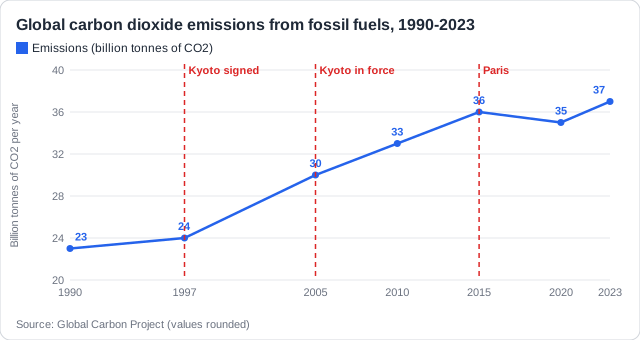
Read the graph fairly: Rising world emissions do not prove Kyoto failed for the countries it covered; they show it did not cover the countries whose emissions grew fastest.
Get feedback like a real examiner
Submit your answers and get instant feedback — what you did well, what's missing, and exactly what to write to score full marks.
Kyoto's lesson was that agreements need everyone. The Paris Agreement, also made under the UNFCCC, swapped binding targets for pledges from every country.
Paris Agreement (2015): every country pledges
Aim: keep global warming well below 2 °C, ideally under 1.5 °C.
Mechanism: every country writes its own pledge, an NDC, and must update it every five years to be more ambitious; a global stocktake checks progress (the first in 2023).
Compliance: no penalties; it relies on transparency, peer pressure and public accountability. Reporting is binding; the targets are not.
Evidence: almost every country has joined; climate reporting and planning are now the norm.
Limitations: current pledges point to about 2.5-2.9 °C of warming; disputes over money and fairness slow it down; the USA left in 2020, rejoined in 2021 and left again from 2026.
Glasgow Climate Pact (2021): strengthening Paris
Pushed countries to strengthen their pledges and act faster.
For the first time named coal ('phase down') and called for an end to inefficient fossil fuel subsidies.
Called for more climate finance and help for the most vulnerable countries.
Useful in essays for the gap between promises and action.
Kyoto (1997)
- Binding targets
- Rich countries only
- Top-down: targets in the treaty
Paris (2015)
- Pledges, not binding targets
- Every country
- Bottom-up: each country chooses
Conventions also protect living things. Biodiversity agreements struggle more than the ozone agreements did.
Ramsar Convention (1971): wetlands
Aim: protect important wetlands and encourage their wise, sustainable use.
Mechanism: countries list their most important wetlands as Ramsar Sites and agree to look after them (more than 2,500 sites).
Compliance: each country enforces it at home; there is no global enforcement body.
Evidence: many key wetlands are now officially recognised and better protected than before.
Limitations: enforcement is weak; protection varies hugely between countries; some listed wetlands are still being damaged.
Convention on Biological Diversity (1992)
Aim: conserve biodiversity, use it sustainably, and share the benefits of genetic resources fairly.
Mechanism: countries write national biodiversity plans with targets and report on progress; the Kunming-Montreal framework (2022) aims to protect 30% of land and sea by 2030.
Compliance: mostly voluntary; countries set their own plans, with no real penalties for failing.
Evidence: biodiversity is taken more seriously in national policies and protected-area planning.
Limitations: global biodiversity is still declining; earlier targets were missed; too little money and monitoring. The USA has never ratified it.
Why biodiversity treaties struggle more than ozone
- Biodiversity loss is spread out and less visible than the ozone hole
- Its causes, such as farming and logging, are deeply built into economies
- Targets are often non-binding and underfunded
- Biodiversity is hard to monitor
Learn what examiners really want
See exactly what to write to score full marks. Our AI shows you model answers and the key phrases examiners look for.
The guide lists why agreements are challenging and slow to develop. Learn the list, then add the weaknesses that remain once they are signed.
Why agreements are slow to make
- Complexity: many countries, many issues, technical detail.
- Evolving science: targets must change as knowledge changes.
- Internal stakeholders: industries and voters push governments (lobbying).
- Differentiated responsibilities: who should cut most, rich or poor countries?
- Finance: how much high-income countries should pay low-income ones.
- Geopolitics and economics: conflicts between countries; fear of lost jobs and growth.
Real example: talks on a global plastics treaty failed to agree in Busan, South Korea (2024), and again in Geneva (August 2025). Oil-producing countries wanted a treaty on waste only; others wanted limits on making new plastic. Plastic is made from oil, so the economic stakes and the lobbying were high.
Weaknesses once agreements exist
- Sovereignty: countries can refuse to sign or can withdraw.
- Enforcement: no global police force to make countries comply.
- Inequity: developing countries can bear costs unfairly.
- Voluntary targets: many agreements have no binding commitments.
- Political will: changes with elections and the economy.
The tragedy of the commons, between countries: The atmosphere is a global commons. Each country gains from polluting, while the damage is shared: a tragedy of the commons. A free rider benefits from others' cuts without contributing, so short-term national interests beat long-term global survival.
Money is often the sticking point. Under common but differentiated responsibilities, rich countries are expected to pay. In 2009 they pledged US$100 billion a year in climate finance by 2020; it was first met in 2022. UNEP's Environment Fund depends on voluntary contributions from UN members, and some pay less than they promised.
For: why countries should contribute
- Ethical duty: richer countries should help those in need.
- Historical responsibility: high emitters caused most of the problem.
- Small islands are hit hardest but have few resources.
- A promise made as a UN member should be kept.
- Climate is a shared problem: helping one helps all; inaction costs more later.
- Giving builds good relations and trade; a donor may need help itself one day.
Real example: the loss and damage fund: Floods in 2022 put a third of Pakistan under water, though Pakistan makes under 1% of world emissions. Countries agreed a loss and damage fund at COP27 (2022); about US$700 million was pledged at COP28, far below the cost of that one disaster.
Against: why countries may not contribute
- No binding legal obligation to pay; sovereignty over a country's own money.
- Today's citizens are not to blame for past emissions.
- Domestic priorities or an economic crisis come first.
- Too many countries in need; the fund may be costly with limited success.
- Poor relations or conflict with the country that would receive the money.
For and against, each side capped: A four-mark 'reasons for and against' question allows at most three points on one side, so give at least one each way.
Never wonder what to study next
Get a personalized daily plan based on your exam date, progress, and weak areas. We'll tell you exactly what to review each day.
Higher-level thinking means comparing agreements and explaining why one worked better.
Why Montreal beat Kyoto
- Clear science and a visible crisis: the ozone hole
- Cheap substitutes for CFCs existed
- Binding phase-out dates and trade sanctions
- Money for developing countries
Paris: broader but weaker
- Almost every country takes part
- Pledges are self-set
- No sanctions for missing them
- Relies on transparency and peer pressure
Lessons
- Few producers make rules easier to check
- Universal take-up matters
- Finance brings poorer countries in
- Amendments let targets follow the science
Compare, then explain why: In evaluate or discuss answers, compare agreements directly and explain WHY one worked better, then finish with a clear judgement.
How this comes up: Paper 2 Section B (c) [9]: 'To what extent have international agreements helped to maintain the steady state of the atmospheric system?' (May 2026). Paper 1 [4]: reasons for and against countries paying into a UN fund.
To what extent have international agreements helped to maintain the steady state of the atmospheric system?
Model answer plan
See the mark-by-mark plan — for / against / judgement, with marking guidance — in study mode.