International courts and tribunals at Higher Level: This statement is part of the environmental law lens, studied at Higher Level only. It shows how international courts have applied environmental law, from a smelter's fumes in 1941 to climate change in 2025, and why compensation for damage is so hard to set.
Practise this as you read
- Outline a case and the principle it set.
- Outline the difficulties of setting compensation for environmental damage.
- Evaluate, to what extent, how far courts can protect the environment.
Free preview
This is the free notes preview
You're reading the free notes. Aimnova Pro unlocks the full study experience — and you can try it with your first topic free to keep:
- FlashcardsLock in vocabulary and key terms with spaced repetition.
- Practice questionsAnswer exam-style questions and get instant AI marking.
- Mock exams & past-paper vaultSit full mocks and see exactly how examiners award marks.
- Personalised study planA daily plan built around your exam date and weak areas.
When countries disagree: International courts and tribunals apply international environmental law to real disputes. They need jurisdiction, and they can also give an advisory opinion.
The courts to know
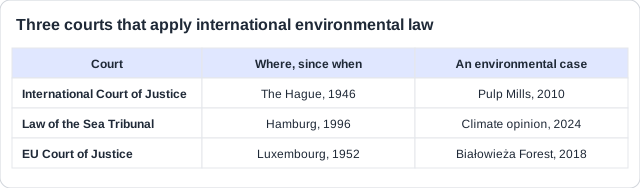
- International Court of Justice (ICJ): the UN's main court; disputes between states.
- ITLOS: the tribunal for the law of the sea (UNCLOS, 1982), in Hamburg.
- EU Court of Justice: makes EU countries obey EU environmental law.
- Courts settle disputes, give advisory opinions, and set principles later cases follow.
- An international court needs the states' consent (jurisdiction).
Remember it as: Hague for states, Hamburg for seas, Luxembourg for the EU.
Never wonder what to study next
Get a personalized daily plan based on your exam date, progress, and weak areas. We'll tell you exactly what to review each day.
Court cases turn general rules into clear principles. Learn one case for each.
Principles set by cases
- No-harm principle: a state must not let its territory harm another's (Trail Smelter, 1941).
- Assess first: an EIA is needed when a project risks harm across a border (Pulp Mills, 2010).
- Sustainable development must guide shared projects (Gabčíkovo-Nagymaros, 1997).
- Treaties are tested: Japan's 'scientific' whaling was not for science (Whaling, 2014).
Trail Smelter (USA v Canada, 1941)
Fumes from a metal smelter at Trail, Canada, damaged farms and forests in Washington State, USA. An arbitration tribunal held Canada responsible: no state may use its territory to cause serious harm to another.
Pulp Mills (Argentina v Uruguay, 2010)
Uruguay allowed a pulp mill on the River Uruguay, a shared river, without telling Argentina properly. The ICJ found Uruguay broke its duty to inform and consult, but pollution was not proved, so the mill stayed open. An environmental impact assessment is required where harm could cross a border.
Whaling in the Antarctic (Australia v Japan, 2014)
The ICJ found Japan's whaling permits were not for scientific research, so Japan had to stop that programme. It later began a new one, and in 2019 left the International Whaling Commission.
Small island states, facing rising seas, asked two courts what the law requires on climate change.
The climate opinions
- ITLOS, 2024: greenhouse gas emissions are pollution of the sea; states must act.
- States need stringent due diligence: every reasonable step to cut emissions.
- ICJ, 2025: states have legal obligations to protect the climate, guided by 1.5 °C.
- Fossil fuel licences or subsidies may be an internationally wrongful act.
- Opinions are not binding, but courts and governments use them.
2019: students in Vanuatu
Law students in Vanuatu began a campaign to take climate change to the ICJ.
2024: ITLOS
Asked by the Commission of Small Island States, the tribunal said emissions pollute the sea and states must use stringent due diligence.
2025: the ICJ
Asked by the UN General Assembly, the 15 judges agreed unanimously that states have legal climate obligations.
Courts for people, too: In 2024 the European Court of Human Rights ruled that Switzerland's weak climate policy broke the rights of a group of older Swiss women (KlimaSeniorinnen), who suffer most in heatwaves.
Stop wasting time on topics you know
Our AI identifies your weak areas and focuses your study time where it matters. No more overstudying easy topics.
The EU Court of Justice can make member states obey EU nature law, and can order fines. Białowieża Forest, on the border of Poland and Belarus, is one of Europe's last ancient lowland forests and a Natura 2000 site.
2016: logging rises
Poland's government tripled logging in part of the forest, saying it was fighting a bark beetle outbreak.
2017: interim orders
The court made an interim order to stop the logging, then warned Poland it could be fined at least €100,000 a day.
2018: judgment
The court ruled that the logging broke EU nature law. Poland stopped the large-scale logging.
Why the EU court is stronger: Unlike the ICJ, the EU court has jurisdiction over every member state automatically and can impose daily fines, so its rulings are harder to ignore.
The guide names one difficulty for these courts: working out fair compensation for damage to the environment.
Why compensation is hard
- Hard to put a price on lost ecosystem services: carbon storage, habitat, flood protection.
- Damage may last decades; recovery times are uncertain.
- Hard to prove which harm the act caused (causation).
- Different valuation methods give very different answers.
- Some losses, such as a species, cannot be repaired with money.
Costa Rica asked for
- About US$2.88 million
- Six ecosystem services, each priced
- Over a 50-year recovery period
The ICJ gave (2018)
- US$120,000 for lost goods and services
- Only four services accepted as proved
- The damage judged as a whole
Real example: Nicaragua dug channels through a protected wetland in Costa Rica in 2010 and 2013, cutting about 300 trees. In 2018 the ICJ made its first ever award for environmental damage: US$378,890 in all, including costs.
See how examiners mark answers
Answer exam-style questions with model answers. Learn exactly what earns marks and what doesn't.
Weigh what courts can and cannot do before you judge them.
Strengths and limits of courts
- Strengths: settle disputes peacefully; set principles; give voice to small states.
- Consent: states can refuse a court's jurisdiction, or leave a treaty.
- Enforcement: no police; states may ignore rulings.
- Slow and costly: cases take years, after the damage is done.
- Small awards: compensation may be far below the real loss.
A ruling is not the end: After the 2014 whaling ruling, Japan started a new programme and later left the treaty. A court can say what the law is; whether a state obeys depends on politics.
How this could come up: No paper has asked this statement on its own yet; May 2026 credited 'International and European Courts of Justice' in an essay on international agreements. Likely shapes: a Paper 1 lens question [6]; Paper 2 Section A, outline two difficulties [2]; a Section B (c) essay [9].
In 2017 and 2018 the EU Court of Justice ruled on Poland's logging in Białowieża Forest, a protected Natura 2000 site.
Through the lens of environmental law, suggest how the court's decisions could lead to the protection of the forest.
Model answer plan
See the mark-by-mark plan — for / against / judgement, with marking guidance — in study mode.