International law and transboundary issues at Higher Level: This statement is part of the environmental law lens, studied at Higher Level only. It asks why problems that cross borders, such as smoke, river pollution and overfishing, need international law, and how well two real agreements work.
Practise this as you read
- State an advantage of an international standard over a national one.
- Outline how an agreement tackles transboundary pollution or a shared resource.
- Suggest, through the lens of law, how a transboundary problem leads to change.
Free preview
This is the free notes preview
You're reading the free notes. Aimnova Pro unlocks the full study experience — and you can try it with your first topic free to keep:
- FlashcardsLock in vocabulary and key terms with spaced repetition.
- Practice questionsAnswer exam-style questions and get instant AI marking.
- Mock exams & past-paper vaultSit full mocks and see exactly how examiners award marks.
- Personalised study planA daily plan built around your exam date and weak areas.
Pollution has no passport: A transboundary issue is pollution or a resource that crosses borders. Because of sovereignty, a country's law stops at its border, so international law gives the framework.
The points to remember
- A transboundary issue crosses borders: pollution carried by air, rivers or seas.
- Or a shared resource: fish stocks, rivers, migrating animals, the high seas.
- One country's law stops at its border (sovereignty), so it cannot fix the whole problem.
- Upstream countries pollute; downstream countries suffer.
- So countries need international law: agreed rules that apply across borders.
Remember it as: One river, many countries, one set of rules.
Spill
- A fire at the Sandoz chemical store near Basel, Switzerland, washed tonnes of pesticides into the Rhine.
Downstream
- Fish died for hundreds of kilometres through Germany, France and the Netherlands.
Law
- The Rhine countries' commission launched the Rhine Action Programme in 1987.
Result
- Cleaner water; salmon have returned to the river.
Study smarter, not longer
Most students waste 40% of study time on topics they already know. Our AI tracks your progress and optimizes every minute.
Why should a standard, such as a safe level of air pollution, be set by an international body and not by each country alone?
Advantages of international standards
- Consistency: the same standard in every country.
- Not swayed by one government's politics, or by local conditions that hide a problem.
- Based on international scientific data, useful where a country lacks its own experts.
- Agreed methods for measuring, so countries' data can be compared.
- A shared rule stops polluters moving to the country with the weakest law.
Real example: the World Health Organization's 2021 air-quality guidelines set a safe yearly level of fine particles (PM2.5) of 5 micrograms per cubic metre. Every country can measure itself against the same number, worked out from studies around the world.
Say what the advantage is: 'It encourages countries to work together' is too vague, and so is 'the WHO knows what is harmful'. Name the advantage: the same standard everywhere, free from one government's politics, based on shared science.
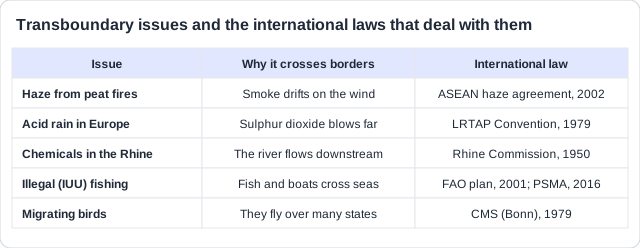
Each dry season, fires clear land for oil palm and paper plantations in Sumatra and Kalimantan, Indonesia. Drained peat smoulders, and the smoke drifts to Malaysia and Singapore.
Transboundary pollution: the ASEAN haze agreement
- Problem: fires clear land for plantations in Indonesia; burning peat sends smoke abroad.
- 2002: ten ASEAN countries signed a legally binding agreement on haze.
- What it does: countries prevent and monitor fires, share warnings, help put fires out.
- Weakness: no fines; it relies on each country acting; Indonesia ratified only in 2014.
- Added law: Singapore's 2014 act fines firms for haze, up to S$100,000 a day.
Strengths
- All ten ASEAN countries are now bound by it
- Shared fire warnings and monitoring
- A forum where neighbours can press the source country
Limits
- No fines or court to enforce it
- Indonesia took 12 years to ratify
- The 2015 haze still caused about 100,000 early deaths (one estimate)
Law at two scales: When the regional agreement was too weak, Singapore added a national law that reaches across the border: firms that cause haze in Singapore can be fined there.
Practice with exam-style questions
Answer exam-style questions and get AI feedback that shows you exactly what examiners want to see in a full-marks response.
Fish do not stop at sea borders. IUU fishing empties shared stocks and harms honest fishers. The FAO, the UN's food and farming body, leads the international response.
Transboundary resources: the FAO plan on IUU fishing
- IUU fishing takes up to 26 million tonnes of fish a year, worth up to US$23 billion.
- Fish stocks swim across sea borders and onto the high seas, where no country rules.
- FAO plan (2001): a voluntary list of what flag, coastal and port countries should do.
- Port State Measures Agreement (in force 2016): binding; ports check boats and refuse illegal fish.
- Closing ports to illegal catches makes IUU fishing pay less.
2001: the FAO plan
A voluntary plan: countries that flag boats, coastal countries and port countries each check fishing and share information.
2009-2016: a binding treaty
The Port State Measures Agreement, adopted in 2009, came into force in 2016. A port state inspects foreign boats and can refuse to let them land illegal fish.
Limits
Boats can use ports in countries that have not joined, and checks cost money that poorer coastal countries often lack.
migratory species cross many borders every year, so no single country can protect them. These are the challenges to explain.
Why migratory species are hard to protect
- Hard to get agreements between countries with different values and priorities.
- Animals may be hunted in transit countries where they are not protected.
- Not all follow the same route, so they end up in many countries.
- Natural risks on the way: storms, predators, lack of shelter or food.
- International law: the Convention on Migratory Species (Bonn, 1979).
Real example: the Amur falcon flies from Siberia and China to southern Africa and back, about 22,000 km a year. In 2012, reports estimated that 120,000 to 140,000 were caught each autumn at a reservoir in Nagaland, India, where they stop on the way. Indian law and the Convention on Migratory Species already protected them; what changed things was local villages agreeing to stop the hunting from 2013.
Two kinds of challenge: Give legal challenges (agreements, transit countries, different values) and natural ones (storms, predators). Both earn credit.
Feeling unprepared for exams?
Get a clear study plan, practice with real questions, and know exactly where you stand before exam day. No more guessing.
How this comes up: Short Paper 1 parts: state an advantage of an international standard [1]; outline the challenges of protecting a migratory species [2]. At HL, a lens question: 'Through the lens of environmental law, suggest how ...' [6], a chain of linked points with the legal step named.
In 1986 a fire at a chemical store near Basel, Switzerland, washed pesticides into the River Rhine, killing fish downstream in Germany, France and the Netherlands.
Through the lens of environmental law, suggest how this spill could lead to cleaner water along the whole river.
Model answer plan
See the mark-by-mark plan — for / against / judgement, with marking guidance — in study mode.