Local, national and international laws at Higher Level: This statement is Higher Level only. Environmental laws are made by councils, by countries and between countries, and the higher law wins. You need a real example at each scale.
Practise this as you read
- State an environmental law at the local, national and international scale.
- Explain how a species' status is recognised at each level.
- Evaluate national laws and international agreements.
Free preview
This is the free notes preview
You're reading the free notes. Aimnova Pro unlocks the full study experience — and you can try it with your first topic free to keep:
- FlashcardsLock in vocabulary and key terms with spaced repetition.
- Practice questionsAnswer exam-style questions and get instant AI marking.
- Mock exams & past-paper vaultSit full mocks and see exactly how examiners award marks.
- Personalised study planA daily plan built around your exam date and weak areas.
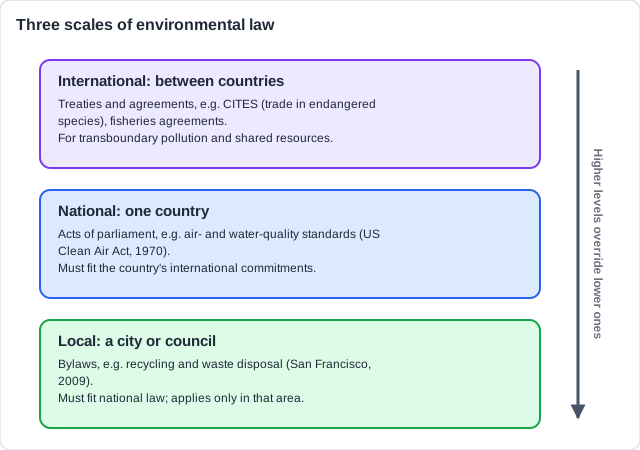
Three scales, one order: Environmental laws can be made at the local, national or international level. Laws made at national or international level supersede local ones.
The points to remember
- Local: a council's bylaws, e.g. on recycling and waste disposal.
- National: a country's Acts, e.g. air- and water-quality standards.
- International: agreements between countries, e.g. on fisheries and trade in endangered species.
- National and international laws supersede local laws: the higher law wins.
- Transboundary issues need international laws or bilateral agreements.
Remember it as: Bins locally, air and water nationally, fish and wildlife internationally.
Memorize terms 3x faster
Smart flashcards show you cards right before you forget them. Perfect for definitions and key concepts.
Local councils make a bylaw for their own area. Waste and recycling are the classic examples.
Local laws
- Councils make bylaws for their own area: rubbish, recycling, litter, noise, parks.
- They are close to the problem, so rules fit local conditions.
- They must fit national law and can be overruled by it.
- They cover only one place: a city cannot control a whole river or the air.
Real example: since 2009 San Francisco's Mandatory Recycling and Composting Ordinance has required every home and business to sort waste into three bins: blue for recycling, green for compost and black for landfill. Firms that do not sort can be fined.
Another city: Taipei: Since 2000 Taipei's households must put rubbish in special bags sold by the city, so the more they throw away, the more they pay. Recycling is collected free.
National laws apply across a whole country. The classic examples set an air- or water-quality standard.
National laws
- A parliament passes Acts that apply across the whole country.
- They set air- and water-quality standards and limits on emissions.
- National agencies issue permits, inspect and fine.
- They put international commitments into practice at home.
- But a country's law stops at its border.
| Landmark national law | What it does |
|---|---|
| Clean Air Act, USA, 1970 | National air quality standards and limits on emissions |
| Clean Water Act, USA, 1972 | Protects the quality of rivers, lakes and coastal water |
| Endangered Species Act, USA, 1973 | Protects threatened species and their habitats |
| Emissions Trading System, EU, 2005 | A cap-and-trade scheme for carbon from industry |
Who enforces it: A national agency, such as the US Environmental Protection Agency, issues permits for polluting activities, checks reports, inspects and fines.
Know your predicted grade
Take timed mock exams and get detailed feedback on every answer. See exactly where you're losing marks.
National laws use two kinds of tool: command and control and the market-based instrument.
Command and control
- Sets fixed limits or standards
- Clear legal penalties
- Predictable: everyone knows the rule
- Example: US Clean Air Act limits
Market-based instruments
- Uses taxes, subsidies or trading
- Encourages innovation
- More economically flexible
- Example: EU Emissions Trading System
- Polluter-pays principle
- those who produce pollution should pay the costs of managing it, so it does not harm health or the environment
- Precautionary principle
- where there is a risk of serious environmental harm, the lack of full scientific certainty should not delay action to protect
Strengths of regulation
- Clear standards that industries must follow
- Legal penalties create accountability
- EIAs stop harmful projects
- Protected areas preserve biodiversity
Limits of regulation
- Can be costly to enforce
- May slow economic development
- Loopholes can be exploited
- Different standards across countries
Some issues cross borders. Fish swim between countries' waters, and wildlife is traded worldwide. For these transboundary issues countries make international laws or a bilateral agreement.
International laws
- Countries agree rules for problems no country can solve alone.
- Fisheries: shared fish stocks get catch limits for all fishing nations.
- Trade in endangered species: CITES controls trade across borders.
- Transboundary pollution: bilateral or regional agreements, e.g. on acid rain.
- A country is bound only if it signs and ratifies; enforcement depends on each country.
Trade in endangered species: CITES
In force since 1975, with 185 parties. It lists over 40,000 species in three appendixes, from a ban on commercial trade to trade with permits.
Fisheries: Atlantic bluefin tuna
In 2007 the international commission for Atlantic tunas (ICCAT) cut quotas and set closed seasons. By 2021 the stock had recovered, and the IUCN moved the species from Endangered to Least Concern.
Pollution: USA and Canada
A 1991 bilateral Air Quality Agreement cut the sulfur dioxide from power stations that drifted across the border and caused acid rain.
Get feedback like a real examiner
Submit your answers and get instant feedback — what you did well, what's missing, and exactly what to write to score full marks.
When a species is listed as threatened on the IUCN Red List, that status is recognised at every level of law, from international to local.
How a listing passes down the levels
- The IUCN Red List sets how endangered a species is.
- International and EU law list it for protection.
- This triggers duties at each lower level.
- National law protects it and sets up a protected area or an action plan.
- Local rules put it into practice on the ground.
International: the loggerhead turtle
Listed as Vulnerable by the IUCN; a priority species under EU law and the Bern Convention.
National: Greece
The National Marine Park of Zakynthos (1999) protects the island's nesting beaches by law. In 2002 the EU Court of Justice ruled that Greece had not protected them well enough.
Local: Laganas Bay
Nesting beaches close from sunset to sunrise; no boats in zone A of the bay and a 6-knot speed limit in zone B; volunteers guard nests.
The higher law wins: The EU ruling shows the order: when Greece's national and local action fell short, EU law, which is above them, required more.
Each scale has strengths and limits. A strong answer weighs them and uses an example at each scale.
| Scale | Strengths | Limits |
|---|---|---|
| Local | Fits local conditions; people feel ownership; quick to make and enforce | Covers one area; can be overruled; cannot tackle transboundary issues |
| National | Binding nationwide; agencies, funding and courts enforce it | Stops at the border; can change with governments; lobbying |
| International | Tackles transboundary issues; the same standard for every country | Binds only countries that ratify; weak enforcement; slow to agree |
Why set safe levels internationally (e.g. the WHO)?
- Consistency: the same safe limit in every country.
- No national political bias: one government cannot bend it to suit its industries.
- International science: set by experts, even for countries with little research of their own.
- Agreed methods: every country measures and reports in the same way.
Be precise: 'It encourages countries to work together' is too vague to score. Say what the international standard does: consistency, no national bias, shared science.
Learn what examiners really want
See exactly what to write to score full marks. Our AI shows you model answers and the key phrases examiners look for.
How this is asked: May 2026 HL Paper 1 asked how a bird's endangered status was recognised at international, national and local levels in a French park [4]. The specimen paper set a Section B essay on national laws and international agreements [9], and an older Paper 1 asked for an advantage of international standards [1].
The loggerhead turtle nests on the beaches of Laganas Bay on Zakynthos, Greece.
Explain how the protection of the loggerhead turtle is recognized at international, national and local levels on Zakynthos.
Model answer plan
See the mark-by-mark plan — for / against / judgement, with marking guidance — in study mode.