Environmental constitutionalism at Higher Level: This statement is Higher Level only. It looks at the highest law of all: what happens when the right to a healthy environment, or even nature's own rights, are written into a constitution. You need a real constitution that worked.
Practise this as you read
- Define environmental constitutionalism.
- Outline a national constitution that helped solve an environmental issue.
- Evaluate how far constitutions protect the environment, including the climate.
Free preview
This is the free notes preview
You're reading the free notes. Aimnova Pro unlocks the full study experience — and you can try it with your first topic free to keep:
- FlashcardsLock in vocabulary and key terms with spaced repetition.
- Practice questionsAnswer exam-style questions and get instant AI marking.
- Mock exams & past-paper vaultSit full mocks and see exactly how examiners award marks.
- Personalised study planA daily plan built around your exam date and weak areas.
Nature in the highest law: Environmental constitutionalism means writing environmental rights and obligations into the constitution.
The points to remember
- Environmental rights go into the constitution: e.g. a right to a healthy environment.
- So do obligations: duties of the state and of citizens to protect nature.
- Some constitutions give nature itself rights.
- The constitution is the highest law: other laws must agree with it.
- It is hard to change, and citizens can go to court to enforce it.
Remember it as: Rights, duties, highest law, take it to court.
Duty
- Every Bhutanese is a trustee of the country's environment.
Rule
- At least 60% of the land must stay under forest for all time.
Highest law
- No ordinary law or project may break this rule.
Result
- Forest covers about 70% of Bhutan today.
See how examiners mark answers
Answer exam-style questions with model answers. Learn exactly what earns marks and what doesn't.
India shows a constitution with duties for both the state and its citizens, and courts that use them.
India: rights and duties
- Article 48A: the state must protect and improve the environment, forests and wildlife.
- Article 51A(g): every citizen has a duty to protect the natural environment.
- Courts read Article 21 (the right to life) as a right to a healthy environment.
- So citizens can take the government to court, and the court can order action.
Real example: Delhi's air was thick with diesel smoke. Using these articles, India's Supreme Court ordered in 1998 that Delhi's buses, taxis and auto-rickshaws switch to CNG; by about 2003 the city had one of the world's largest fleets of gas buses. In 1996 the Court had also ordered polluting factories near the Taj Mahal to switch to gas or move away.
A successful constitution: The guide asks for an example of a constitution that worked. India's Delhi bus ruling is a clear one: a constitutional right, a court order and a measurable change.
Ecuador went further in 2008. Its constitution gives rights to nature, called Pachamama.
Rights of nature: Ecuador
- Ecuador's 2008 constitution says nature has rights: to exist, to keep its cycles, to be restored.
- Anyone can go to court on nature's behalf.
- This is an ecocentric idea, built on indigenous beliefs.
- The state must prevent harm and restore damaged ecosystems.
Vilcabamba River, 2011
A road project dumped rubble into the river. A court in Loja ruled that the river's own rights had been broken and ordered the damage to be repaired.
Los Cedros, 2021
Ecuador's Constitutional Court cancelled mining permits in the Los Cedros cloud forest, because mining would break the forest's rights.
Rights are not the whole story: Ecuador still drills for oil in the Amazon. A right in the constitution helps only when someone takes a case to court and the ruling is carried out.
Study smarter, not longer
Most students waste 40% of study time on topics they already know. Our AI tracks your progress and optimizes every minute.
Environmental constitutionalism is growing around the world, as more and more cases are won on these rights.
A growing trend
- Portugal (1976) was among the first constitutions with a right to a healthy environment.
- Today more than 100 national constitutions include one.
- 2022: the UN General Assembly recognised a right to a clean, healthy and sustainable environment.
- More and more court cases are won on these rights.
- Climate change is now argued in constitutional courts too.
1976: Portugal
One of the first constitutions with a right to a healthy environment.
2008: Ecuador and Bhutan
Rights of nature in Ecuador; a 60% forest rule in Bhutan.
2022: the UN
161 countries voted for a human right to a clean, healthy and sustainable environment; none voted against.
Today: over 100 countries
More than half the world's constitutions include a right to a healthy environment.
Climate change is increasingly argued in constitutional courts. Germany is the clearest success.
Climate change and constitutions
- Young people argue that weak climate action takes away their future rights.
- Courts can rule a climate law unconstitutional and order a stronger one.
- This protects future generations (intergenerational justice).
- Rulings push governments to set earlier and deeper emission cuts.
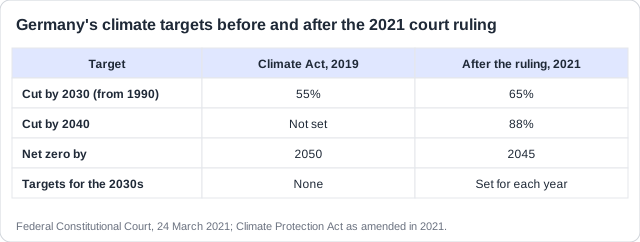
Real example: Germany's Basic Law, Article 20a, says the state must protect the natural foundations of life for future generations. Young people argued that the 2019 Climate Act left most cuts until after 2030. In March 2021 the Constitutional Court agreed that this was partly unconstitutional. Within months the law was rewritten, with net zero brought forward from 2050 to 2045.
Practice with exam-style questions
Answer exam-style questions and get AI feedback that shows you exactly what examiners want to see in a full-marks response.
Environmental constitutionalism can be powerful, but a right on paper is not the same as a healthy environment.
Strengths
- Highest law: ordinary laws and projects must respect it.
- Hard to repeal when governments change.
- Gives citizens a way to sue, and courts power to order action.
- Protects future generations and, in some countries, nature itself.
Limits
- Wording can be vague, so it depends on how judges read it.
- Court cases are slow and costly.
- Governments may ignore or delay rulings.
- It needs independent courts and enforcement to work.
- Rights can clash with others, such as the right to develop and earn a living.
Real example: in Colombia in 2018, 25 young people won a Supreme Court case that declared the Amazon a 'subject of rights' and ordered a plan to stop deforestation. Yet clearing stayed high for years after, and the plans were slow to appear: the ruling was a success in court, but not yet in the forest.
How this could come up: No paper has asked this statement on its own yet, but May 2026 essays on laws listed 'environmental constitutionalism'. Likely shapes: a Paper 1 lens question [6], Paper 2 Section B (a) [4], or a (c) essay on how effective constitutions are [9].
Germany's Basic Law, Article 20a, requires the state to protect the natural foundations of life for future generations. In 2021 young people won a case in Germany's Constitutional Court about the country's Climate Act.
Through the lens of environmental law, suggest how Germany's constitution could lead to faster cuts in greenhouse gas emissions.
Model answer plan
See the mark-by-mark plan — for / against / judgement, with marking guidance — in study mode.