Legal personhood for nature at Higher Level: This statement is part of the environmental law lens, studied at Higher Level only. It looks at laws and court rulings that give rivers, forests and lagoons legal rights, from New Zealand to Spain, and asks whether they really protect nature better.
Practise this as you read
- Outline how legal personhood can strengthen protection, with a named example.
- Suggest, through the lens of law, how personhood leads to change.
- Evaluate how effective legal personhood is.
Free preview
This is the free notes preview
You're reading the free notes. Aimnova Pro unlocks the full study experience — and you can try it with your first topic free to keep:
- FlashcardsLock in vocabulary and key terms with spaced repetition.
- Practice questionsAnswer exam-style questions and get instant AI marking.
- Mock exams & past-paper vaultSit full mocks and see exactly how examiners award marks.
- Personalised study planA daily plan built around your exam date and weak areas.
Can a river have rights?: More and more laws make a river, lake or forest a legal person. A guardian speaks for it, so harm to nature can be taken to court in nature's own name.
The points to remember
- A legal person has rights and duties: it can sue and be sued in court.
- Companies have long been legal persons; the same idea can apply to a river or forest.
- Guardians speak and act for the natural entity.
- Anyone harming it can be taken to court on its behalf, without proving harm to a person.
- Aim: stronger protection, because nature's own interests count in law.
Remember it as: If a company can be a person, so can a river.
The idea is not new: in 1972 the American lawyer Christopher Stone asked 'Should trees have standing?', meaning a right to be heard in court.
Never wonder what to study next
Get a personalized daily plan based on your exam date, progress, and weak areas. We'll tell you exactly what to review each day.
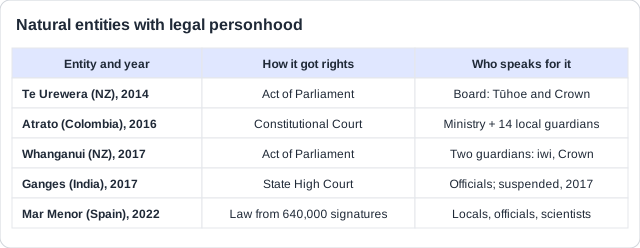
New Zealand gave legal personhood through settlements with Māori iwi, whose ancestors were wronged by the government.
New Zealand: Te Urewera and the Whanganui River
- Te Urewera (2014): a former national park became a legal entity, run by a board.
- Whanganui River (2017): 'an indivisible and living whole', mountains to the sea.
- Two guardians (Te Pou Tupua): one named by the iwi, one by the government.
- NZ$80 million redress plus a NZ$30 million fund for the river's health.
- It ended about 140 years of Whanganui iwi claims.
'I am the river, the river is me': The Whanganui iwi say 'Ko au te awa, ko te awa ko au'. The 2017 law used their way of seeing the river: not a resource owned by someone, but a living ancestor with its own rights.
In some countries it was judges, not parliaments, who gave rivers rights. The results differed.
Courts give rights: Colombia and India
- Atrato, Colombia (2016): the Constitutional Court made the river a subject of rights.
- Why: illegal gold mining poured mercury into it; logging damaged it.
- Guardians: the environment minister and 14 community representatives.
- Ganges and Yamuna, India (2017): a state High Court made them living entities.
- Four months later the Supreme Court suspended it: who would be liable for floods?
Atrato: rights upheld
- Ordered illegal mining to be dismantled
- A health study of mercury in local people
- Communities share guardianship
Ganges: rights suspended
- State government appealed; the Supreme Court made a stay
- Unclear who pays if a river floods
- Rights never came into effect
Stop wasting time on topics you know
Our AI identifies your weak areas and focuses your study time where it matters. No more overstudying easy topics.
The Mar Menor, one of Europe's largest saltwater lagoons, in Murcia, Spain, was choking. nitrates from intensive farms fed algae: in 2016 the water turned green, and tonnes of dead fish washed up in 2019 and 2021.
Citizens act
About 640,000 people signed a citizens' initiative, more than the 500,000 needed to put a law to parliament.
2022: the law
The lagoon and its basin became a legal person, with rights to exist, to be protected and to be restored: the first in Europe.
Its voice
A committee of representatives, a monitoring commission and a scientific committee act for it; anyone may go to court on its behalf.
2024: upheld
Spain's Constitutional Court ruled, by 7 votes to 5, that the law fits the constitution.
Law, not just a label: Say what personhood lets people DO: here, anyone can sue farms or authorities that harm the lagoon.
The guide links legal personhood to three other ideas. Use them to explain why it appeals.
Links to worldviews and ethics
- Indigenous knowledge: many systems do not separate humans and nature.
- Ecocentric value system: nature has value in itself.
- But personhood is also anthropocentric in method: it uses human courts and laws.
- Rights-based (deontological) ethics: a river has a right to exist, whatever the cost.
- Like companies: an old legal tool, used in a new way.
Indigenous knowledge
- Whanganui: the river is an ancestor
- Humans and nature not separate
Value systems
- Ecocentric: nature matters in itself
- Anthropocentric tools: courts and guardians
Ethics
- Deontological: a right is a right
- Not a cost-benefit calculation
- Ecocentric
- Nature-centred: nature has value in itself, whatever its use to people.
- Anthropocentric
- People-centred: nature is managed for human benefit.
- Deontological
- Judging actions by duties and rights, not by their results.
See how examiners mark answers
Answer exam-style questions with model answers. Learn exactly what earns marks and what doesn't.
Does personhood actually protect nature better? Weigh both sides.
Strengths and limits
- Strengths: anyone can sue for nature; guardians give it a voice; long-term protection.
- Respects indigenous worldviews and their role in managing the land.
- Enforcement: rights on paper do not stop illegal mining (Atrato).
- Liability: if a river has rights, can it be sued for flood damage? (Ganges)
- Money and capacity: guardians need funding and power to act.
Rights need resources: Years after the 2016 ruling, illegal gold mining still pollutes the Atrato. A right on paper protects nature only if guardians have money, power and support from the state.
How this could come up: No paper has asked this statement yet. Likely shapes: a Paper 1 lens question, 'Through the lens of environmental law, suggest how ...' [6]; Paper 2 Section B (a), outline how personhood strengthens protection [4]; a Section B (c) essay on how effective it is [9].
In 2017 New Zealand's Te Awa Tupua Act made the Whanganui River a legal person, with two guardians to act for it.
Through the lens of environmental law, suggest how this law could lead to a healthier river.
Model answer plan
See the mark-by-mark plan — for / against / judgement, with marking guidance — in study mode.